


Scientists at National Taiwan University have reported the first experimental evidence of the orbital Nernst effect, showing how a heat current drives transverse accumulation of electrons' orbital angular momentum in a naturally oxidized copper film.
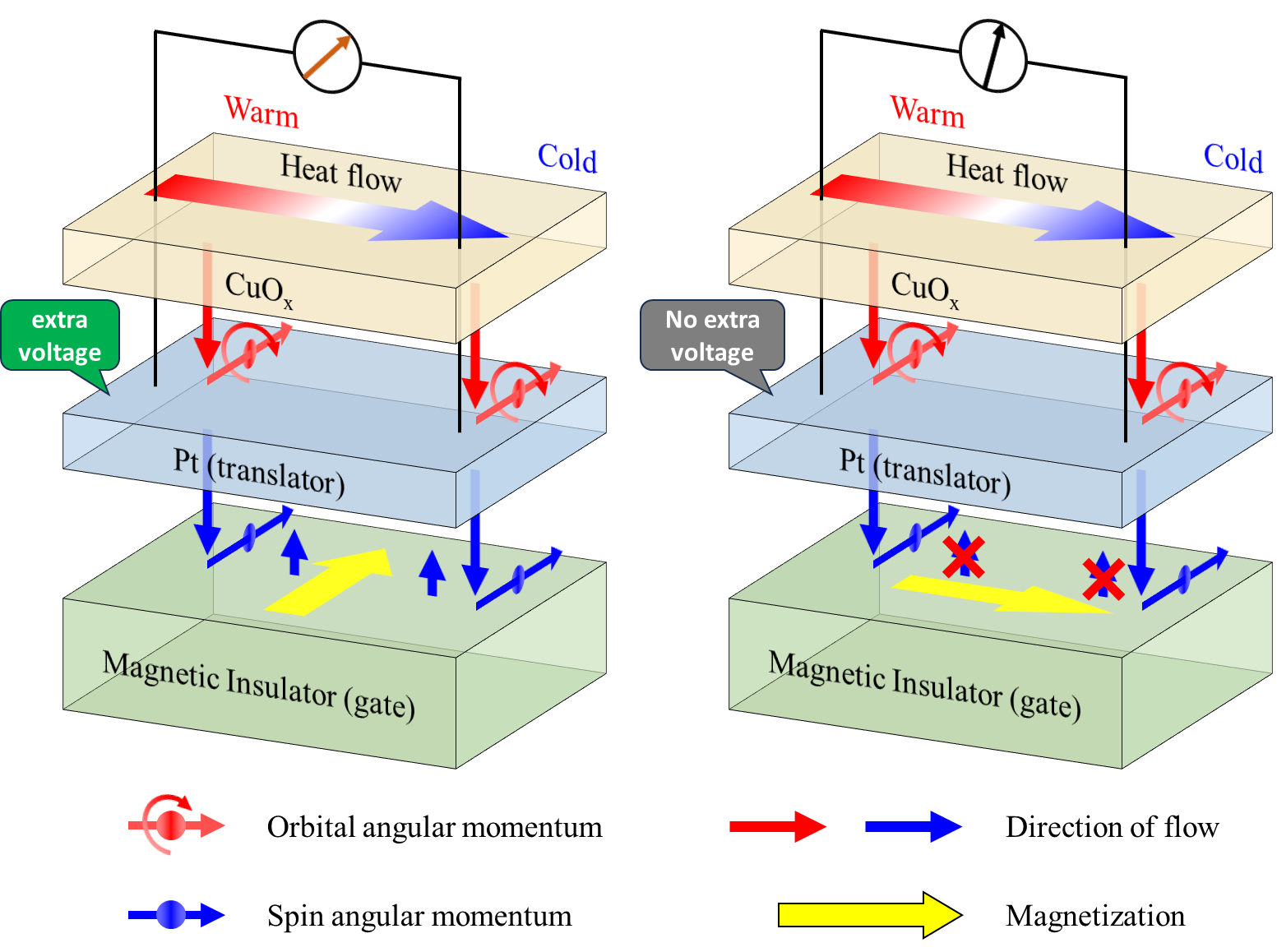
How the team detected heat-driven orbital motion (layers drawn apart for clarity).
Heat flows along the sample from its warm end to its cool end. In the oxidized copper (CuOx), the in-plane temperature difference drives the orbital angular momentum accumulation at the top and bottom surfaces of the CuOx film. The orbital angular momentum diffuses into the platinum (Pt) layer, and spin-orbit coupling converts it into spin current. The magnetic insulator acts as a gate that controls spin-current absorption and reflection. Left: when spins align with the YIG magnetization (M), they are reflected back into Pt, producing an extra voltage. Right: when spins are perpendicular to M, they are absorbed by YIG, producing no extra voltage. For simplicity, the spin Nernst effect in Pt is not shown in this figure.
Image: National Taiwan University, redrawn from Li et al., Nature Communications (2026).
National Taiwan University
Researchers at National Taiwan University (NTU) have reported the first experimental evidence of heat-current-driven transverse accumulation of electrons' orbital angular momentum, a phenomenon known as the orbital Nernst effect. The study was recently published in Nature Communications.
The Hall and Nernst effects are fundamental phenomena in electric and thermal transport. They describe how information carriers, such as electrons or spins, can develop a transverse response when driven by an electric field or a temperature gradient. They provide insights into the material’s electronic band structure and hold the key to applications.
Among the Hall family, the spin Hall and orbital Hall effects have attracted considerable interest because they allow an electric current to generate transverse flows of spin and orbital angular momentum, respectively. These forms of angular momentum can be transferred, directly or indirectly, to the magnetic moments in a material. When sufficiently strong, they can even switch the magnetization, providing a promising mechanism for writing information in spintronic memory devices.
However, experimentally, distinguishing orbital from spin angular momentum remains challenging, since both break time-reversal symmetry and share the same detection geometry. It is even more demanding to establish the orbital Nernst effect, because heat flow is generally harder to control and characterize than electrical current.
To overcome these challenges, the NTU research team carefully designed a multilayer structure that converts heat-generated orbital angular momentum into a measurable electrical signal (see figure).
The researchers selected naturally oxidized copper film (CuOx) as the orbital current source. Previous studies have shown that CuOx can generate substantial orbital currents through the orbital Hall effect while producing negligible spin current. The researchers used yttrium iron garnet (YIG), a magnetic insulator, as the detection layer. YIG acts as a spin current gate that controls the reflection and absorption of spin currents without introducing additional charge transport. Between these two layers, the team inserted a thin platinum (Pt) film, which serves as a translator between orbital and spin angular momentum.
The working principle is conceptually straightforward. When a temperature gradient is applied along the sample, the orbital Nernst effect generates a transverse orbital current in CuOx, leading to orbital angular momentum accumulation near its surfaces. Upon entering Pt, spin-orbit coupling converts the orbital angular momentum into spin angular momentum. The resulting spin current propagates toward the Pt/YIG interface, where its reflection or absorption depends on the direction of YIG’s magnetization. The reflected spin current is subsequently converted into an electric signal through the inverse spin Hall effect in Pt.
By measuring the voltage differences between different magnetization orientations of YIG, the researchers can quantify the contribution from the orbital Nernst effect, using a macroscopic spin/orbital current diffusion model they developed.
In practice, however, identifying the orbital current-dependent thermoelectric signal requires overcoming several experimental complications.
The first challenge comes from the charge Seebeck effect. When a temperature gradient is applied, not only the sample but also the connecting wires can experience temperature differences, producing an additional voltage. This background contribution must be carefully identified and removed to isolate the signal of interest.
A second challenge is an unintended out-of-plane temperature gradient. Although the experiment is designed to generate heat flow along the sample in the film plane, the heater geometry and differences in thermal conductivity among the films, substrate, and surrounding environment inevitably produce additional heat flow perpendicular to the film plane. The unavoidable out-of-plane temperature gradient contaminates the orbital Nernst signal with the spin Seebeck voltages. By examining their distinct symmetries under magnetic field reversal, the researchers were able to separate the symmetry-even in-plane thermal response from symmetry-odd out-of-plane thermal responses.
The final challenge is distinguishing the orbital Nernst effect in CuOx from the conventional spin Nernst effect in Pt. Platinum itself can generate a transverse spin current under a temperature gradient, making it essential to identify the additional contribution originating from CuOx.
To address this issue, the team compared three sample structures: YIG/Pt, YIG/CuOx, and YIG/Pt/CuOx. The Pt-only sample exhibited a clear thermal signal associated with the spin Nernst effect, whereas the CuOx-only sample showed almost no detectable response. This is consistent with the picture that CuOx primarily generates orbital rather than spin angular momentum, which cannot be efficiently detected without the Pt conversion layer.
Strikingly, when Pt and CuOx were combined, the measured signal reversed sign, and the estimated total spin current that reached the YIG interface increased to more than twice that of the Pt-only sample. This sign reversal and signal enhancement provide compelling transport evidence for an additional heat-generated orbital current in CuOx that is converted into a spin current through Pt.
From the experimental results, the researchers estimated that the orbital Nernst response of CuOx is approximately four times greater than the spin Nernst response of Pt, highlighting the potential of orbital transport as an efficient pathway for converting thermal energy into angular momentum.
Although the small voltages measured in this study serve as detection signals rather than usable electrical power, the results suggest a possible way to utilize thermal energy in spintronic systems. Since heat is inevitably generated during the operation of electronic devices, converting part of this thermal energy into angular momentum could provide an additional mechanism for spintronic device operations.
“The orbital Hall effect has been intensively studied in recent years, while much less is known about its thermal counterpart, the orbital Nernst effect. Our work provides experimental evidence that a temperature gradient can generate orbital angular momentum transport. This finding extends our understanding of orbital transport from electrical to thermal driving and may offer new possibilities for spintronic applications,” says corresponding author Dr. Danru Qu of Center for Condensed Matter Sciences, National Taiwan University.
The article, "Transport evidence for the orbital Nernst effect," was published in Nature Communications at 10.1038/s41467-026-77878-2.
Dr. Danru Qu’s email address: [email protected]
Advertisement