

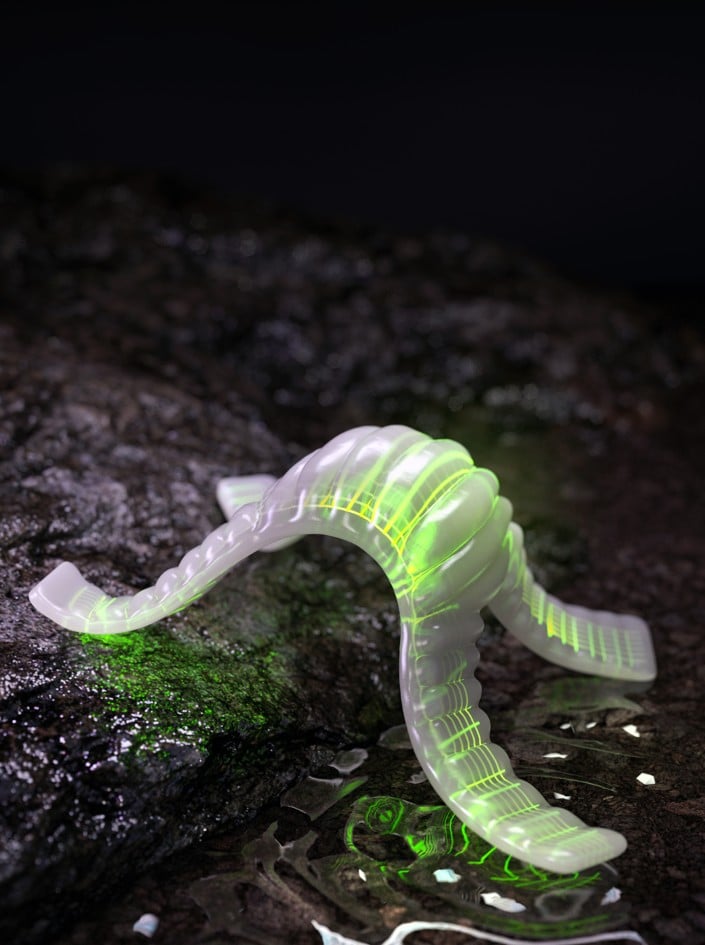

- Research team led by Professor Soon Moon Jeong of the Department of Advanced Technology develops a battery-free soft robot using highly stretchable “mechanoluminescent fibers”
- Study selected for the cover article of the October issue of Small Structures, a prestigious international journal in nanotechnology and advanced materials
□ A research team led by Professor Soon Moon Jeong of the Department of Advanced Technology at the Graduate School of Engineering Practice, DGIST (President Kunwoo Lee), has developed a new sensing technology for soft robots that emits light whenever the robot moves, providing an intuitive visual representation of its movement trajectory without requiring separate batteries or complex electronic circuits.
□ Made from flexible materials such as rubber or silicone, "soft robots" move smoothly like octopus arms or human muscles, and are promising as next-generation robots for applications in medical devices and disaster rescue operations. However, detecting their subtle movements traditionally requires attaching numerous rigid electronic sensors and wires, which poses a major challenge in maintaining the inherent flexibility of the robot.
□ To address this challenge, the research team focused on the phenomenon of "mechanoluminescence," in which a material emits light on its own when subjected to external mechanical forces (such as stretching, bending, or pressure). The team developed a new type of thin, tough "tubular mechanoluminescent fiber" by mixing luminescent particles (zinc sulfide) with a flexible polymer material and filling this mixture in an elastic silicone tube.
□ The resulting specialized fiber demonstrated excellent durability, withstanding stretching to more than twice its original length (200%) and reliably maintaining its initial light-emitting performance after more than 1,000 stretching–release cycles.
□ The research team covered the surface of a soft robot with a mesh-like network of these fibers and operated it. Green light was emitted immediately from the areas undergoing deformation whenever the robot moved. This enabled the team to develop a true "battery-free optical sensor" that allows the bending and stretching movements of the robot to be observed directly and intuitively without the need for an external power supply or attached sensors.
□ "The significance of this study lies in opening up a groundbreaking new approach for detecting deformation immediately in soft robots without an external power source or interfering with their flexible movements," stated Professor Soon Moon Jeong of the Department of Advanced Technology at DGIST's Graduate School of Engineering Practice. "We plan to further improve the light-emitting performance and durability of the fibers and expand their applications to a wide range of next-generation flexible electronic devices that enable human–robot interaction, including wearable devices and artificial skin."
□ This research was supported by the Individual Basic Research Program of the Ministry of Science and ICT (MSIT), the National Research Foundation of Korea (NRF), and the DGIST R&D Program. The study, by co-first-authors Minseok Lee, a master's student in the Interdisciplinary Studies program at DGIST, and Seongkyu Song, a full-time researcher in the Division of Energy & Environmental Technology at DGIST, was published as the Front Cover article in the October issue of Small Structures, a prestigious international journal in nanoscience and advanced materials.
Advertisement