

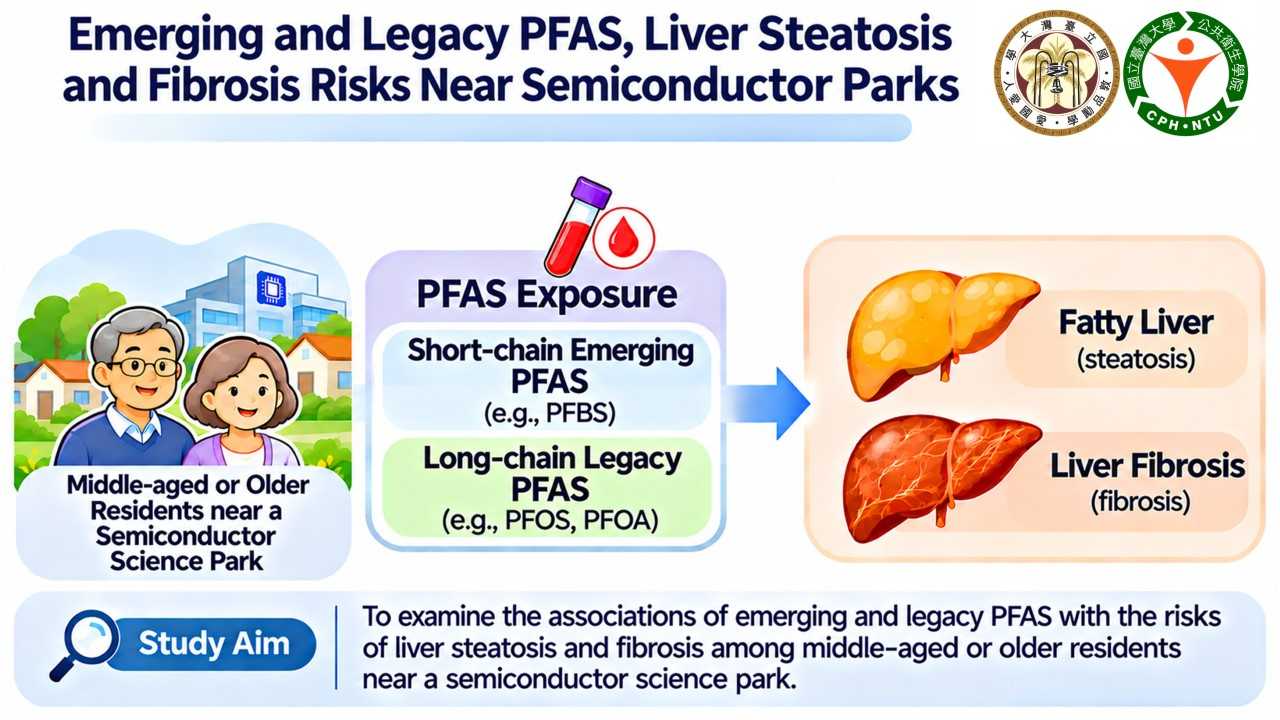

Higher serum PFBS levels and PFAS mixture exposure are associated with an increased risk of liver fibrosis among residents living near a semiconductor science park. The association between PFAS mixture exposure and liver fibrosis is more pronounced in males.
Overview of the study investigating associations between emerging and legacy PFAS exposure and liver health among middle-aged and older adults living near a semiconductor science park in Taiwan.
National Taiwan University
Per- and polyfluoroalkyl substances (PFAS), often known as “forever chemicals”, are widely used in industrial applications, including semiconductor manufacturing. As regulations increasingly restrict legacy PFAS such as PFOS and PFOA, industries have shifted towards alternative compounds, including short-chain PFAS. However, whether these substitutes are safer for human health remains an important question.
A study conducted in Taiwan has identified a potential link between exposure to perfluorobutanesulfonic acid (PFBS), a short-chain PFAS used in industrial applications, and an increased risk of liver fibrosis among adults living near a major semiconductor science park. The study is published in Journal of Hazardous Materials.
The research team evaluated 338 residents, with an average age of 64 years, recruited between 2016 and 2017. Blood samples were analyzed for seven PFAS compounds using Ultra Performance Liquid Chromatography-Tandem Mass Spectrometry. The researchers assessed metabolic dysfunction-associated steatotic liver disease (MASLD) and liver fibrosis using established non-invasive clinical indices.
The findings revealed that each doubling of serum PFBS concentration was associated with a 51% increase in the odds of liver fibrosis, as estimated by the Fibrosis-4 (FIB-4) index. Importantly, exposure to PFAS mixtures was also associated with an increased risk of liver fibrosis, with stronger associations observed among men.
Interestingly, the researchers did not find significant associations between PFAS exposure and MASLD, suggesting that the potential effects of PFAS on the liver may extend beyond conventional fatty liver disease. The findings also highlight the importance of examining individual PFAS compounds and combined exposure, rather than focusing exclusively on traditional long-chain chemicals.
Although short-chain PFAS were introduced as alternatives to legacy compounds partly because of their shorter biological half-lives, their environmental persistence and potential health effects remain concerns. PFBS may affect liver health through pathways involving oxidative stress, inflammation and endocrine disruption, although these mechanisms require further investigation.
The researchers emphasize that the findings should be interpreted cautiously. As this was a cross-sectional study, causality cannot be established, and liver fibrosis was estimated using FIB-4 rather than confirmed through liver biopsy or elastography. Larger prospective studies are needed to determine whether long-term exposure to short-chain PFAS contributes to liver fibrosis.
“Our findings highlight the importance of continued research into emerging PFAS and their potential health effects. Further studies are needed to better understand the long-term implications of exposure to these chemicals,” says corresponding author Pau-Chung Chen, M.D., Ph.D., distinguished professor of the Institute of Environmental and Occupational Health Sciences at National Taiwan University.
Prof. Pau-Chung Chen’s email address: [email protected]
Reference:
Ying-Hao Su, Chih-Fu Wei, Ching-Chun Lin, Mei-Huei Chen, Meng-Kan Chen, Kuan-Yu Hung, Pau-Chung Chen*. Exposure to emerging and legacy PFAS and risks of metabolic dysfunction-associated steatotic liver disease and liver fibrosis in adults living near a semiconductor science park. J Hazard Mater. 2026 Oct 24:518:144007. doi: 10.1016/j.jhazmat.2026.144007.
Advertisement