

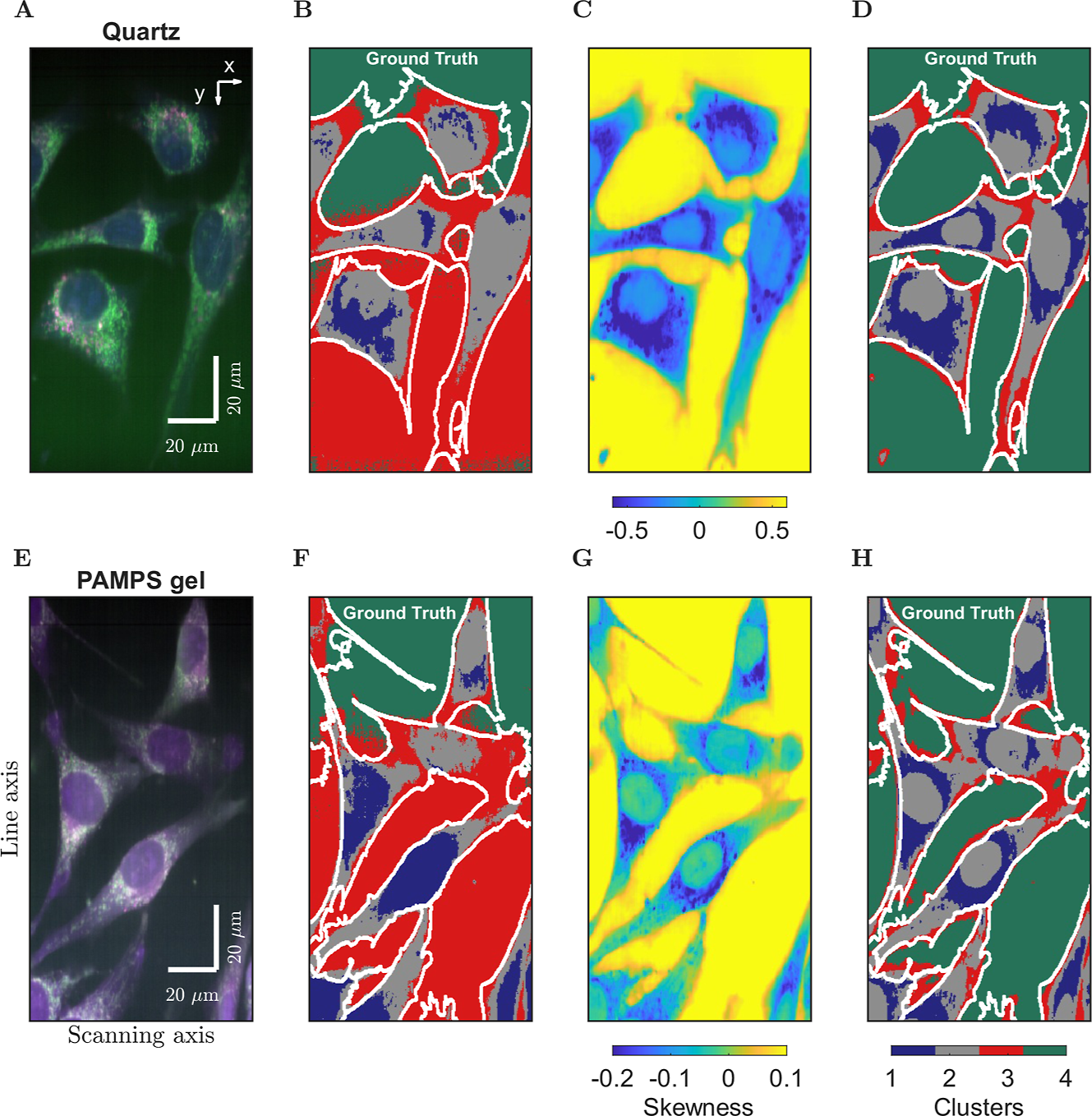

Researchers develop a computational method that reduces interference from surrounding materials, making it easier to detect the molecular signatures of individual cells in Raman spectroscopy.
Molecular signals from cells can be difficult to distinguish from background signals in Raman spectroscopy. The images show how different analytical approaches can affect the accuracy of cell identification.
Clément et al., 2026
When light interacts with a material, a small part of it gets scattered with a different energy. This change can reveal information about the molecules within the material based on their unique molecular fingerprints. This phenomenon, which earned physicist C. V. Raman the 1930 Nobel Prize in Physics, forms the basis of Raman spectroscopy, a widely used technique for studying the chemical composition of materials.
In biology, Raman microscopy, which generates images by recording the Raman spectra at individual pixels, is especially valuable because researchers can use it to study the molecules inside individual cells without the need for staining or fluorescent labelling. For instance, using this technique enables researchers to monitor how cells respond to their changing environment. But signals from cells can get obscured by interference from surrounding materials. Cells are often grown on supporting structures called scaffolds, which produce their own Raman signals that can overlap with those from the cells.
Now, an international team of researchers from Japan, France, Germany and Bangladesh has developed a new computational method to distinguish molecular signals from cells and those from surrounding materials more effectively. The method could improve researchers’ ability to study the biochemical characteristics of individual cells, particularly in complex environments. The findings were published in Analytical Chemistry.
The method, called ALIVA (Adaptive Local Intensity Variation Adjustment), reduces unwanted background signals in Raman measurements. Unlike conventional approaches that assume that background interference is the same throughout an image, ALIVA estimates it locally using signals from nearby cell-free regions.
“It is like trying to listen to someone in a room where the surrounding noise changes depending on where you are standing,” says Professor Tamiki Komatsuzaki of Hokkaido University, who led the study. “Rather than removing the same noise everywhere, ALIVA estimates the local interference around each cell region and corrects it accordingly.”
To test their method, the researchers studied mouse cells carrying a gene associated with the cancer synovial sarcoma. The cells were grown on two different surfaces: a hard quartz surface and a soft, water-rich material called a PAMPS hydrogel.
When the researchers analyzed Raman measurements using conventional methods, cells grown on the two surfaces appeared substantially different. However, much of this variation came from the surrounding materials rather than the cells themselves. After applying ALIVA, these differences were substantially reduced, making the molecular signatures of the cells more distinct and easier to compare. Researchers could identify a distinct subgroup of cells that were more common in the hydrogel sample. These cells exhibited molecular characteristics resembling those associated with cancer stem-like cells in previous studies. Using ALIVA enabled the researchers to detect this subgroup directly through their Raman signatures.
By reducing interference from surrounding materials, the new method helps researchers study biochemical properties that would otherwise be obscured. With further validation, ALIVA could also be extended to more complex biological systems, such as organoids, which are three-dimensional cell structures that mimic certain features of tissues and organs.
Advertisement