
Space sciences Astronomy
News

24 Aug 2026
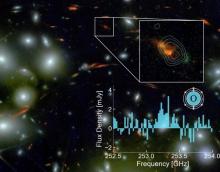
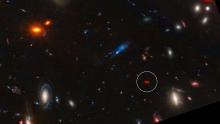
New study of James Webb Space Telescope images suggests that little red dots are not simply single points of light but likely exist within compact star-forming galaxies.

13 Aug 2026
Black hole "blast", Bacteria-detecting robot, A crab's tale, Sensors that remember, and Silk in cycling. Plus submission deadline for 2027 magazine. Read all in the latest Editor's Choice.
29 Jul 2026
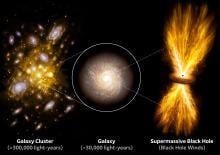
Despite our knowledge of supermassive blackholes far from complete, astronomers have long known that they produce violent winds. But a recent discovery has shown that these winds are more powerful than previously thought, 100 times more powerful, to be precise. High-precision observations of gas surrounding a black hole 3.4 billion light-years from Earth showed that the winds carry energy across distances of approximately 300,000 light-years, impacting surrounding galaxies.
17 Jul 2026
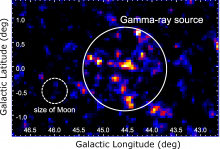
An accelerator of the highest-energy protons in our galaxy has been identified; it could help scientists better understand the nature of these fast-moving particles that fill the space between stars.
06 Jul 2026
An international team including Professor Meng GU of the Hong Kong Institute for Astronomy and Astrophysics (HKIAA) at The University of Hong Kong (HKU) has directly measured the mass of an inactive supermassive black hole in the early Universe for the first time.

18 Jun 2026
Sweet power nanogenerator, Cosmic fossil, Dopamine and Alzheimer's link, Sustainable 3D printing, Quantum dots for brain diseases, Smart trolley and Bamboo and bone. Read all in the latest Editor's Choice. Plus SciCom Coffee talk: Inside a University Merger.
15 Jun 2026
Astronomical observations provide new insights into how galaxies formed and grew during the Universe's first billion years
15 May 2026
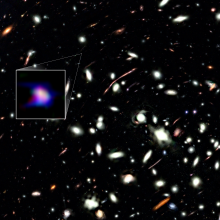
An international team led by Associate Professor Kimihiko Nakajima of Kanazawa University has captured a rare look at the early universe. Using the James Webb Space Telescope (JWST *1) and the power of a gravitational lensing (*2) in space, the team achieved a definitive characterization of LAP1-B, an ultra-faint galaxy from 13 billion years ago. Expanding upon initial detections, this new study utilized deep JWST spectroscopy to reveal a record-breaking low oxygen abundance (*3) -- merely 1/240th that of the Sun. This chemically primitive state, coupled with an elevated carbon-to-oxygen ratio and a dominant dark matter halo, suggests that LAP1-B is the long-sought "ancestor" of the mysterious fossil galaxies found near our Milky Way today, providing a historic window into the earliest, most primitive stages of galaxy assembly.
14 May 2026
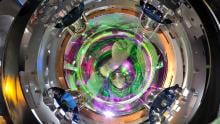
The LIGO–Virgo–KAGRA (LVK) detector network has a new trick up its sleeve to improve the instruments’ sensitivity to gravitational waves: it’s called Astrophysical Calibration and it plays a role similar to auto-tune in music production.
05 May 2026
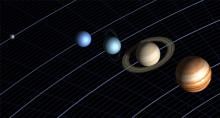
Observations of a distant object beyond Pluto suggest that it is surrounded by a thin atmosphere, potentially fuelled by ice volcanoes or produced by the impact of a comet-like body.

14 Apr 2026
A mysterious layer of particles that occupies the lower regions of Venus’s atmosphere has long puzzled astronomers. However, a research team has finally solved the mystery of the “lower haze,” discovering that the haze comes from cosmic dust left by shooting stars that constantly rain down on Venus.

17 Mar 2026
The complete set of nucleobases found in terrestrial DNA and RNA have been detected in samples returned from the asteroid Ryugu, offering insights into the early Solar System's chemistry.

09 Dec 2025
Brain atlas, From perfume to plastic, Stable solar power, Plant aging switch, Anti-cancer droplets, Greener gold, Extreme star factory and How research shapes sustainability policy. Read all in the latest Editor's Choice.
19 Nov 2025
Astronomers have uncovered a previously unknown, extreme kind of star factory by taking the temperature of a distant galaxy using the ALMA telescope. The galaxy is glowing intensely in superheated cosmic dust while forming stars 180 times faster than our own Milky Way. The discovery indicates how galaxies could have grown quickly when the universe was very young, solving a long-standing puzzle for astronomers.

07 Oct 2025
Ancient black holes, How good cholesterol is made, Self-healing plastic, Dengue’s genetic imprint, Korean mussel power & Space clean-up. Read all in the latest Editor's Choice.
22 Sep 2025
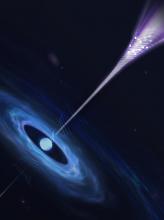
The University of Hong Kong and collaborators from Nanjing University and the Institute of High Energy Physics of the Chinese Academy of Sciences (CAS) unveiled signal pointing to the birth of a “millisecond magnetar”—a rapidly rotating neutron star with an ultra-strong magnetic field.

27 Jun 2025
A group of researchers have observed images from the James Webb Space Telescope. The images were like a time machine, allowing the researchers to understand how these galaxies built their disks over history and compare this to how our own Milky Way formed.

17 Mar 2025
Using AI image recognition, deep learning model efficiently and accurately finds structures related to star formation

24 Jan 2025
Astronomer John Silverman works just outside of Tokyo but spends his days with some of the world's biggest telescopes in Hawaii, Chile, and space to study the earliest black holes in the Universe.
13 Mar 2024
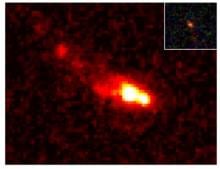
An international research team have made unprecedentedly detailed observations of the earliest merger of galaxies ever witnessed. They suggest stars developed much faster and more efficiently than we thought. They used the James Webb Space Telescope (JWST) to observe the massive object as it was 510 million years after the Big Bang – i.e. around 13 billion years ago.
29 Feb 2024
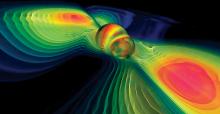
Jun’ichi Yokoyama once amused his professors by proposing a far-fetched idea of using neutrinos and gravitational waves to observe the Universe. Decades later, he was proven right and contends young scientists should be nurtured to believe in themselves.
01 Feb 2024
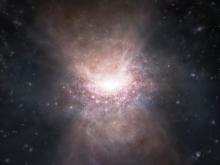
Theoretical predictions have been confirmed with the discovery of an outflow of molecular gas from a quasar when the Universe was less than a billion years old.
19 Jan 2024
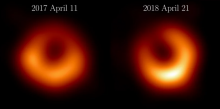
A recent paper published in the journal Astronomy & Astrophysics presents new images from the 2018 data that reveal a familiar ring the same size as observed in 2017. This bright ring surrounds a deep central depression, “the shadow of the black hole,” as predicted by general relativity. Excitingly, the peak brightness of the ring has shifted by about 30º counter clockwise compared to its position in 2017, which is consistent with our theoretical understanding of the variability of the turbulent material around black holes.
22 Nov 2023
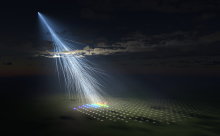
Osaka Metropolitan University researchers and their colleagues have successfully detected an ultra-high-energy cosmic ray with an energy level comparable to the most energetic cosmic ray ever observed. The cosmic ray is set to be named after the Japanese sun goddess, Amaterasu. No promising astronomical object has been identified in the direction from which this cosmic ray originated, implying the potential existence of unknown astronomical phenomena and novel physical origins beyond the Standard Model.
10 Oct 2023
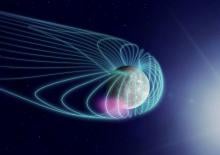
Observations during two flybys by the Mio spacecraft as part of the BepiColombo International Mercury Exploration Project have revealed that chorus waves occur quite locally in the dawn sector of Mercury. Mercury's magnetic field is about 1% of that of Earth, and it was unclear whether chorus waves would be generated like on Earth. The present study reveals that the chorus waves are the driving source of Mercury’s X-ray auroras, whose mechanism was not understood.
10 Mar 2023
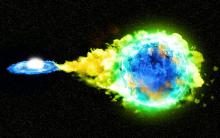
One astronomer never thought of leaving Japan, but then he did and became a world best.

01 Mar 2023
Osaka Metropolitan University scientists identified about 140,000 molecular clouds in the Milky Way Galaxy from large-scale data of carbon monoxide molecules, observed in detail by the Nobeyama 45-m radio telescope. Using artificial intelligence, the researchers estimated the distance of each of these molecular clouds to determine their size and mass, successfully mapping the distribution of the molecular clouds in the Galaxy in the most detailed manner to date.
06 Feb 2023
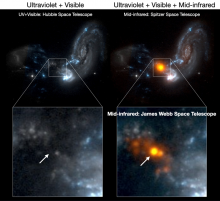
Researchers used the James Webb Space Telescope to identify the precise location of a powerful energy source hidden by cosmic dust in the luminous merging galaxy IIZw096.

25 Oct 2022
Small neighboring galaxy filled with dark matter detected with gamma rays, How a virus induces heart inflammation, Shedding light on the happy hormone, Microfossils may hold key evolution clues. Read all in the October's Editor's Choice plus Upcoming event KNOWLEDGE MARKETPLACE – Bangkok 2022: Exchanging of ideas for a Democratic Myanmar.
13 Oct 2022
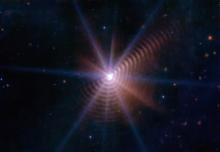
Puzzling image from the James Webb Space Telescope explained in two new studies
Events
Sorry, nothing coming up for this discipline
Researchers
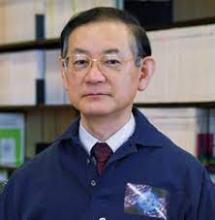
Ken’ichi Nomoto is a visiting senior scientist at Kavli IPMU and Professor Emeritus at The University of Tokyo. He is one of the best experts in the world in astronomy and astrophysics, particularly on stellar evolution and supernovae. He was awarded the Order of the Sacred Treasure by the Japanese government in 2020.

Jia Liu is the Director of the Center for Data-Driven Discovery and associate professor at CMB Group at Kavli IPMU. Her research integrates data science techniques in the study of large-scale structures of the universe (dark matter, halos, filaments, voids).
Giants in history

Chinese electron microscopy specialist Li Fanghua (6 January 1932 – 24 January 2020) facilitated the high-resolution imaging of crystal structures by eliminating interference.

Haisako Koyama (1916 – 1997) was a Japanese solar observer whose dedication to recording sunspots – cooler parts of the sun’s surface that appear dark – produced a sunspot record of historic importance.