
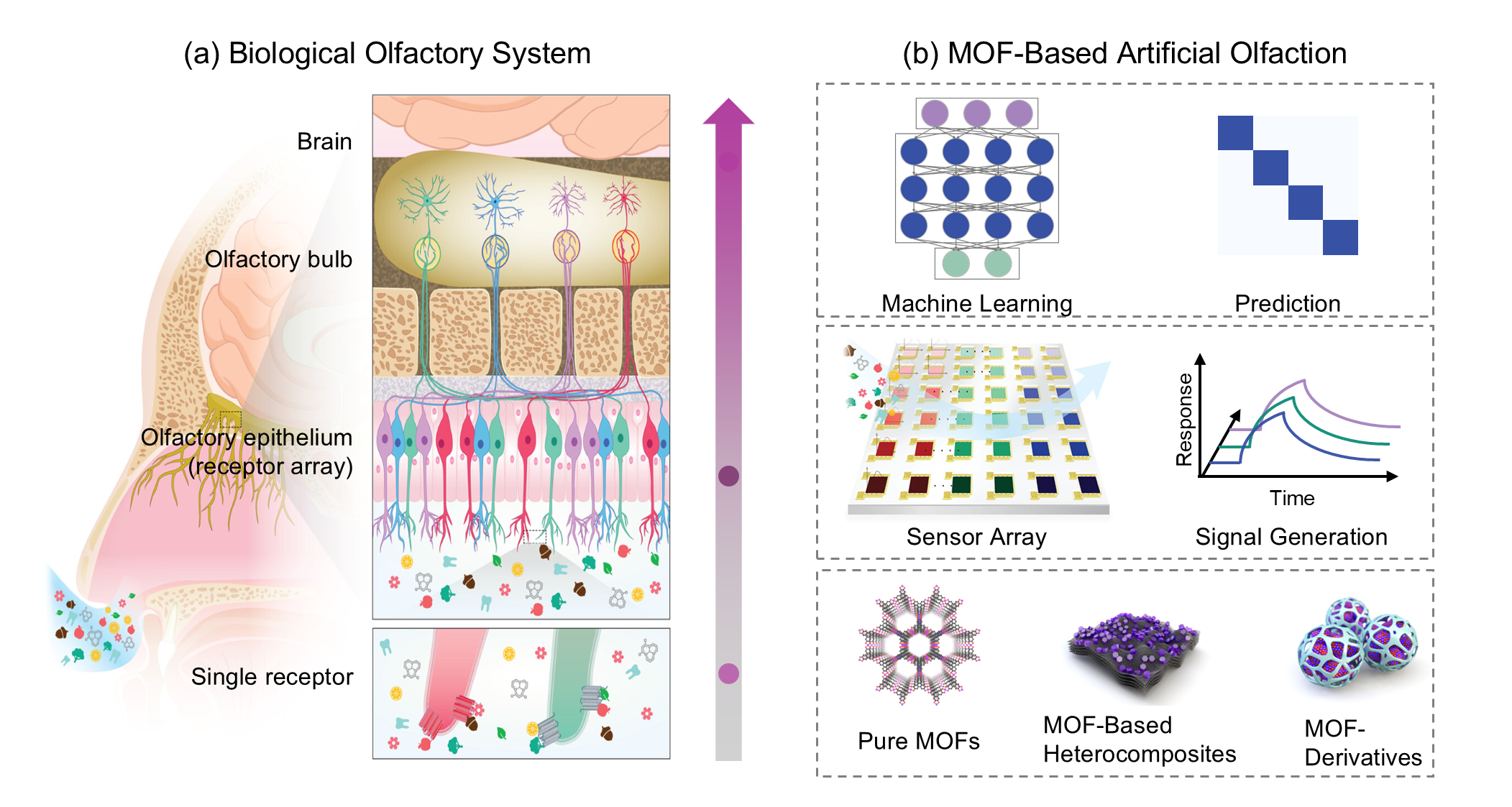

- Prof. Hyuk-Jun Kwon’s research team presents a roadmap for an intelligent artificial olfactory system that combines the novel material metal-organic frameworks with AI
- Overcomes existing limitations by mimicking the principles of the human olfactory system, poised to drive innovation across future industries such as disease diagnosis and environmental monitoring
- Published in Progress in Materials Science, one of the world’s leading journals in materials science (top 0.7% in JCR)
□ DGIST (President Kunwoo Lee) announced that Prof. Hyuk-Jun Kwon’s research team in the Department of Electrical Engineering & Computer Science has presented a roadmap for the development of an “artificial olfactory system” that detects odors like the human nose and analyzes them using artificial intelligence (AI) by leveraging metal-organic frameworks (MOFs). The team systematically organized and reviewed the key research trends in electronic nose technology, from MOF material design to sensor implementation and AI-based odor pattern recognition.
□ An artificial olfactory system, or “electronic nose (e-nose),” is a technology in which AI learns and analyzes signal patterns generated when multiple sensors respond to odor molecules. Although it has broad potential applications in areas such as food safety, environmental pollution monitoring, hazardous gas detection, and disease diagnosis, conventional sensor materials have faced limitations in terms of selectivity, response speed, and operating conditions.
□ The research team focused on MOFs as a key material for overcoming these limitations. MOFs are porous materials formed by combining metal ions and organic compounds, and they can effectively adsorb odor molecules through their microscopic pores. Moreover, because their structures and chemical properties can be tailored for specific purposes, they are regarded as a next-generation sensor material capable of sensitively detecting various odors even under room-temperature, low-power operating conditions.
□ In particular, the study explained electronic nose technology by drawing on the principles underlying the human sense of smell. Humans can distinguish countless odors using only a limited number of olfactory receptors because a single odor activates multiple receptors simultaneously, generating a unique combination of signals. Based on this principle of “combinatorial coding,” the research team comprehensively presented an array of MOF sensors with different response characteristics together with an AI-based signal analysis strategy.
□ The team categorized MOF-based electronic nose technologies into three groups: MOFs, MOF-composites, and MOF-derivatives. MOFs serve as the fundamental platform with porosity and a framework structure that can be tailored, while MOF-composites and MOF-derivatives contribute to enhancing sensitivity, stability, and selectivity. When combined with machine- and deep learning-based analytical techniques, these materials enable more accurate classification and interpretation of complex odor signals.
□ “MOFs provide a virtually unlimited materials library that can be designed to exhibit different responses to different odors, much like human olfactory receptors,” stated Prof. Hyuk-Jun Kwon. “This paper is significant in that it bridges the gap between materials research and AI-based odor recognition research while presenting a roadmap for the development of intelligent electronic noses tailored to specific applications.”
□ The research team expects MOF-based electronic noses to find broader applications in the future, including healthcare such as disease diagnosis, air quality and industrial safety monitoring, smart agriculture, and chemical perception technologies for autonomous vehicles and robots.
□ Meanwhile, integrated M.S.-Ph.D. student Hyungtae Lim served as the first author in this study, with Prof. Hyuk-Jun Kwon serving as the corresponding author. The research findings were published in Progress in Materials Science (IF: 42.9; top 0.7% in JCR), one of the world’s leading journals in materials science. This research was supported by the Mid-Career Researcher Program, the Core Research Program, and the InnoCORE Program of the Ministry of Science and ICT, as well as the Convergence Research Advanced Centre for Olfaction under the Ministry of Education’s Priority Research Centers Program.
Advertisement