
□ A research team led by Prof. Junghyup Lee of the Department of Electrical Engineering and Computer Science at DGIST (President Kunwoo Lee) has become the first in the world to develop a “time-interleaved noise-shaping SAR ADC (analog-to-digital converter)” semiconductor chip capable of simultaneously measuring multiple biosignals, including electrocardiograms (ECG) and electromyograms (EMG). The team developed this technology in an actual semiconductor chip and successfully completed functional validation.
□ Accurate measurement of multiple biosignals using wearable devices such as smartwatches requires meeting several demanding conditions. These include “ultra-high input impedance (resistance)” to prevent signal loss even when no sweat is present on the skin or when contact is loose (dry or non-contact electrodes), a “wide input range” to prevent signal distortion caused by vigorous movement, and “ultra-low power consumption” for long-term operation. However, conventional measurement approaches have struggled to satisfy all these requirements simultaneously within a single chip.
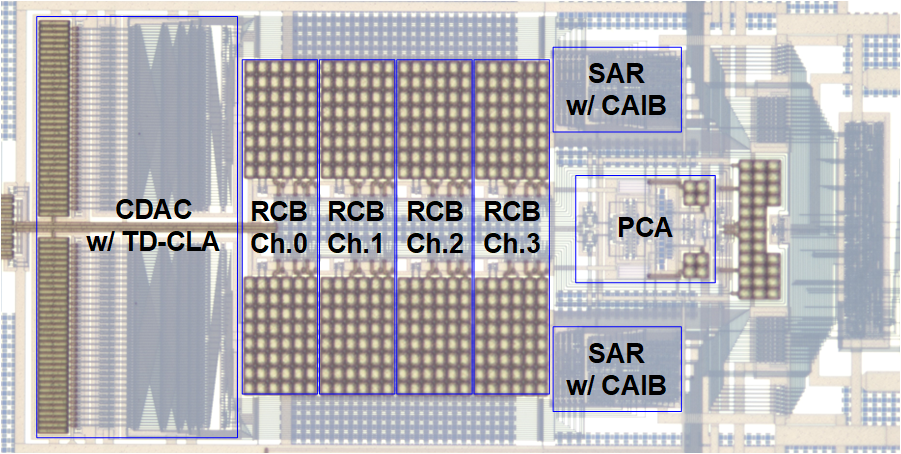
□ Prof. Lee’s research team addressed this challenge by proposing a novel “time-interleaved third-order noise-shaping SAR ADC” architecture in which circuit blocks that consume significant power and chip area are shared across multiple channels, while only essential components (the residual capacitor banks) are allocated separately to each channel. This approach dramatically reduced the circuit area and power consumption required for multi-channel systems, enabling an ultra-compact, ultra-low-power chip.
□ Moreover, the team achieved world-leading performance by incorporating original design techniques, including CAIB, which minimizes power consumption by presetting voltage levels prior to measurement, and TD-CLA, which effectively compensates for signal distortion.
□ This study is particularly significant in that it presents a core design technology that can integrate all key requirements for wearable devices into a single ultra-compact semiconductor chip. The developed chip is expected to be widely applied in various fields including long-term health monitoring in daily life, next-generation digital healthcare devices and high-precision medical equipment.
□ Prof. Junghyup Lee of the Department of Electrical Engineering and Computer Science at DGIST stated, “This research is significant in that it presents a new semiconductor architecture capable of simultaneously achieving ultra-compact size, ultra-low power consumption, and high performance, while maintaining stable operation despite the various forms of motion and changes in electrode contact encountered in wearable environments.” Geunha Kim, a Postdoctoral Researcher, added, “By advancing the performance of wearable devices based on dry and non-contact electrodes, this technology is expected to contribute to the development of next-generation digital healthcare platforms capable of long-term measurement of a wide range of biosignals.”
□ Moreover, this study was supported by Samsung Electronics, the Basic Research Laboratory (BRL) Program of the National Research Foundation of Korea (NRF), and the Brain Engineering Convergence Research Center. The research findings were presented at the IEEE Symposium on VLSI Technology & Circuits 2026, one of the world's most prestigious international conferences in the semiconductor field, held in Hawaii, USA, in June.