
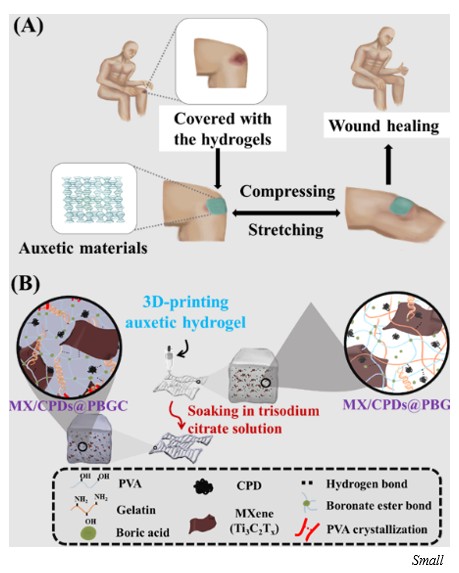

A study, published in Small, has introduced a breakthrough solution in the form of a 3D-printed, auxetic hydrogel dressing known as MX/CPDs@PBGC.
Small
The global rise of antimicrobial resistance has turned once-routine infections into life-threatening crises, particularly for patients with chronic conditions like diabetes. Chronic wounds are frequently colonized by "superbugs" such as Methicillin-resistant Staphylococcus aureus (MRSA), which are notoriously difficult to treat. Traditional bandages often fail in these scenarios because they lack the ability to actively kill bacteria or adapt to the body’s constant movement.
However, a recent study, published in Small, has introduced a breakthrough solution in the form of a 3D-printed, auxetic hydrogel dressing known as MX/CPDs@PBGC. This new dressing is a masterpiece of bioengineering, specifically designed to address the physical and biological challenges of wound care. Its most striking feature is its "auxetic" structure.
Unlike conventional materials that become thinner when stretched, an auxetic material expands in all directions. This property allows the hydrogel to maintain perfect contact with complex, high-movement areas like knees or elbows without peeling or losing its seal.
The base of the dressing, composed of a polyvinyl alcohol and gelatin matrix, is held together by dynamic "self-healing" bonds. This means that even if the dressing is stressed or slightly torn by physical activity, it can repair its own internal network to ensure a continuous barrier against contamination.
The true power of this dressing lies in its infusion of two advanced nanomaterials: MXenes and Carbonized Polymer Dots (CPDs). MXenes act as the wound’s internal pharmacy, providing potent antioxidant and anti-inflammatory effects by neutralizing the harmful free radicals that typically stall the healing process. Meanwhile, the CPDs—derived from mannose and arginine—serve as the primary antibacterial agents. They physically disrupt the membranes of drug-resistant bacteria, killing them effectively without the need for traditional antibiotics.
Furthermore, the MX/CPDs@PBGC hydrogel is highly responsive to its environment. While stable at room temperature, it is designed to degrade and release its therapeutic cargo rapidly at body temperature (37°C).
It also responds to the acidic pH levels typically found in infected wounds, ensuring that the highest concentration of antibacterial "assassins" is released exactly when and where the infection is most severe. This smart delivery system minimizes waste and maximizes the treatment's impact.
In a diabetic mouse model, this multifunctional dressing outperformed high-end commercial antibacterial bandages. Beyond simply killing MRSA, the hydrogel actively reprogrammed the immune system, encouraging white blood cells to switch from an inflammatory state to a regenerative one. This resulted in faster skin closure, better collagen deposition, and the growth of new blood vessels.
“By combining the structural adaptability of 3D printing with the molecular precision of nanotechnology, this hydrogel offers a comprehensive strategy for managing the most stubborn wounds and represents a significant leap forward in the field of regenerative medicine,” said co-corresponding author Prof. Tzu-En Lin from Institute of Applied Mechanics at National Taiwan University.
Prof. Tzu-En Lin’s email address: [email protected]
Advertisement