
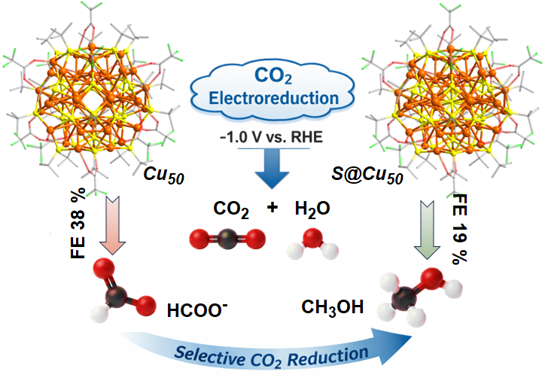
Representation of the whole work with nanocluster structures and their CO₂ reduction capabilities. Hydrogen atoms are omitted for clarity.
A collaborative research team from Tohoku University and the Indian Institute of Technology Indore has made a significant breakthrough in carbon dioxide (CO₂) conversion. Their discovery offers a promising strategy for converting harmful CO₂ into valuable fuels and chemicals under mild conditions, advancing efforts toward sustainable carbon utilization and clean energy technologies. The findings were published in JACS Au on June 30, 2026.
Nanoclusters made of copper (Cu) - an inexpensive, naturally abundant material - have been gaining traction as promising aids of catalytic transformations. If developed correctly, these nanoclusters can improve the efficiency of a reaction called the electrochemical CO₂ reduction reaction. Doing so may bring us closer to developing better renewable energy storage and becoming a carbon neutral society.
One issue in this reaction is that formate - an unwanted byproduct - is conventionally produced. To suppress formate production, the research team modulated the Cu(I)/Cu(II) ratio in a Cu nanocluster. Instead of formate, the reaction now selectively produces the desired outcome: methanol (CH3OH). This greatly improves the efficiency of the reaction.
To achieve this boost in efficiency, the researchers needed to precisely engineer the structure of the nanocluster. The result was a structurally well-defined sulfide-templated Cu nanocluster, [S@Cu₅₀S₁₂(StBu)₂₀(CF₃COO)₁₂] (S@Cu₅₀) featuring a unique core-shell architecture composed of an inner S@Cu₁₄S₁₂ core surrounded by an outer Cu36(StBu)20 shell protected by thiolate ligands. This allowed for the controlled modulation of the Cu(I)/Cu(II) ratio, while preserving the overall geometric framework.
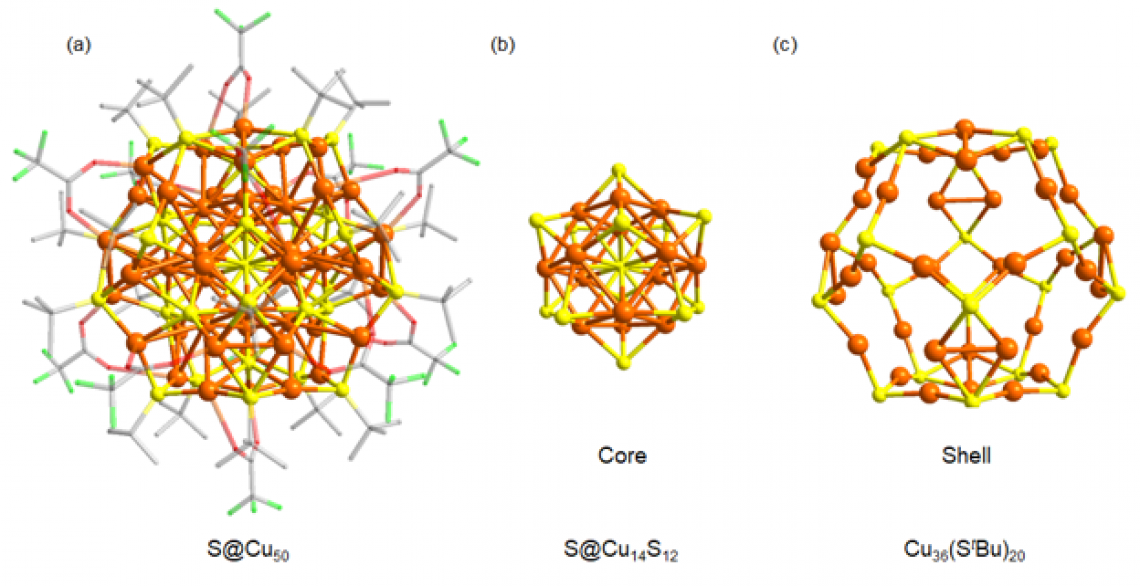
Detailed structural architecture of synthesized S@Cu₅₀ NC (a) Overall core-shell structural architecture (b) geometry of core and (c) geometry of shell. Hydrogen atoms are omitted for clarity.
In addition, the team compared this nanocluster to a reported Cu₅₀S₁₂(StBu)₂₀(CF₃COO)₁₂] (Cu₅₀) nanocluster analogue, to directly investigate the influence of valence-state changes on catalytic performance.
Although both nanoclusters share very similar structural frameworks, the introduction of a sulfide ion at the center of the S@Cu₅₀ cluster led to subtle but crucial changes in its electronic properties. Altering the overall valence-state distribution of Cu and shifting the electronic structure significantly changed how reaction intermediates interacted with the catalyst surface, ultimately redirecting CO₂ conversion.
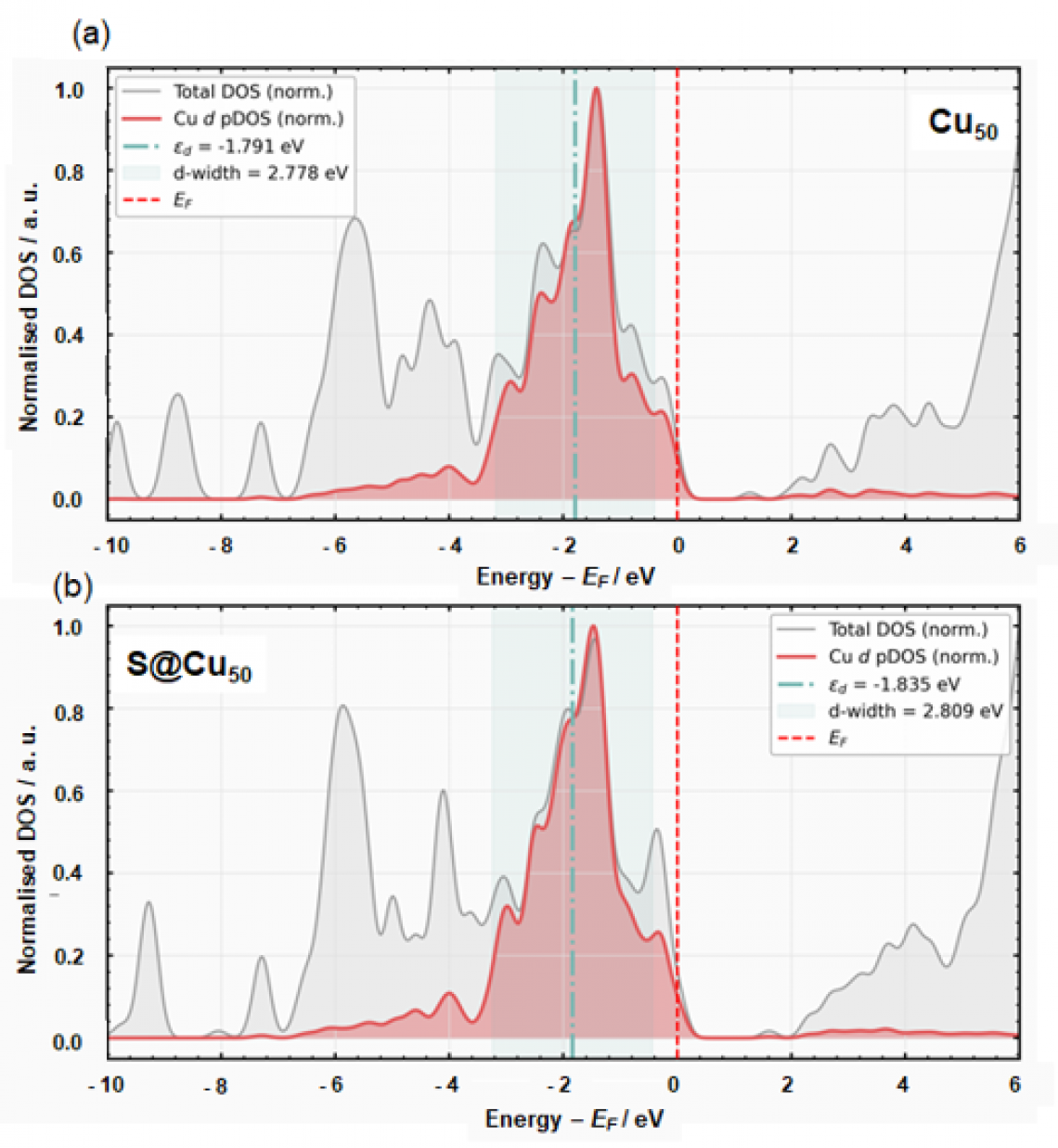
Normalised DOS and p-DOS of Cu d orbitals are presented along with the evaluated d-band center, d-band width and their relative position with respect to the Fermi level for (a) Cu₅₀ NC and (b) S@Cu₅₀ NC.
The researchers found that although both nanoclusters exhibited comparable overall catalytic activity, their product selectivity during CO₂ electroreduction differed remarkably. While Cu₅₀ predominantly produced formate (the undesired outcome) with a Faradaic efficiency of 38%, the newly developed nanocluster significantly suppressed formate formation to below 11% and instead enabled selective methanol production with a Faradaic efficiency of approximately 19% at −1.0 V versus RHE - a product completely absent in the Cu₅₀ system.
"This study provides the first clear evidence that precise modulation of the copper valence state in Cu nanoclusters can directly influence the selectivity of CO₂ reduction pathways," explains Professor Negishi (Tohoku University).
This breakthrough marks an important step toward designing next-generation catalysts, where atomic-level control can unlock cleaner and more efficient pathways for converting CO₂ into valuable fuels.
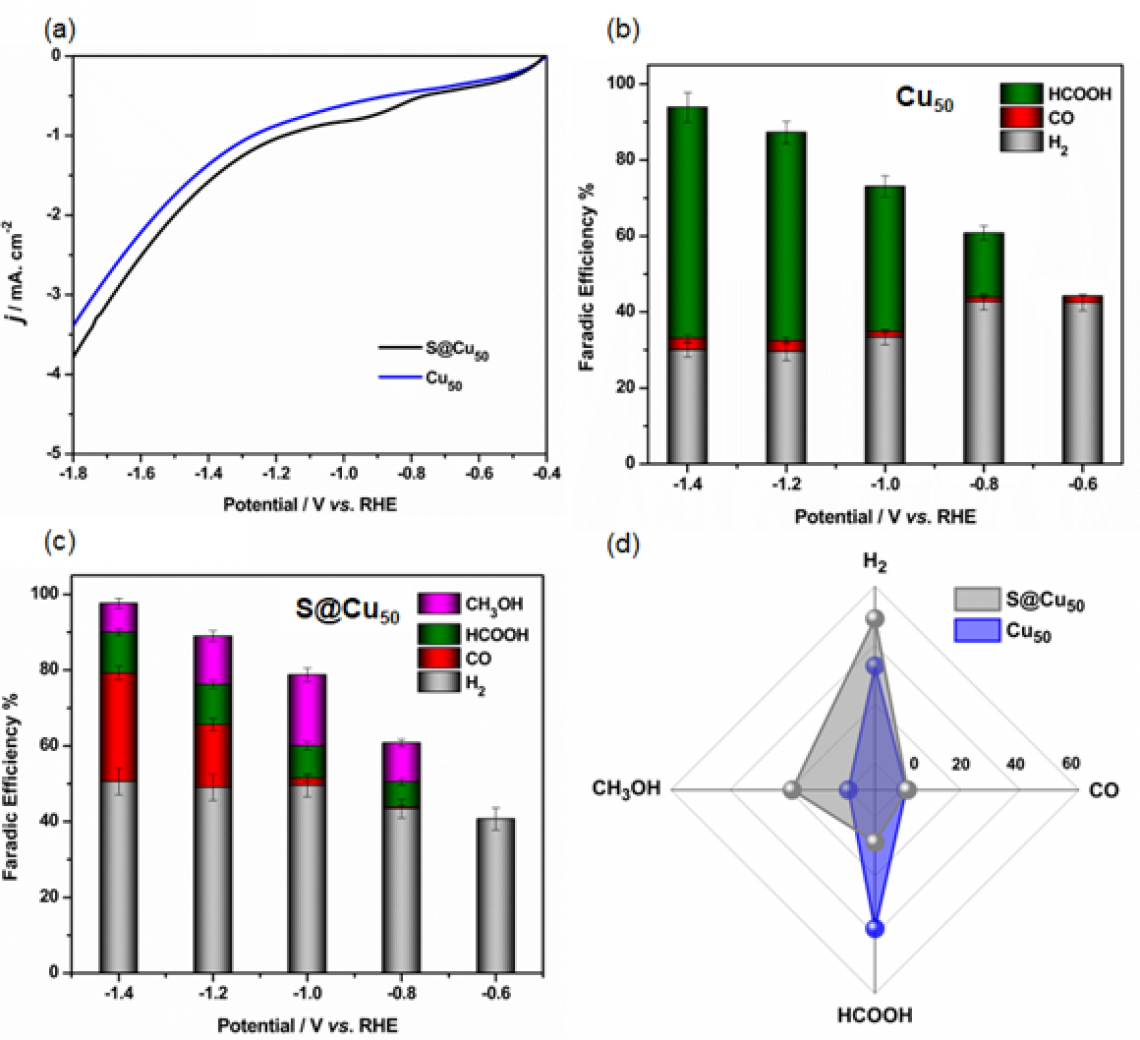
(a) LSV plots for both nanoclusters comparing their CO₂ reduction capabilities, (b) FE of all products with Cu₅₀ NC, (c) FE of all products with S@Cu₅₀ at different potential, (d) FE of all products comparison of both nanoclusters at -1.0 v vs RHE.