


Study shows improved flow of information, threat alerts among more diverse bird communities
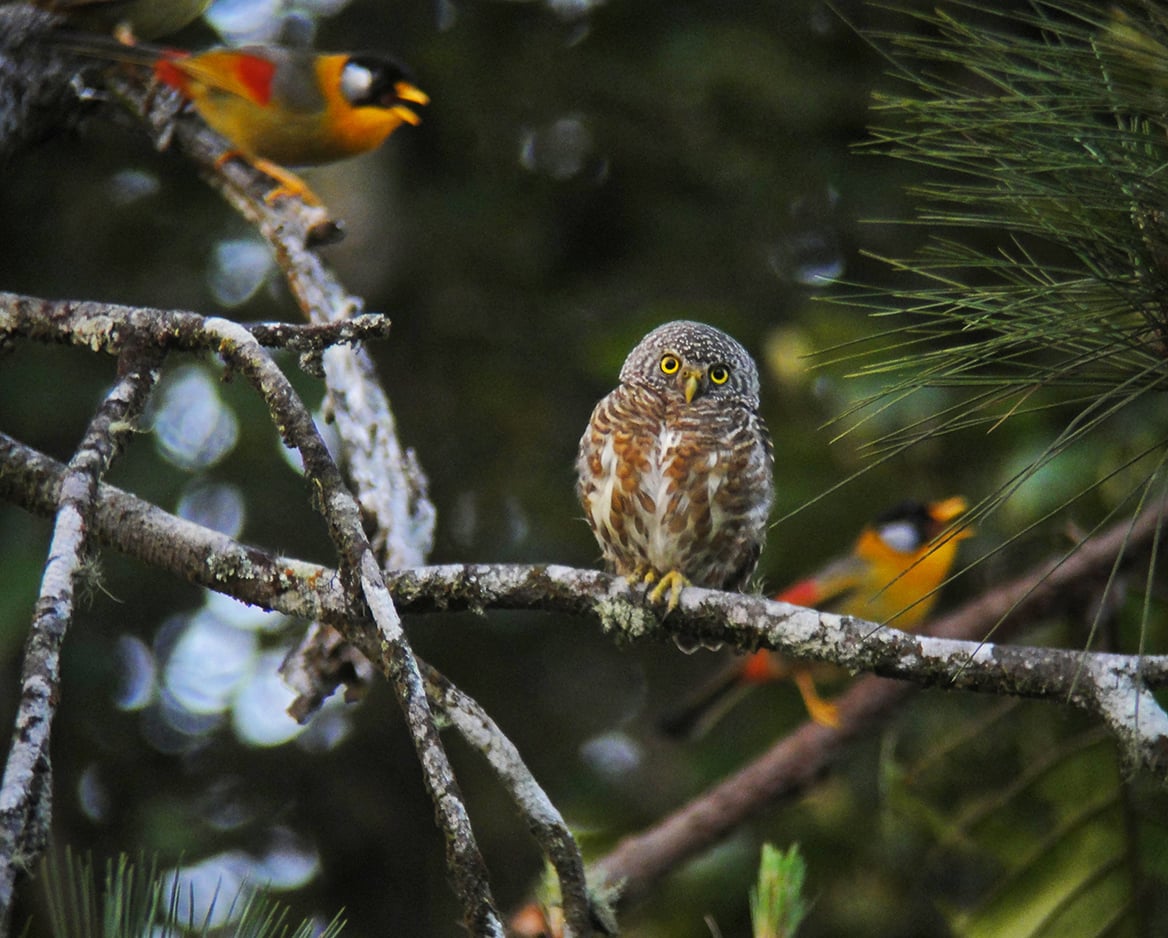
A Collared Owlet (Taenioptynx brodiei) is mobbed: mobbing involves prey birds detecting a stationary predator and recruiting other birds to come and harass it, and thus is an important example of information flow in animal communities.
Khoo Siew Yoong | https://plos.io/4yIXmSA
Birds respond quicker to predators in habitats with greater species diversity
Study shows improved flow of information, threat alerts among more diverse bird communities
The more bird species share a habitat, the better they all defend themselves from predators, according to a study published November 24th in the open access journal PLOS Biology by Agnishikhe Kumar of Xi’an Jiaotong-Liverpool University, China, and colleagues.
The diversity of species in a habitat is a common focus of conservation efforts. Local biodiversity has been shown to influence important ecosystem functions like pollination and pest control. In this study, Kumar and colleagues investigated the impact of diversity on the flow of ecological information in the form of defensive bird calls.
The team conducted several hundred experiments across ten nature reserves in eastern China. In the first round of experiments, researchers used flying hawk models and sitting owl models to encourage prey birds to respond either with alarm calls, which alert fellow birds to flee, or mobbing calls, which recruit other birds to gather around the predator and repel the threat. In the second round, the team played recorded mobbing calls on speakers to invoke responses from local birds, varying the number of species that were included in the sounds, from one to eight. The team found that increased species diversity in the recorded call playback was strongly correlated with larger mobbing groups, as well as faster and more response calls.
These results further highlight the importance of local biodiversity, indicating that in habitats with reduced species richness, local prey might exhibit weaker responses to danger thanks to diminished flow of community information. The authors note that future research might identify similar patterns with regard to other information such as valuable resources or habitat space, and in other groups of influential animals such as insects.
The authors add, “The number of birds signaling about predation increases with the species diversity of the community, even in the high-risk context of alarm calls. Further, we show using a manipulative playback experiment that the more species that signal in mobbing contexts, the larger the response, demonstrating that species diversity can influence the transmission of information.”
Press preview: https://plos.io/4fmNdUK
In your coverage, please use this URL to provide access to the freely available paper in PLOS Biology: https://plos.io/48fw63k (EA), https://plos.io/3WedBtk (MW)
Contact: Eben Goodale, [email protected]
Image caption: A Collared Owlet (Taenioptynx brodiei) is mobbed: mobbing involves prey birds detecting a stationary predator and recruiting other birds to come and harass it, and thus is an important example of information flow in animal communities.
Image credit: Khoo Siew Yoong (CC-BY 4.0,https://creativecommons.org/licenses/by/4.0/)
High-resolution image link: https://plos.io/4yIXmSA
Citation: Kumar A, Wu J, Ding P, Bro-Jørgensen J, Dutour M, Martínez AE, et al. (2026) Species diversity increases information flow about predation in bird communities. PLoS Biol 24(11): e3003805. https://doi.org/10.1371/journal.pbio.3003805
Author countries: United Kingdom, China, France, United States
Funding: The fieldwork for this study was funded by the National Natural Science Foundation of China (NNSFC; https://www.nsfc.gov.cn/english/site_1/index.html; W2431023) to E.G., NNSFC (32471628) to Q.Z., Basic and Applied Basic Research Foundation of Guangdong Province (gdstc.gd.gov.cn; 2025A1515011932) to Q.Z., and Xi’an Jiaotong-Liverpool University (XJTLU; https://www.xjtlu.edu.cn/en/research; RDF-22-02-023) to EG. Support for the larger Thousand Island Lake project was provided by NNSFC (32030066) to P.D. and NNSFCs (32371590 and 32311520284) to X.S. XJTLU doctoral scholarships supported A.K. and J.W. (PGRSSP230901, PGRSSP220901). The sponsors or funders did not play any role in the study design, data collection and analysis, decision to publish, or preparation of the manuscript.
Competing interests: The authors have declared that no competing interests exist.
____________________________
About PLOS Biology
Our leading life science journal, PLOS Biology, champions inclusive, high-impact research across all disciplines—from molecules to ecosystems.
We offer innovative publication formats, rigorous, transparent and accountable decision-making, and collaborative editorial support that is focused on helping researchers publish their best work.
Our transdisciplinary approach and author-friendly policies ensure your work reaches its full potential and impact.
Media and copyright information
For information about PLOS Biology relevant to journalists, bloggers and press officers, including details of our press release process and embargo policy, visit https://plos.org/media/.
PLOS journals publish under a Creative Commons Attribution License, which permits free reuse of all materials published with the article, so long as the work is cited.
About PLOS
PLOS is a non-profit organization on a mission to drive open science forward with measurable, meaningful change in research publishing, policy, and practice. We believe in a better future where science is open to all, for all.
Building on a strong legacy of pioneering innovation, PLOS continues to be a catalyst in open science, reimagining models to meet open science principles, removing barriers and promoting inclusion in knowledge creation and sharing, and publishing research outputs that enable everyone to learn from, reuse, and build upon scientific knowledge.
Disclaimer
This press release refers to upcoming articles in PLOS Biology. The releases have been provided by the article authors and/or journal staff. Any opinions expressed in these are the personal views of the contributors, and do not necessarily represent the views or policies of PLOS. PLOS expressly disclaims any and all warranties and liability in connection with the information found in the release and article and your use of such information.
Advertisement