
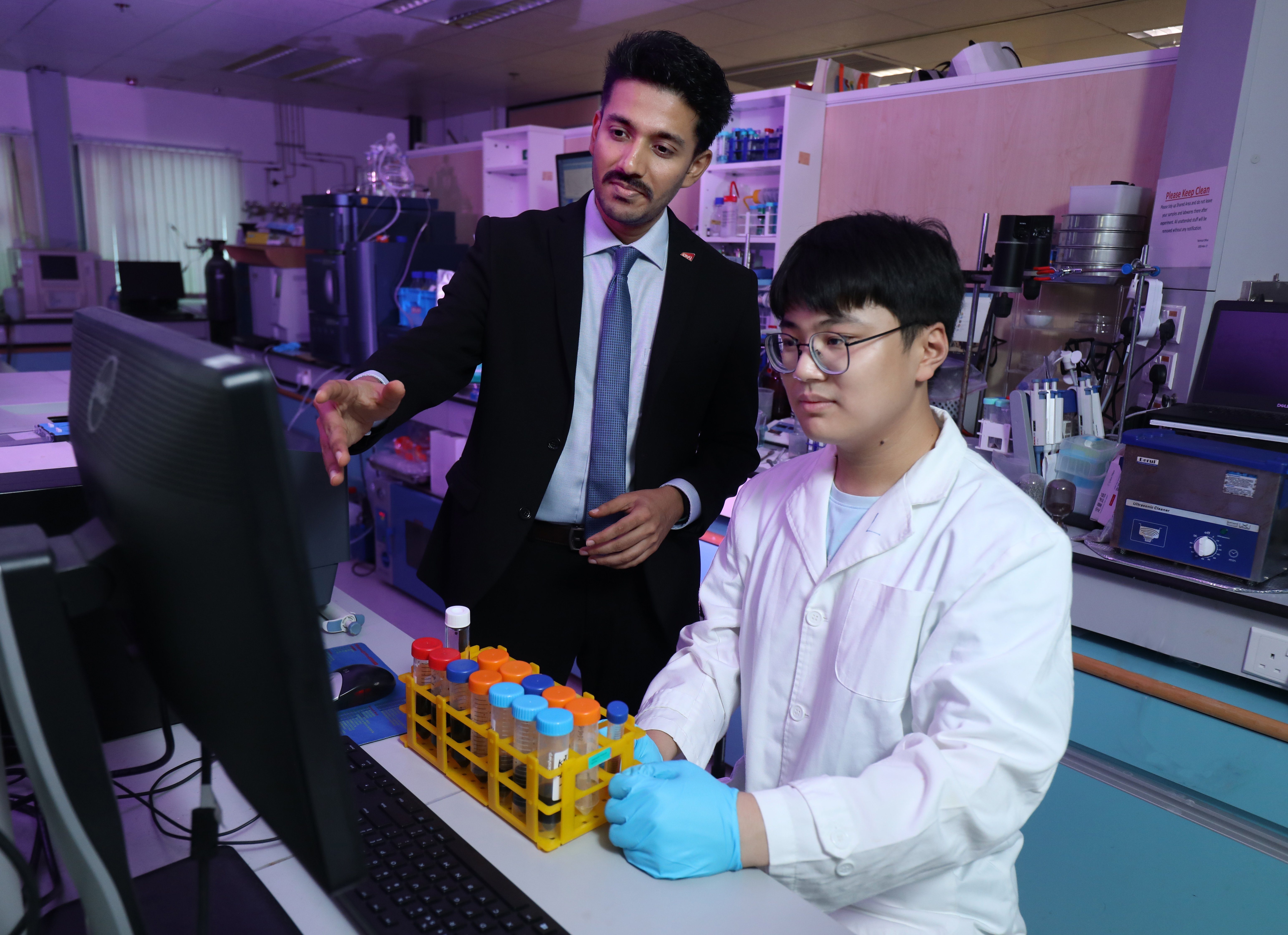

A research team led by Professor Sai Kishore Ravi from SEE at CityUHK has successfully demonstrated how mechanical vibrations can be harnessed to drive the production of useful chemicals from water.
Professor Ravi (left) with member of his research team at CityUHK
City University of Hong Kong
From ocean waves and flowing rivers to the systems used to transport and treat water, vibrations are everywhere. But can vibrations do more than just shake water? Can they split water or drive the production of useful chemicals from water?
A research team led by Professor Sai Kishore Ravi from the School of Energy and Environment (SEE) at City University of Hong Kong (CityUHK) has successfully demonstrated how mechanical vibrations can be harnessed to drive the production of useful chemicals from water.
The team showcased these breakthroughs in two recent studies: one on vibration-driven hydrogen peroxide generation, published in Nature Communications under the title "Bulk polarization field and interfacial electron sink in MXene-modified iodine-doped Bi4Ti3O12 enhance piezocatalytic H2O2 generation", and another on hydrogen production, in Advanced Energy Materials under the title “Enhanced Lattice Polarization and Directed Charge Transport Toward Pt Surface Sites Accelerate the Volmer Step in Piezocatalytic H2 Evolution on Co-Doped BiFeO3”.
The studies contribute to the emerging field of piezosynthesis, where mechanical deformation in piezoelectric materials generates charges that can be directed to drive redox reactions in water. A key challenge is preventing the loss of these charges through recombination before they reach surface reaction sites.
To overcome this, the team developed a piezoelectric bismuth ferrite-based system for vibration-driven hydrogen production. By applying structural tuning strategies, such as controlled doping and cocatalyst loading, they improved charge utilisation and surface reaction kinetics, achieving a sixteen-fold increase in hydrogen generation compared to the starting material. Additionally, they developed a hydrogen peroxide–producing system based on a layered bismuth titanate structure operating under mechanical vibration. The system delivered a hydrogen peroxide production rate of 5,890 μmol g⁻¹ h⁻¹ without adding sacrificial chemicals to drive the reaction. The generated product was shown to degrade pollutants and inactivate bacteria, highlighting its potential for water treatment applications.
“Despite the different chemical products, the two studies rely on the same principle of controlling how vibration-generated charges are separated and directed to drive chemical transformations,”explained Professor Ravi.“Our current studies use controlled ultrasonic vibrations to deepen our understanding of the underlying science. The next challenge is to move beyond the laboratory reactor and explore systems that can operate using vibrations present in the environment.”
This prospect is compelling for coastal cities like Hong Kong. Preliminary studies are underway on floating catalytic platforms designed to harness vibrations from ocean waves, an approach the team is now investigating for future real-world applications of piezosynthesis. Waves that reach the cities’ shores could one day help produce useful chemicals, drive environmental remediation and generate clean fuels.
Advertisement
Advertisement