Philippine science news website FlipScience's Editor in Chief, Mr Mikael Francisco, shared his expertise in doing science communication across different platforms.
At the heart of effective science communication is the most intrinsic, human pastime of telling stories. And like all captivating stories, its role is to meet audiences where they are, to make the narrative – the knowledge passed on – accessible and relevant without losing meaning.
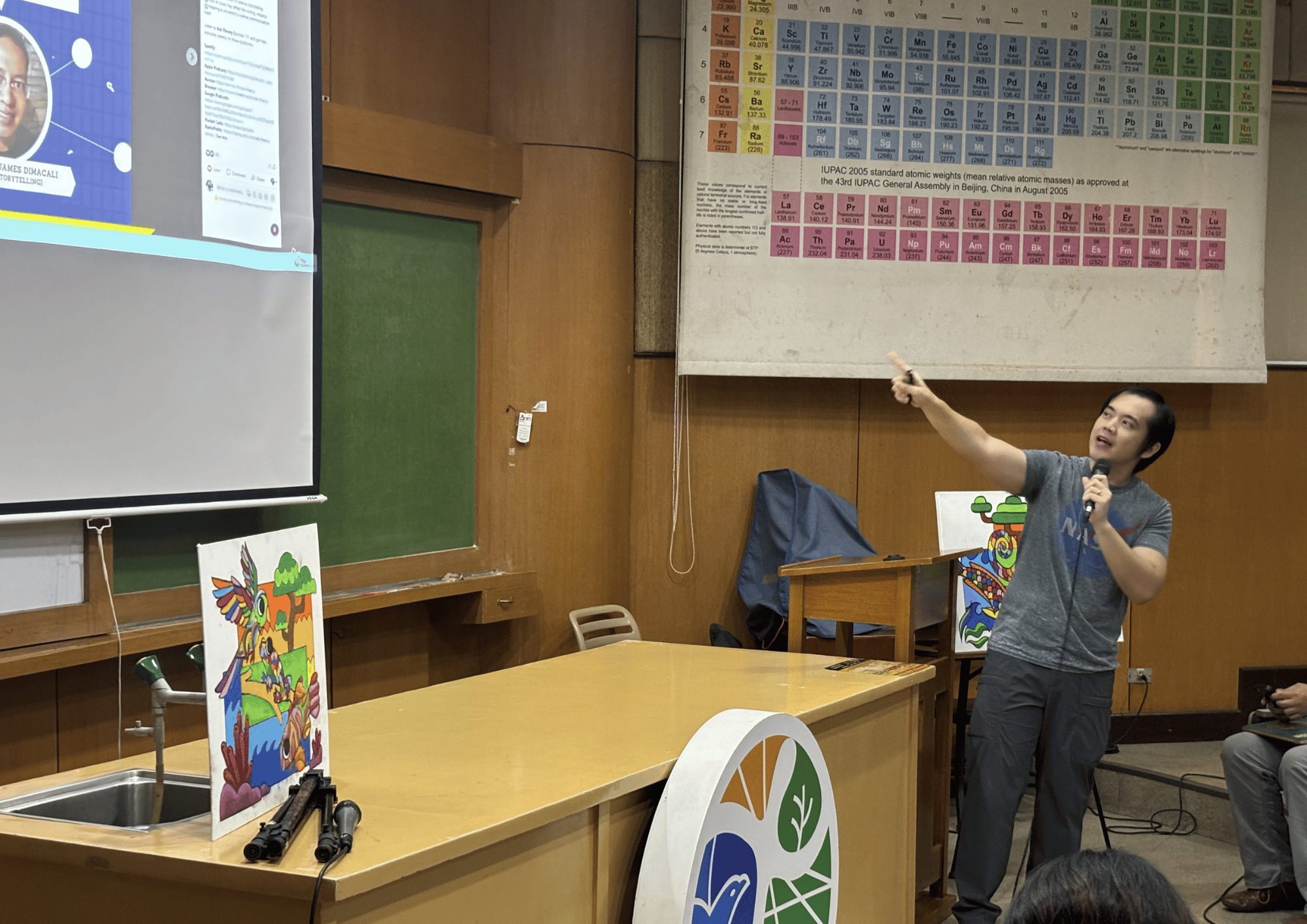
Organized by the Ateneo Institute of Sustainability (AIS), the Office of the Assistant Vice President for Research, Creative Work, and Innovation (OAVP–RCWI), and Science Communicators Philippines (SciCommPH), the Science Communication Workshop was held on 08 April 2026. Its goal was simple: To equip participants with the practical science communication skills that will help engage various audiences, as well as to explore further interdisciplinary collaboration in order to create more meaningful impact. All these were brought to life by two experts in the field, Mr TJ Dimacali and Mr Mikael Francisco.
Going from study to story
The movement from scientific research and data to engaging and accessible content means laymanizing and developing a story worth paying attention to. In his session on basic science communication writing, Mr Dimacali, Research Communications Head of OAVP-RCWI and Vice President for External Affairs of SciCommPH, describes it as to “start from the very raw – then look at these and figure out ano ba ang kwento?” He emphasizes that the role of the science communicator is to serve as a bridge, as one who brings the topics to a place where audiences can understand best. It can be as simple as finding familiar connections, relating to pop culture – any angle that might pique interest for audiences to keep reading.
As with any form of writing, Mr. Dimacali talked about the merits of building a clear structure: A reliable arc, a captivating hook, and supporting details to satisfy piqued curiosities. He also noted that while new information is exciting, writers need to be mindful that, “Journalism does not begin or end with one story,” riding on the truth that brevity is often key in engagement, and that a foot in the door of wonder — or, learning, or curiosity – is a great entry point.
Easily, one story can lead to many more, as curiosities become more constant.
A plethora of platforms
In his session entitled, “the Scicomm [e]cosystem: Science Communication via Digital Media”, Mr. Francisco, Co-Founder and Editor-in-Chief of FlipScience, took participants through a myriad of examples of science communication on various media – across platforms such as Youtube, podcasts, and social media spaces. Through these, participants understood more deeply the unique facets of each platform, and how each one lends itself to ways to connect, engage, and build on knowledge. Effective science communication then is not just finding the best words or best angle to frame a story, but also choosing the best form in which a story is told to an audience.
Working on the wording
The afternoon ended with an actual workshop exercise, in which the facilitators and participants read through and gave feedback on submitted works from anonymous members of the group present. Mr. Dimacali and Mr. Francisco helped participants navigate through the experience of “holding the editor’s pen” in critiquing and offering suggestions for the texts in question.
The takeaway of the three-hour workshop? People love to know – crave curiosity, create curiosity, and celebrate curiosity.