
□ DGIST (President Kunwoo Lee) officially launched the “2026 Institutes of Science and Technology (IST) InnoCORE Program,” which aims to drive innovative research and foster early-career research talent in advanced future technologies, and held a series of launch ceremonies for its affiliated research organizations from August 18 to September 8.
□ The “InnoCORE Program” is a key DGIST research support program designed to enable outstanding postdoctoral researchers (InnoCORE Fellows) to take the lead in convergence research in future strategic technologies and build a robust collaborative ecosystem between universities and government-funded research institutes (GFRIs).
□ Using the program, DGIST introduced four organizations: two research units under the “IST-led” track, which conduct large-scale convergence research, and two research groups under the “GFRI-linked” track, which pursue strategic collaboration with GFRIs. The inauguration ceremonies for each organization were attended by DGIST researchers, faculty members participating in joint research, and representatives from related organizations, who engaged in in-depth discussions on ways to promote convergence research.
□ First, under the “IST-led” track, two convergence research units were introduced to lead research in advanced energy materials and the bio and brain sciences. The Center for Energy Materials Commercialization through AI Transformation (AX) (E-MatAX Research Center), introduced on August 18–19, outlined a strategy for building an integrated platform that uses AI to transform the entire lifecycle of energy materials from design to demonstration. Thereafter, the Multiscale Brain Digital Twin Convergence Research Group introduced on September 3 presented detailed research topics to implement brain disease modeling using digital twin technology (a technology that creates an identical virtual twin of a physical object in a virtual environment for testing) and strengthened networking for convergence.
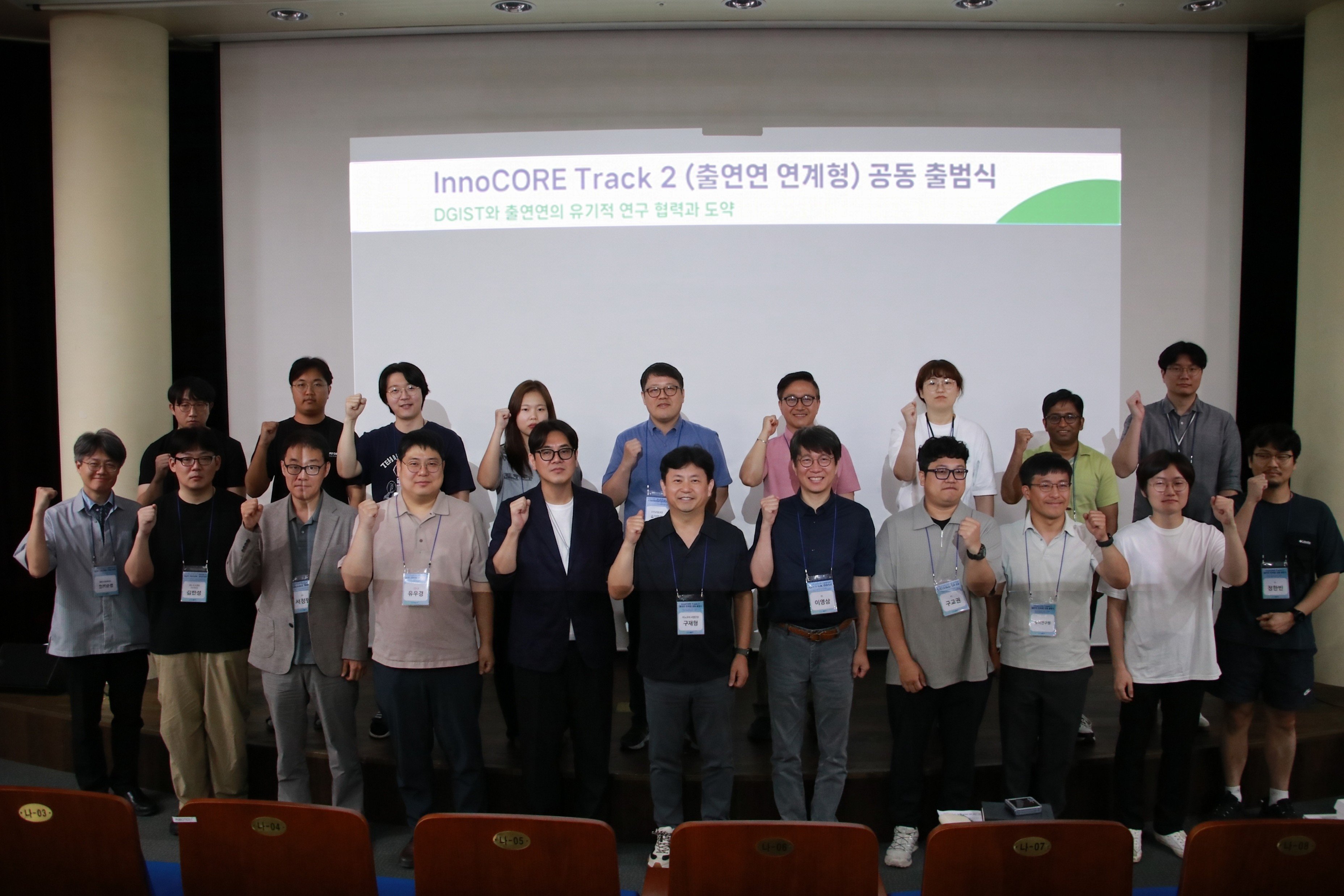
□ Moreover, inauguration ceremonies for the “GFRI-linked” track, which leads substantive joint research with GFRIs, were held on two occasions. At the first inauguration ceremony on August 27, the principal investigators of five key research projects and Fellows presented their research directly, strengthening the foundation for collaboration. At the second inauguration ceremony on September 8, participants shared detailed implementation plans for each linked project and developed strategies to further strengthen a joint research framework that bridges institutional boundaries.
□ Moreover, the “Bio-Embodied Physical AI (AI that interacts directly with the real world) Research Group,” an organization under the “IST Convergence” track that collaborates with other institutes of science and technology, plans to hold a joint workshop within the year to generate tangible convergence synergies, building on the stable foundation it has established since its introduction last year.
□ The DGIST InnoCORE Program will operate a multi-mentoring system and customized career development tracks (academia, industry, and entrepreneurship) to help early-career researchers develop into independent, self-directed researchers. The program aims to establish itself as a platform for cultivating next-generation core talent across academia, industry, and entrepreneurship, by creating a research environment that maximizes autonomy.
□ “This series of launch ceremonies marks a strong starting point for achieving innovative outcomes in national strategic technology fields such as energy materials and brain digital twins,” stated JaeHyung Koo, Director of the DGIST InnoCORE Program. “We will establish an open platform for convergence research where talented early-career researchers can freely collaborate across institutional and disciplinary boundaries, and provide comprehensive support so that they can produce world-class research outcomes.”
□ The DGIST InnoCORE research units and projects are currently recruiting highly qualified InnoCORE Fellows (postdoctoral researchers). Further details are available on the official DGIST website (https://www.dgist.ac.kr).