

Scientists have shown that the two exponents (inelastic scattering exponent and dephasing exponent) commonly used to describe electron scattering in graphene do not necessarily follow the same behavior. Using gated epitaxial graphene, a multi-institutional team of researchers independently extracted the two exponents through current-heating measurements and weak-localization analysis. The contrasting gate-voltage dependence provides evidence that energy relaxation and loss of quantum phase coherence can be governed by different microscopic processes.
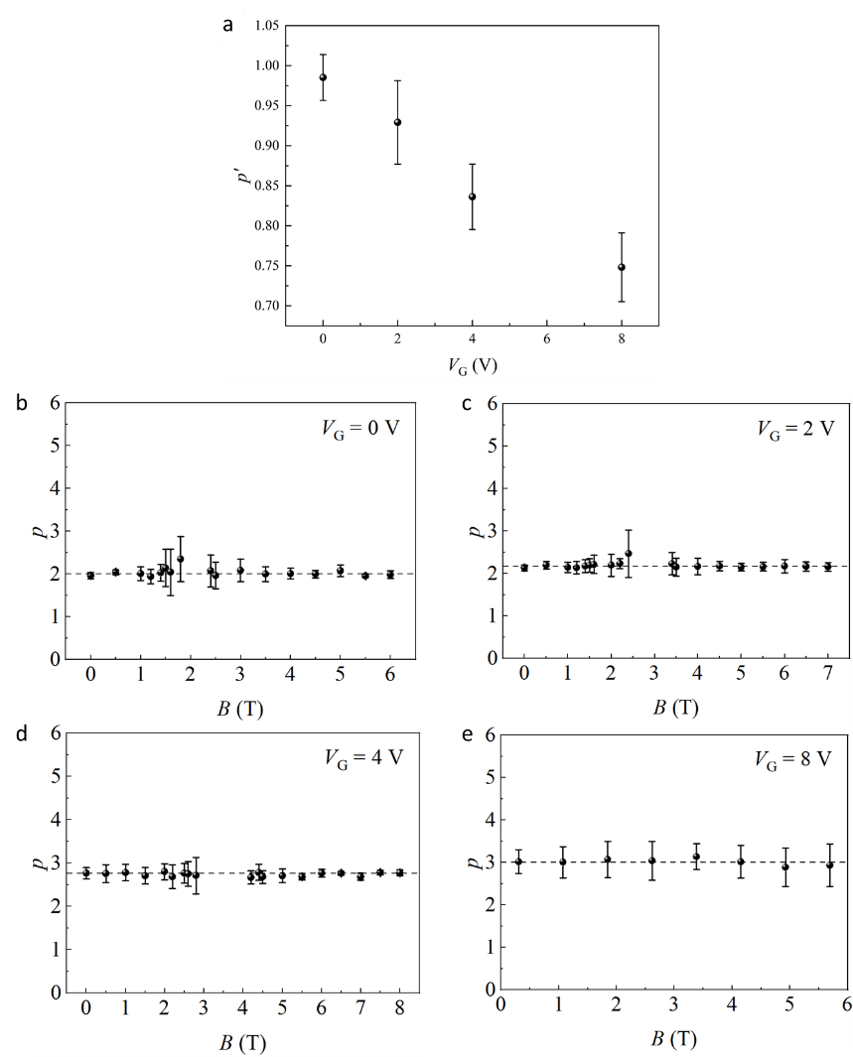
Gate-tunable p’ and p in epitaxial graphene. (a) Weak-localization measurements reveals how p’ varies with carrier density from about 1 to 0.75 as the gate voltage is increased. (b-e) From current scaling theory, a demonstration of p gradually changes from approximately 2 to 3 with increasing gate voltages, which evolves differently from the dephasing behavior.
National Taiwan University
A research team led by Dr. Wei-Chen Lin at National Taiwan University and collaborating institutions uncovered a distinction between inelastic scattering and quantum dephasing in gated epitaxial graphene. This study, published in Carbon, addresses a long-standing assumption that the exponents used to characterize these two processes should be equivalent.
An electron in a solid can lose its energy through inelastic scattering processes, while quantum coherence can be lost when the phase relationship between electron wavefunctions is disrupted. These two phenomena are closely related, but they do not necessarily provide the same information. In this study, scientists used epitaxial graphene grown on silicon carbide and controlled its carrier density with a gate voltage.
Researchers independently determined the inelastic scattering exponent p from current-heating measurements simply by increasing the current and the dephasing exponent p’ from weak-localization measurements. At zero gate voltage, the two quantities were already distinct, with p ≈ 2 and p’ ≈ 1. More importantly, increasing the gate voltage caused the two exponents to evolve in opposite directions; that is, p increased from approximately 2 to 3, whereas p’ decreased from approximately 1 toward 0.75.
This contrasting behavior demonstrates that the inelastic scattering exponent and the dephasing exponent should not be assumed to be universally equivalent. Instead, the measurements indicate that energy relaxation and quantum phase coherence can respond differently to changes in carrier density and gate voltage.
The findings provide a framework for independently examining energy relaxation and quantum coherence in graphene and the other two-dimensional materials.
“Distinguishing these processes is important for understanding low-temperature quantum transport and for developing devices that rely on long-lived electronic coherence,” says corresponding author Chi-Te Liang, professor of physics at National Taiwan University.
Keywords: Graphene, Quantum Transport
Prof. Chi-Te Liang's email address: [email protected]
The Cryogenic Electronic-Optical Semiconductor Lab of Prof. Liang linked to
Advertisement
Advertisement