


Light may be the key to creating bendable displays and wearable sensors
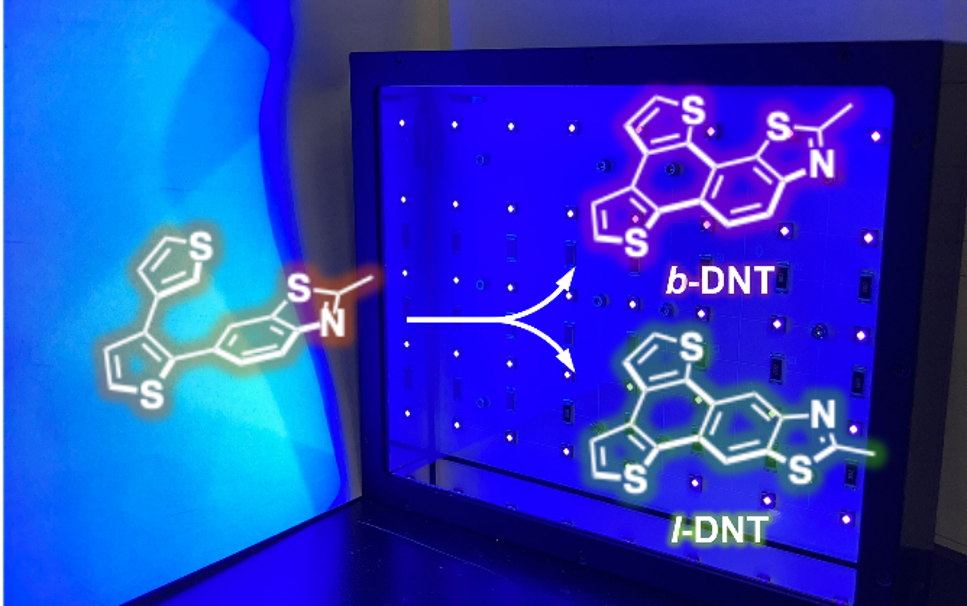
Light is used to transform the precursor molecule into two different organic semiconductor molecules, b-DNT and l-DNT: Researchers used a photochemical reaction to transform a sulfur- and nitrogen-containing precursor into two new organic semiconductor molecules, b-DNT and l-DNT. Their different molecular structures affect how the molecules pack together and, consequently, their predicted ability to transport electrical charge.
Osaka Metropolitan University
Researchers have developed two new organic semiconductor materials using a light-driven chemical reaction.
The new materials have an internal molecular arrangement that allows them to stack together in crystals so that electrical charge moves efficiently between neighboring molecules. This arrangement could serve as the building blocks of the next generation of flexible electronics, where alignment of molecules is key.
“The development of lightweight and flexible organic semiconductors, like the ones in this experiment, would be useful in electronics such as bendable displays and wearable sensors,” Associate Professor Yasunori Matsui explained.
An organic semiconductor can achieve optimal performance when “holes,” the carriers of electrical charge, can move freely and rapidly from one molecule to another. However, to enable this flow, the molecules must be packed closely and regularly to create the most efficient pathways.
The research group led by Specially Appointed Assistant Professor Takuya Ogaki, Professor Hiroshi Ikeda, from the Graduate School of Engineering, Osaka Metropolitan University, synthesized a new sulfur- and nitrogen-containing organic semiconductor using a photochemical reaction. The light triggered a chemical reaction, making parts of the molecule form new carbon-carbon bonds and causing them to fold into a more compact ring structure, ideal for hole transport.
The experiment is the latest in a series of studies on sulfur- and nitrogen-containing semiconductors. In their latest experiment, the researchers found that by simply changing light irradiation conditions, they could successfully produce a mixture of two distinct molecular structures, a bent isomer (b-DNT) and a linear isomer (l-DNT), or b-DNT exclusively.
However, understanding how these isomers were formed was tricky as some of the chemical species involved existed for an extremely short time. Therefore, the researchers turned to laser flash photolysis and nanosecond absorption spectroscopy to observe these short-lived reaction intermediates and density-functional theory calculations to analyze them.
They were able to piece together a sequence of events where the starting molecule undergoes light absorption to create short-lived intermediates leading to a new ring structure and forming the l- and b-DNTs.
Crystal structure analysis revealed that both molecules formed tightly packed crystal structures supported by sulfur-sulfur and sulfur-nitrogen interactions. However, l-DNT exhibited greater overlap between neighboring molecules that serve as charge-transport pathways.
“As a result, we found that its predicted hole mobility reached approximately five times higher than that of b-DNT, comparable to those of leading organic semiconductor materials,” Masato Uenaga, the study's first author, said. “This study demonstrates that combining a clean photochemical synthesis method with molecular design incorporating a thiazole unit can generate promising candidates for high-performance organic semiconductors.”
The findings were published in Chemistry – A European Journal.
COI statement:
The authors declare no conflict of interests.
###
About OMU
Established in Osaka as one of the largest public universities in Japan, Osaka Metropolitan University is committed to shaping the future of society through the “Convergence of Knowledge” and the promotion of world-class research. For more research news, visit https://www.omu.ac.jp/en/ and follow us on social media: X, Instagram, LinkedIn.
Advertisement
Advertisement