


This work reports a Na and Ag co-doped SnS with ultrahigh thermoelectric (TE) performance near room temperature (RT).
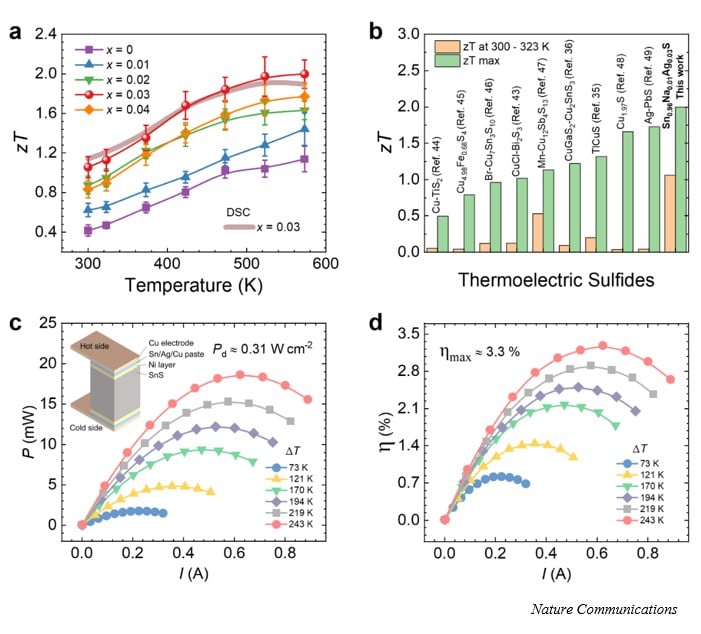
Figure of merit (zT) and performance of Sn0.99-xNa0.01AgxS demonstrating state-of-the-art sulfide-based TE performance. a, Temperature-dependent zT. b, Benchmark comparison of near room-temperature zT and zT peak values with those of the reported sulfide-based TE materials. c-d, Input current (I) versus output power (P) and efficiency (η) for different temperature gradients (ΔT) with an inset schematic of the fabricated single-leg module.
Nature Communications
In this work SnS is co-doped with Na and Ag rendering high electric conductivity and Seebeck coefficient while reducing thermal conductivity yielding high thermoelectric performance near room temperature. The study is published in Nature Communications.
The resulting highly metallic conductivity combined with high thermopower yields an ultrahigh room-temperature power factor of ~101 µW cm-1K-2 in Sn0.96Na0.01Ag0.03S single crystals. Coupled with the intrinsically low thermal conductivity of SnS, the optimized crystal achieves the figure of merit (zT) of ~1.06 at 300 K and ~2.0 at 573 K, delivering a conversion efficiency of ~3.3% and an output power density of ~0.31 W cm-2 in a single-leg module under a 243 K temperature gradient.
Detailed characterizations including XRD, Raman spectroscopy, HAADF-STEM, ARPES, XANES, EXAFS, and DFT calculation have been applied to elucidate the lattice and electronic structural modification under the Na and Ag co-doping. Multivalence-band convergence facilitated efficient charge transport in flattened bands rendering strong coupling effect between σ and S in Sn0.96Na0.01Ag0.03S single crystal, enabling the realization of an ultrahigh TE performance at near RT.
“Notably, a high zT peak of ~2 at 573 K was realized within a sulfide-based system, highlighting a significant advance in earth-abundant and environmentally friendly thermoelectrics near RT,” says co-corresponding author Dr. Kuei-Hsien Chen, distinguished research fellow of Institute of Atomic and Molecular Sciences, Academia Sinica and Center for Condensed Matter Sciences, National Taiwan University.
Dr. Kuei-Hsien Chen’s email address: [email protected]
Advertisement
Advertisement