
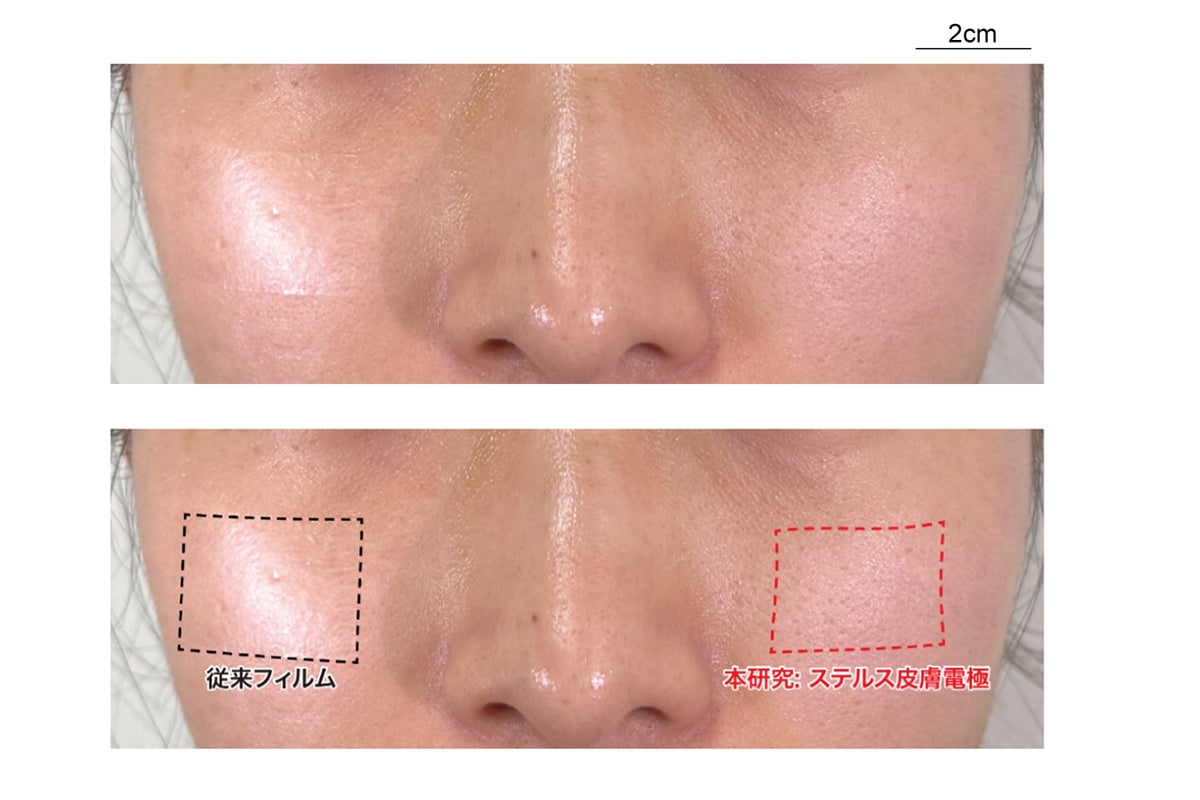
Tokyo, Japan – While wearable health sensors are becoming increasingly common, current iterations are awkward to wear. For example, devices attached to the face can draw unwanted attention, increase self-consciousness, and influence the very signals users are trying to measure. However, recent research may have found a solution to these problems by introducing ultrathin sensors that cannot be seen by observers or felt by the wearer.
In an article recently published in Science Advances, researchers from the Institute of Industrial Science, The University of Tokyo and collaborating institutions reported the development of thin, stretchable on-skin electrodes that are effectively invisible when worn on the face. The new technology can measure biological signals while remaining undetectable by eye and by touch, allowing monitoring to take place under more natural conditions.
Biosignals such as eye movements, facial muscle activity, and brain activity provide valuable information for healthcare monitoring and human–machine interaction. However, conventional facial electrodes can alter a person's appearance and affect social interactions, creating what are called appearance artifacts – changes in behavior or psychological state caused simply by wearing a device the individual and others can see.
“To truly integrate wearable electronics into daily life, they need to disappear into the background,” explains senior author Naoji Matsuhisa. “People should be able to wear sensors without feeling watched, judged, or uncomfortable.”
The new electrodes achieve this by combining several design features, including an ultrathin elastic film approximately 200 nanometers thick and transparent conductive nanowires. The resulting device closely matches the appearance and texture of natural skin, reducing reflections and eliminating the glossy appearance that often makes wearable electronics noticeable.
“In our experiments, neither wearers nor outside observers could reliably detect the electrodes by sight or touch,” says lead author Yijun Liu. “The devices remain comfortable and breathable during use and work across a wide range of skin tones and features.”
Importantly, the electrodes still perform their intended function. The team successfully recorded electrooculography signals from eye movements, electromyography signals from facial muscles, and electroencephalography signals from brain activity using these electrodes. For several signal types, the signal quality was measurably better than that obtained using conventional gel electrodes, owing to lower skin impedance.
“By making wearable electronics that are both fully functional and effectively invisible, we are moving one step closer to a future in which health monitoring and human–machine interaction are seamlessly integrated into everyday life,” remarks Matsuhisa.
The team believes that future applications of their sensor could include subtle monitoring of emotional state and cognitive function, as well as new ways to control devices or virtual-reality systems using eye movements and facial expressions. More broadly, invisible sensors like these could help create a future in which technology adapts seamlessly to people, rather than the other way around.
###
The article, “Reduction of appearance artifacts in wearable on-skin electronics,” was published in Science Advances at DOI: 10.1126/sciadv.aee6417.
About Institute of Industrial Science, The University of Tokyo
The Institute of Industrial Science, The University of Tokyo (UTokyo-IIS) is one of the largest university-attached research institutes in Japan. UTokyo-IIS is comprised of over 120 research laboratories—each headed by a faculty member—and has over 1,200 members (approximately 400 staff and 800 students) actively engaged in education and research. Its activities cover almost all areas of engineering. Since its foundation in 1949, UTokyo-IIS has worked to bridge the huge gaps that exist between academic disciplines and real-world applications.