
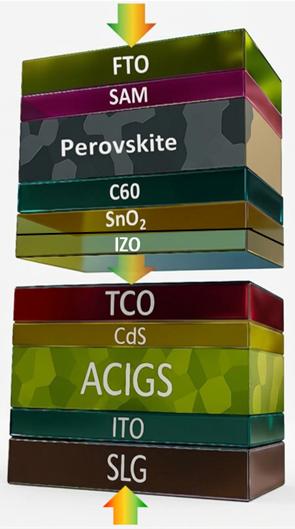
□ A joint research team led by Dr. Dae-Gyu Hwang and Dr. Dae-Hwan Kim from the Division of Energy & Environmental Technology at DGIST (President Lee Kunwoo) has significantly enhanced the power generation performance of bifacial thin-film solar cells that absorb light from both front and rear surfaces, achieving a record-high bifacial power density using an advanced next-generation solar cell architecture.
□ With the rapid expansion of AI data centers driving electricity demand, high-efficiency solar cells that maximize power output in limited space are becoming increasingly vital. Four-terminal bifacial tandem solar cells, which harness light from both front and rear surfaces, are emerging as a key next-generation technology to enhance conversion efficiency and energy yield. Thin-film bifacial CIGS solar cells are promising candidates for the bottom cell; however, their efficiency has been constrained by the formation of unwanted oxide layers between the transparent electrode and absorber layer.
□ The research team successfully overcame this limitation by precisely controlling the thickness of the transparent rear electrode to 200 nm and selectively applying silver (Ag) alloying processes. Suppressing the formation of interfacial oxide layers that hinder charge transfer significantly enhanced the charge collection efficiency and maximized bifacial photovoltaic performance.
□ The newly optimized bifacial CIGS solar cell recorded an outstanding bifacial power density (power output per unit area generated by simultaneously absorbing light from both sides) of 19.05 mW/cm² under conditions simulating real-world reflective environments.
□ Furthermore, the team stacked a perovskite solar cell—highly efficient at absorbing short-wavelength light—on top of the CIGS cell, realizing a tandem solar cell architecture with expanded spectral response and higher light utilization efficiency. Consequently, this architecture achieved a record-high bifacial power density of 28.42 mW/cm², substantially boosting the technical feasibility of four-terminal perovskite–CIGS bifacial thin-film tandem solar cells.
□ Dr. Dae-Gyu Hwang, Principal Researcher at DGIST, explained, “The developed four-terminal tandem solar cell is highly advantageous for commercialization because the top and bottom cells operate independently, allowing flexible adaptation to varying light incidence and reflection conditions.” Dr. Dae-Hwan Kim, Principal Researcher, added, “We will further optimize the interface and optical structures to achieve even higher power output in future work.”
□ This research was supported by the Ministry of Science and ICT, the National Research Foundation of Korea, and the Korea Institute for Advancement of Technology under the Ministry of Trade, Industry and Resources. The findings (First Author: Amanat Ali, Integrated MS–PhD Student in the Interdisciplinary Program) were published in Carbon Energy, a prestigious international academic journal in energy research.