

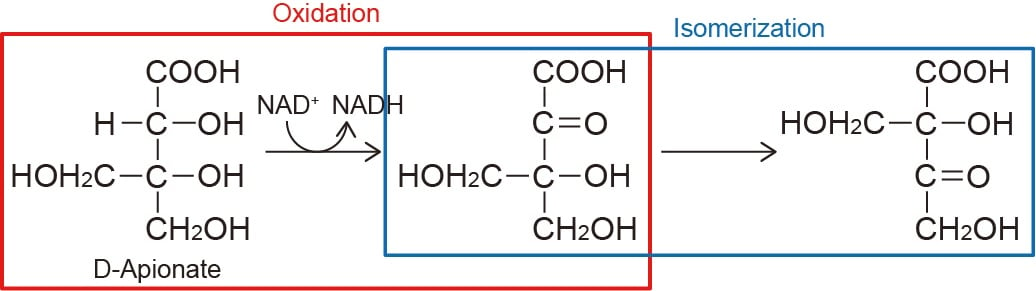

Only four enzymes including D-apionate oxidoisomerase (ApnO) are known to catalyze distinct, sequential chemical reactions at a single active site. Biochemical and crystallographic analysis revealed the catalytic mechanism of ApnO containing zinc and manganese ions as metal cofactors, and unique tetrahedral coordination geometry of the later. This study provides new insight into the molecular evolution of rare enzymes that defy the general paradigm wherein a single enzyme's activity is classified under a single reaction mode.
【Figure.1】
Schematic reaction of ApnO
Seiya Watanabe
【Figure.2】
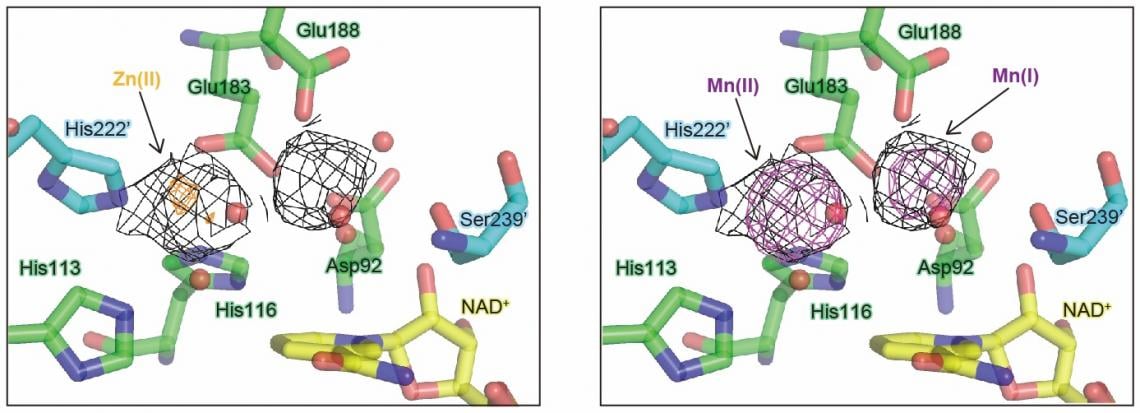
Anomalous dispersion peaks of zinc (orange) and manganese (purple) measured at wavelengths of 1.28 Å (left) and 1.89 Å (right).
Seiya Watanabe
The EC numbers (Enzyme Commission numbers) serve as a widely used classification system for enzymes based on seven reaction types. However, a very small number of enzymes cannot be clearly assigned to a single class, and contain ketol-acid reductoisomerase (KARI) and D-apionate oxidoisomerase (ApnO). Among them, ApnO, a recently discovered member in 2018, had not yet undergone detailed functional analysis.
To elucidate the catalytic mechanism at atomic level, we first determined its three-dimensional structure using X-ray crystallography. Despite no significant sequence homology, the overall structure of ApnO closely resembled that of KARI. It is known that two Mg2+ ions, Mg(I) and Mg(II), octahedrally coordinate at sites I and II in KARI, respectively. In contrast, coordination geometry of Zn2+/Mn2+ at the equivalent position to Mg(II) was uniquely tetrahedral, and that of Mn2+ at the equivalent position to Mg(I) was normally octahedral. To identify these metal ions, we utilized the anomalous dispersion effect that occurs at wavelengths near the respective X-ray absorption edges. The Zn(II)/Mn(II) in ApnO and the Mg(II) in KARI differ not only in the type of metal ion and coordination geometry but also show no conservation of surrounding active-site residues. This strongly suggested that this metal ion binding site II independently acquired between ApnO and KARI, and another metal ion binding site I shared a common evolutionary origin.
Since it become possible to accurately predict protein structure, we should significantly consider why the direct determination of structures remains necessary. In this regard, the direct identification and novel binding mode of the metal ion(s) at the active site cannot be absolutely revealed by structural models alone. This study would provide new insight into the molecular evolution of rare enzymes that defy the general paradigm wherein a single enzyme's activity is classified under a single reaction mode.
Advertisement