

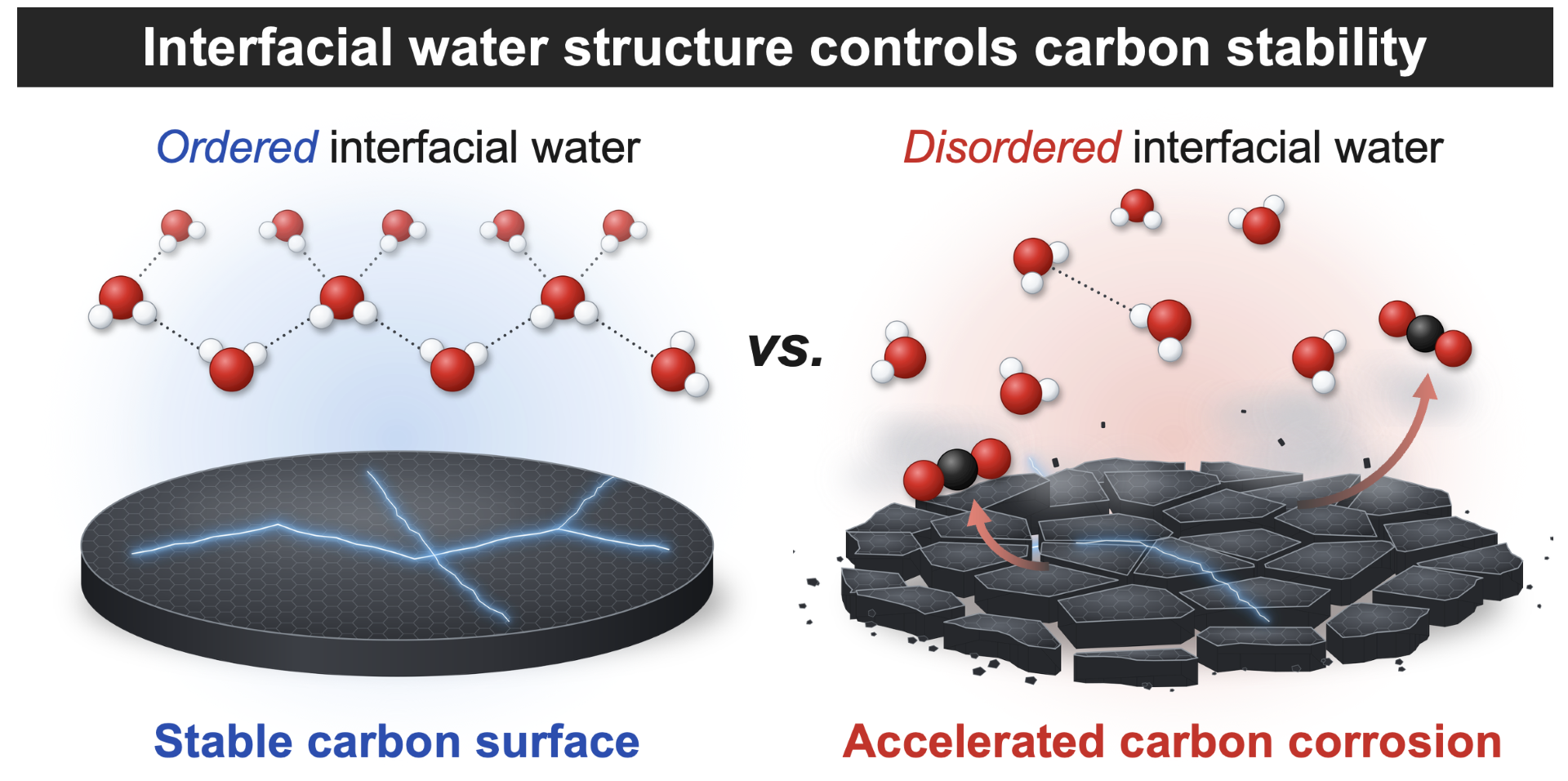

Researchers at the University of Osaka and their collaborators found that the structure of water directly next to carbon electrodes strongly affects their durability. Carbon corrosion accelerated when the network connecting water molecules became disrupted. By controlling this interfacial water with ion-conducting polymer coatings, the team suppressed corrosion while maintaining catalytic activity. The findings offer a new design strategy for longer-lasting carbon electrodes in water electrolysis, chlorine production, fuel cells, and other electrochemical technologies.
Fig. 1
Interfacial water structure regulates the stability of carbon electrodes. When interfacial water molecules form an ordered, strongly hydrogen-bonded network, the carbon surface remains stable (left). When the network is disrupted, carbon corrosion (oxidation of carbon to CO2) is accelerated (right).
Original content, Credit must be given to the creator., 2026 Cho et al., Interfacial Water-Networks Regulate the Anodic Stability of Carbon Electrodes, Angewandte Chemie International Edition
International research team reveals how the structure of water at electrode surfaces regulates carbon corrosion, opening a new route to more durable electrochemical devices
Osaka, Japan – Carbon is inexpensive, conductive, and widely used in technologies such as fuel cells and water electrolyzers. But under strongly oxidizing conditions, carbon electrodes gradually corrode. Researchers at the University of Osaka and their international collaborators have now found that the arrangement of water molecules directly next to the electrode plays a key role in this degradation, suggesting a new way to improve durability.
By monitoring both carbon corrosion and interfacial water during operation, the researchers found that corrosion accelerated as the network connecting nearby water molecules became more disrupted. Weakly connected water appeared to be preferentially involved in the oxidation of carbon to carbon dioxide, and deliberately disturbing the network further increased corrosion.
Rather than modifying the carbon itself, the team then changed its immediate environment. They used different ion-conducting polymers, known as ionomers, to reorganize water at the electrode surface. Sustainion created a more strongly connected water network than the commonly used Nafion and reduced carbon corrosion by about 51%.
The researchers next tested the concept in a chlorine-producing system using a carbon-supported platinum catalyst. Although Sustainion improved durability, it initially reduced catalytic activity. By combining Sustainion with Nafion, the team retained high initial activity while limiting performance loss to 19% after 500 cycles.
“Electrodes are often considered the main players in electrochemical reactions, but the water immediately surrounding them is also important,” says Dr. Yu Katayama, one of the corresponding authors at the University of Osaka. “Our results show that designing the environment around an electrode, not only the electrode material itself, could help improve its durability.”
The findings highlight control of interfacial water as a promising design principle for carbon electrodes and could contribute to longer-lasting electrochemical technologies, including green hydrogen production, chlorine manufacturing, and fuel cells.
###
The article, “Interfacial Water-Networks Regulate the Anodic Stability of Carbon Electrodes,” was published in Angewandte Chemie International Edition at DOI: https://doi.org/10.1002/anie.8140389
About The University of Osaka
The University of Osaka was founded in 1931 as one of the seven imperial universities of Japan and is now one of Japan's leading comprehensive universities with a broad disciplinary spectrum. This strength is coupled with a singular drive for innovation that extends throughout the scientific process, from fundamental research to the creation of applied technology with positive economic impacts. Its commitment to innovation has been recognized in Japan and around the world. Now, The University of Osaka is leveraging its role as a Designated National University Corporation selected by the Ministry of Education, Culture, Sports, Science and Technology to contribute to innovation for human welfare, sustainable development of society, and social transformation.
Website: https://resou.osaka-u.ac.jp/en
Advertisement