
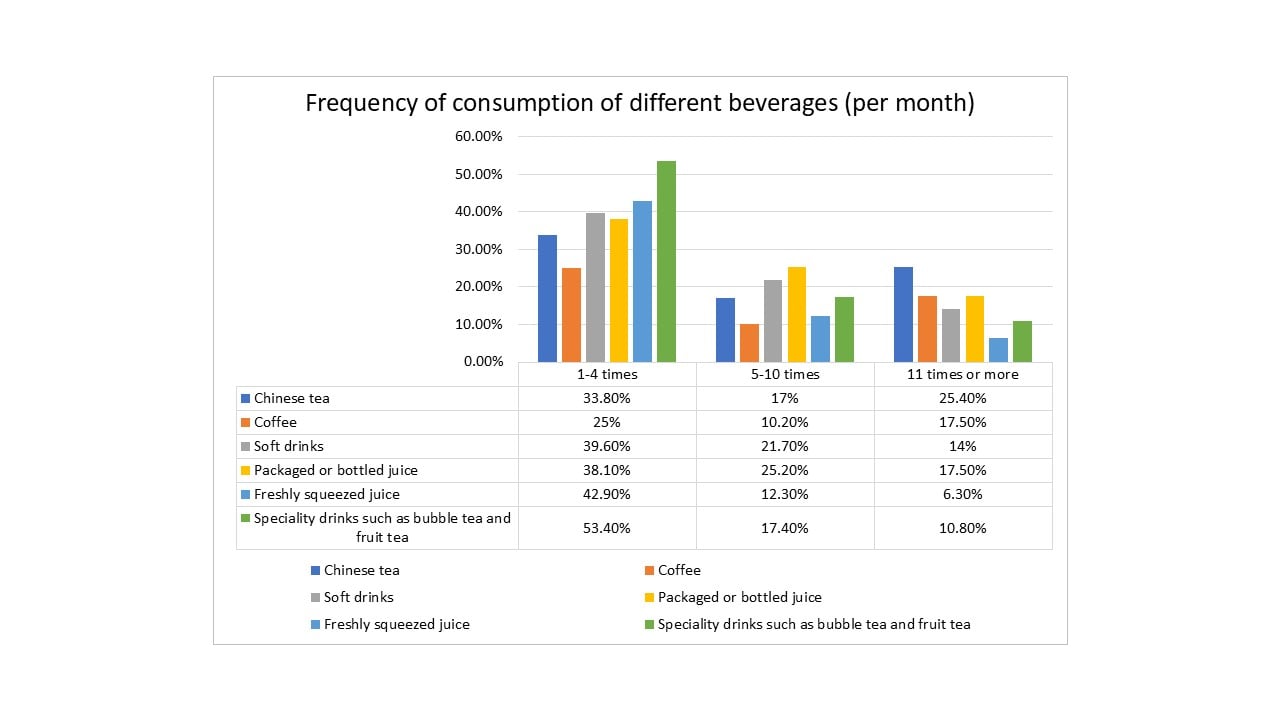
The largest proportion of young respondents reported drinking Chinese tea one to four times a month (33.8%). For more than a quarter (25.4%) of those who drank Chinese tea more than 11 times per month, the proportion was the highest of all beverage categories.
Between March and July 2025, the researchers circulated a questionnaire to 488 Hong Kong SAR residents aged between 12 and 39 to find out how much they know about Chinese tea and related beverages and how much they drink. More than three quarters (76.2%) of respondents drink Chinese tea regularly, and the largest proportion (33.8%) drink Chinese tea one to four times a month Although this was a higher proportion than for coffee (25%), it remained lower than for other beverages. As many as 53.4 per cent of respondents consume speciality drinks such as bubble tea and fruit tea one to four times per month, followed by freshly squeezed juice (42.9%), soft drinks (39.6%), and packaged or bottled juice (38.1%).
The proportion of respondents who drank Chinese tea 11 or more times a month was 25.4 per cent, the highest of all beverage categories, surpassing coffee (17.5%), packaged or bottled juice (17.5%), soft drinks (14%), speciality drinks (10.8%), and freshly squeezed juice (6.3%), which suggests that some young people have developed a regular habit of drinking tea in the long-term.
Regarding their preferences, young respondents usually preferred pu-erh (65%), followed by tieguanyin (49%) and jasmine tea (31%). However, nearly half of respondents (49%) also drink flavoured teas containing sugar, floral flavours or milk frequently, reflecting increasingly blurred boundaries between traditional and modern teas in younger generations.
When asked whose opinions influenced their choice of tea, 39.7 per cent of respondents said that their parents had a “great” or “strong” influence. By comparison, the influence of their friends (11.4%) and social media (11%) was much less, which shows the stronger role of families in passing on the Chinese tea culture to younger generations.
The most common reasons for choosing a tea were the “aroma” (55%) or “taste” (50%). Nearly half (47%) also cited “family customs” - more than those who associated Chinese tea with “health benefits” (37%), “cultural identity” (19%), or “emotional stability” (17%).
However, young people who drink tea have a limited understanding of its health benefits. More than one third of respondents (34.1%) said that they “knew nothing about” or had “only heard of” these benefits of tea, and nearly half (44.2%) that they “knew nothing about” or had “only heard of” Chinese tea brewing techniques. The study also found that nearly 70% of respondents (68.1%) expressed “average”, “considerable”, or “very strong” interest in learning tea arts, which shows that although the Hong Kong younger generation’s knowledge of Chinese teas is limited, they are generally interested in learning more.
Prof Dickson Chan Chak-Kwan, Research Professor and Director of Asia-Pacific Institute of Ageing Studies at Lingnan University, said that traditional Chinese tea processing techniques and associated social practices were inscribed on the United Nations Educational Scientific and Cultural Organisation (UNESCO) Representative List of the Intangible Cultural Heritage of Humanity in 2022. He noted that while the Chinese Mainland has actively promoted tea culture education for young people, the Hong Kong SAR still does not really understand the health benefits of tea or how to brew it, adding “Promoting tea culture helps pass on the essence of Chinese culture to younger generations. The study finds that parents have a great influence on forming the habit of tea drinking in their children, and recommends that primary and secondary schools and cultural organisations undertake activities that encourage parents and children to learn about Chinese tea together, so that tea drinking is encouraged and the cultural heritage of Chinese tea more effectively passed on to young people.”
Prof Chan also suggested that the education sector make the most of young people’s interest in the tea arts to develop their understanding of Chinese tea culture. Flavoured teas may initially build public awareness of the differences between pure and sugar-sweetened flavoured teas, reduce dependency on sugary beverages, and in the long run help promote a healthier diet.
"Research on Tea Consumption among Youth in Hong Kong" is part of the "Chinese Tea Promotion in Young People " Project (2024-2026). The project is sponsored by the Tin Ka Ping Foundation and aims to promote Chinese tea arts among young people and the public in Hong Kong through seminars and tea appreciation workshops, to encourage the understanding of Chinese traditional culture and promote physical and mental well-being.