
Charging and discharging processes of anode-free sodium batteries. During charging, sodium (Na) metal is deposited on the aluminium (Al) current collector, and during discharging, sodium returns to the cathode.
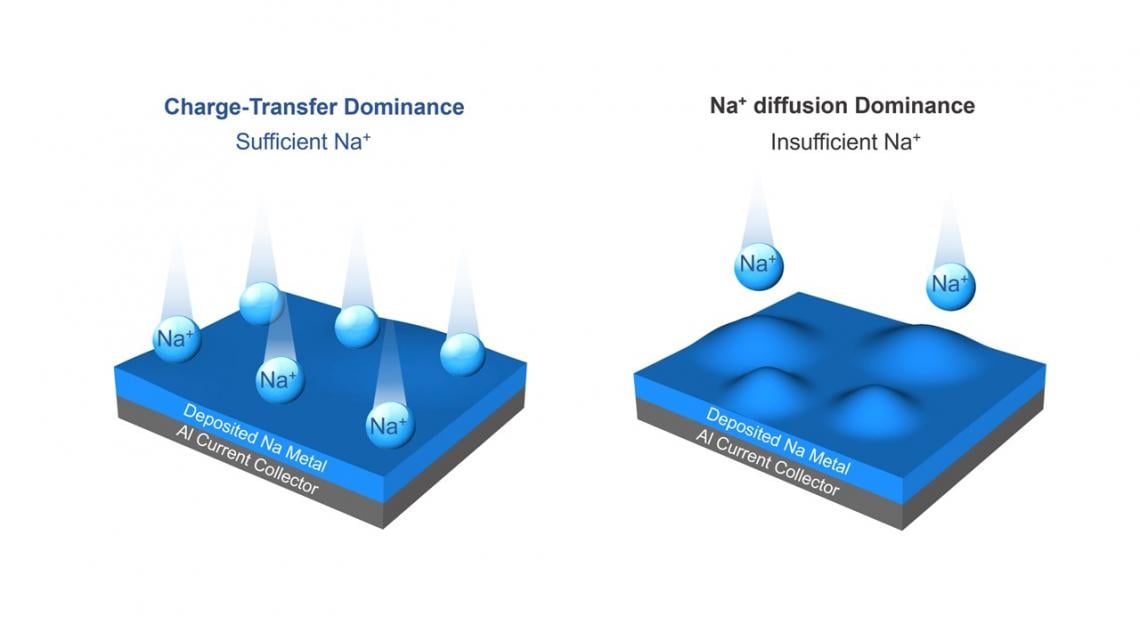
Sodium deposition under conditions dominated by charge transfer and sodium-ion diffusion. Under charge-transfer-dominated conditions with sufficient Na+ supply, sodium metal deposits uniformly on the Al current collector. Under diffusion-dominated conditions, where the Na+ supply is insufficient, sodium metal deposits non-uniformly, leading to short circuits.
In recent years, the academic sector has actively explored anode-free sodium batteries (also known as reservoir-free sodium batteries) as a potential alternative to lithium batteries. A major barrier to commercialisation, however, has been the inherent softness of sodium, an alkali metal that makes these batteries prone to short circuits and rapid capacity loss under fast-charging conditions.
The joint research team from Lingnan University, Tsinghua University, and the Beijing Institute of Technology identified the critical step governing the stability of sodium batteries: the kinetics of sodium ion deposition. By increasing the electrolyte salt concentration appropriately, the team successfully shifted the deposition process from a diffusion-controlled mode to a charge-transfer-controlled mode, which minimises the risks of short circuits, thereby improving battery stability and lifespan. Additionally, since the fully discharged anode-free sodium battery contains no metallic sodium, production and transportation are safer.
Laboratory experiments confirm that increasing the electrolyte salt concentration ensures a better supply of sodium ions and enables smoother deposition. The critical current density for sodium deposition was enhanced to over 20 mA cm⁻², and the batteries demonstrated a fast-charging capability of 10C, completing charging within minutes, much faster than the typical 1C to 2C charging rate of commercial lithium-ion batteries. Moreover, the cells maintained over 70 per cent of capacity after 500 charge–discharge cycles.
The research team noted that this breakthrough provides valuable insights into the design of safe and stable anode-free sodium batteries, laying the groundwork for future applications. They hope to extend their findings beyond laboratory-scale prototypes to larger applications in electric vehicles, renewable energy storage such as wind and solar power, and consumer electronics.
Prof Li Liangliang, Associate Professor of the School of Interdisciplinary Studies at Lingnan University and co-corresponding author of the research paper, explained “Global society relies heavily on electric vehicles and electronics, yet lithium resources are limited, costly, and unevenly distributed, with extraction processes that damage land and water. Our new anode-free sodium battery replaces lithium with sodium, a more abundant and affordable resource. Sodium costs less than a tenth of lithium, is plentiful in seawater, and can significantly reduce the price of electric vehicles and energy storage systems. Its extraction is also simpler, more sustainable, and less environmentally damaging for the green economy.”
Prof Li Liangliang also pointed out that the research aligns with Hong Kong’s carbon neutrality and electric mobility goals, and that “This study responds to urgent global and local needs in energy transition. The technology has the potential to support greener and more affordable mobility solutions, while reducing dependence on imported lithium.”
Lingnan University has in recent years conducted interdisciplinary research and innovation projects addressing global challenges such as climate change and the clean energy transition. This collaborative research, combining expertise in materials science, chemical engineering, and mechanical engineering, also follows United Nations’ Sustainable Development Goals on “Affordable and Clean Energy” (SDG 7) and “Climate Action” (SDG 13).

Prof Li Liangliang, Associate Professor of the School of Interdisciplinary Studies at Lingnan University and co-corresponding author of the research paper.
Advertisement