
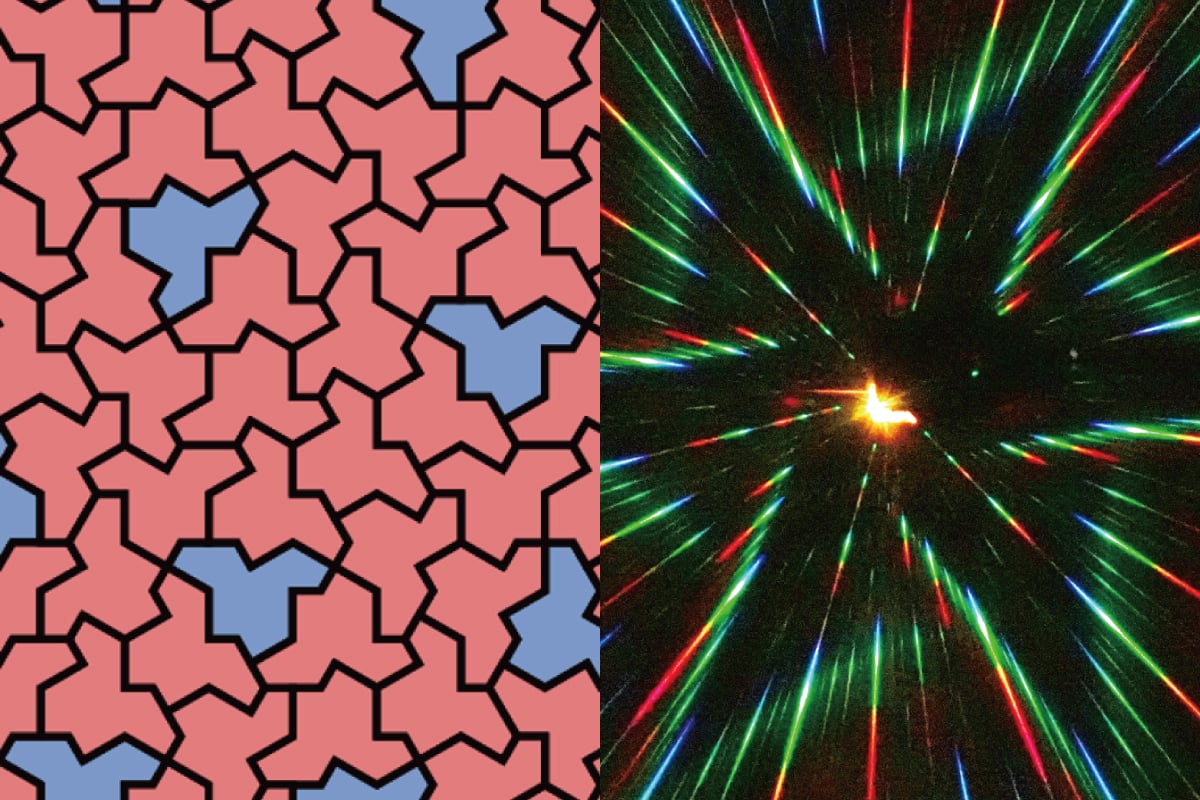

Researchers from the Institute of Industrial Science, The University of Tokyo experimentally demonstrate unique optical behavior from a long-sought aperiodic pattern
Tokyo, Japan – A shape that captured worldwide attention for solving a decades-old mathematical puzzle has now returned to the spotlight. While the shape’s properties allowed it to solve previous puzzles, there is still little information regarding the other associated properties, creating the opportunity for further discovery. These unexplored properties may also help solve new physics mysteries, such as how to twist light into striking chiral patterns.
In an article recently published in Nature Communications, researchers from the Institute of Industrial Science, The University of Tokyo and collaborating institutions created optical structures based on the “Smith hat,” an unusual shape that solves the so-called Einstein problem in mathematics. By shining laser light onto these structures, the team discovered diffraction behaviors never before observed in conventional quasicrystals.
The long-standing Einstein problem asks whether a single tile shape or “monotile” can be used to cover an entire surface in a non-repeating pattern. While periodic tilings such as honeycombs or checkerboards repeat regularly, an aperiodic monotile can cover all of space without ever producing a repeating arrangement. In 2023, the first such monotile, the Smith hat, was discovered, sparking widespread interest in the scientific community.
“What is especially fascinating about the hat tile is that, although the resulting pattern appears irregular at first glance, it is actually constructed from the honeycomb lattice,” says lead author Yuto Moritake. “We wanted to see whether this unique shape could also produce any unexpected physical phenomena.”
To explore these phenomena experimentally, the researchers fabricated nanoscale patterns on silicon nitride films using electron-beam lithography. When laser light illuminated the structures, the team observed distinctive pinwheel-like patterns, directly revealing the chiral nature of the aperiodic structure.
“We found that the diffraction patterns themselves become chiral because the structure lacks mirror symmetry,” explains senior author Masaya Notomi. “This kind of optical response is fundamentally different from that observed in conventional quasicrystalline materials.”
The experiments also showed that the diffraction pattern changes depending on the direction and polarization of the incoming light. Structures mirrored in real space produced corresponding reversals in optical behavior, demonstrating a new form of symmetry-controlled optical response.
“These results open a new direction of research on the fusion of quasiperiodic order and chirality,” remarks Moritake. “Monotile patterns provide a platform for exploring optical phenomena that emerge from the interplay of symmetry, chirality, and aperiodicity.”
The team hopes that monotile-inspired structures will contribute to technologies involving light manipulation, polarization control, and advanced optical devices. More broadly, the team’s findings are a shining example of how an abstract mathematical discovery can unexpectedly lead to entirely new physical phenomena.
###
The article, “Chiral Diffraction from Aperiodic Monotile Structure,” was published in Nature Communications at 10.1038/s41467-026-75023-7.
About Institute of Industrial Science, The University of Tokyo
The Institute of Industrial Science, The University of Tokyo (UTokyo-IIS) is one of the largest university-attached research institutes in Japan. UTokyo-IIS is comprised of over 120 research laboratories—each headed by a faculty member—and has over 1,200 members (approximately 400 staff and 800 students) actively engaged in education and research. Its activities cover almost all areas of engineering. Since its foundation in 1949, UTokyo-IIS has worked to bridge the huge gaps that exist between academic disciplines and real-world applications.
Advertisement