

Researchers at the University of Osaka developed chiral hole-transport materials that selectively conduct electrons according to spin. Across three classes of materials, molecular handedness consistently determined the direction of spin polarization. The homochiral material also showed nearly threefold higher hole mobility and improved charge extraction and surface passivation in perovskite solar cells, highlighting new possibilities for controlling spin, charge transport, and interfaces through molecular design.
Fig. 1
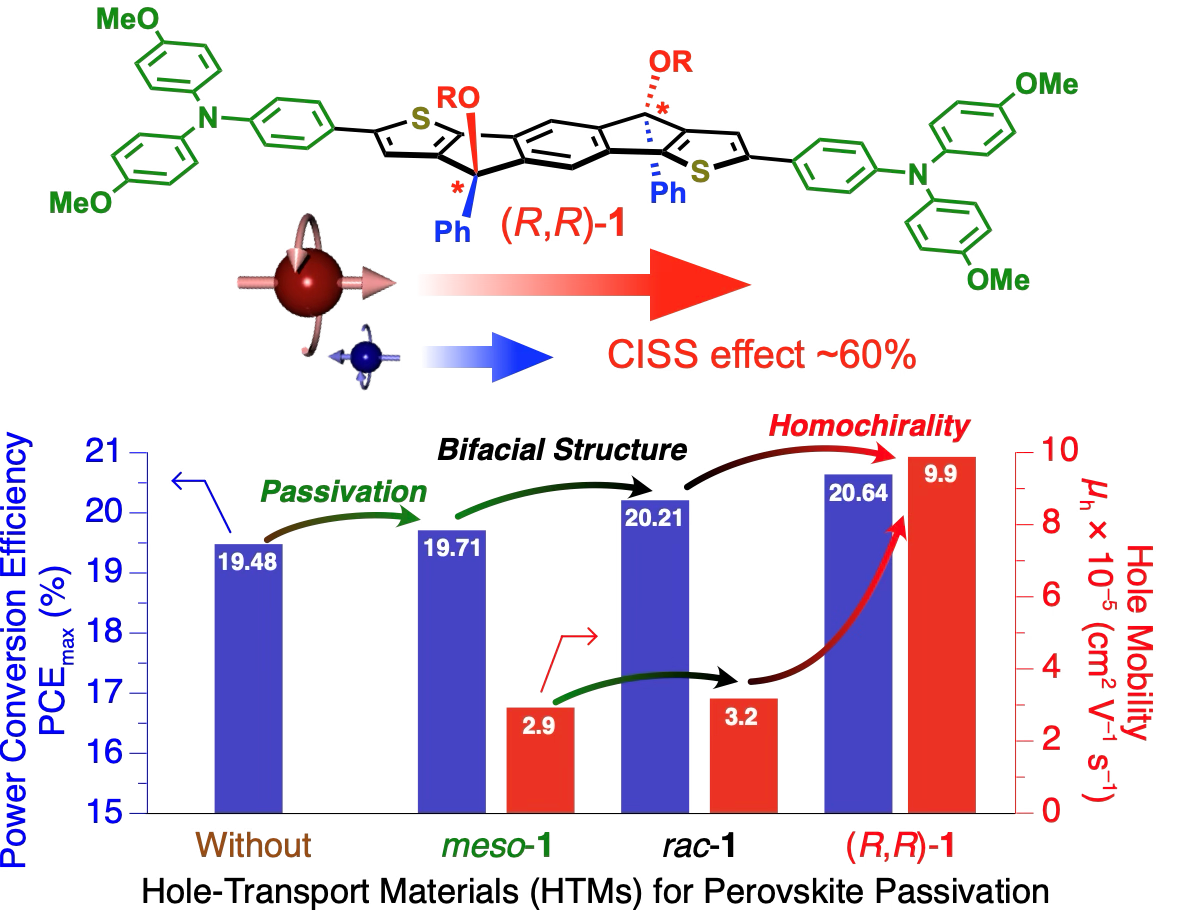
Overview of the chiral bifacial IDT-based hole-transport materials (HTMs). Chemical structures, CISS characteristics, hole mobilities, and power conversion efficiencies of perovskite solar cells incorporating the developed HTMs.
Original content, No restrictions., Fumitaka Ishiwari - All Rights Reserved
Researchers at the University of Osaka reveal a consistent link between molecular handedness and electron spin, boosting charge transport and solar cell performance
Osaka, Japan – Just as left and right hands are mirror images, some molecules come in two “handed” forms. This property, called chirality, can influence not only how molecules interact with light but also which electron spins they allow to pass. Researchers at the University of Osaka have developed novel chiral hole-transport materials that shed new light on this unusual effect while also improving the interfaces of perovskite solar cells.
The team built the materials around a chiral “bifacial” indacenodithiophene (IDT) structure, whose two faces carry different chemical groups. Thin films made from the two mirror-image forms showed strong chirality-induced spin selectivity, or CISS, with spin polarization reaching about 60%.
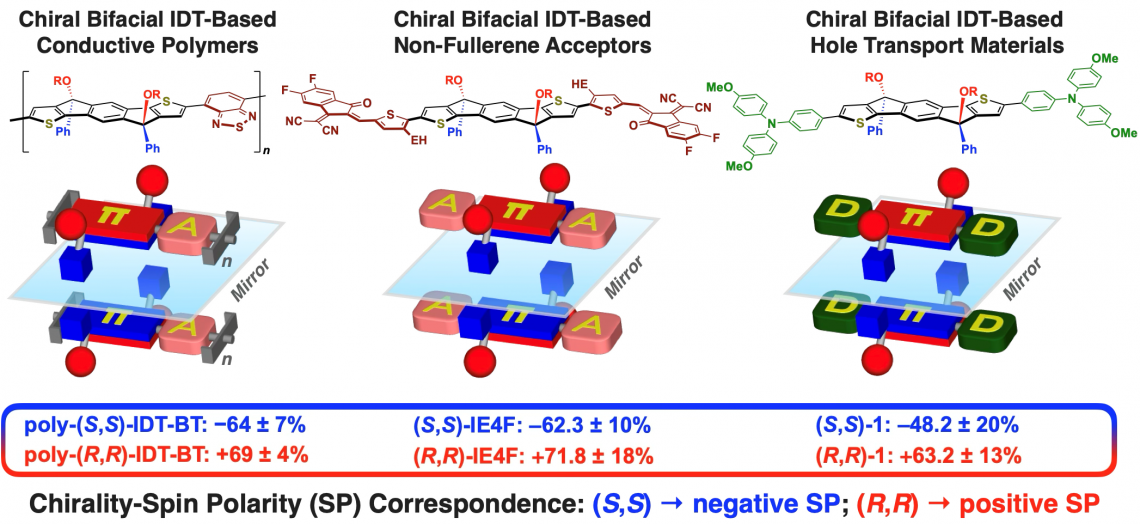
Most strikingly, molecular handedness consistently determined spin preference. The (S,S) form favored negative spin polarization, whereas the mirror-image (R,R) form favored positive polarization. The researchers found the same relationship in two classes of materials they had previously developed – conductive polymers and non-fullerene acceptors—providing a common pattern across three different types of organic electronic materials.
The molecules also produced an unexpected result. The homochiral (R,R) material transported positively charged “holes” nearly three times faster than the racemic and non-chiral counterparts. Whether this improvement is caused directly by CISS remains unclear, but the finding points to an intriguing connection between molecular handedness and charge transport.
When added as an ultrathin layer to perovskite solar cells, the new molecules helped suppress surface defects and promote hole extraction. Cells treated with the homochiral material reached a power conversion efficiency of 20.64%, compared with 19.48% for untreated control devices.
“We are excited to see a consistent relationship between molecular structure and spin preference across three different material classes,” says senior author Fumitaka Ishiwari. “The unexpected increase in hole mobility also raises new questions that we hope to answer.”
###
The article, “Chiral Bifacial Indacenodithiophene-Based Hole-Transport Materials with Chirality-Induced Spin Selectivity: Chirality-Spin Polarity Correspondence and Perovskite Passivation,” was published in Small on August 8, 2026 at DOI: https://doi.org/10.1002/smll.75074
Fig. 2
Relationship between asymmetric structure and the polarity of spin selectivity. All three chiral bifacial IDT-based material classes investigated by our group exhibited the CISS effect, with the (S,S) derivatives showing negative spin polarization and the (R,R) derivatives showing positive spin polarization.
Original content, No restrictions., Fumitaka Ishiwari - All Rights Reserved
About The University of Osaka
The University of Osaka was founded in 1931 as one of the seven imperial universities of Japan and is now one of Japan's leading comprehensive universities with a broad disciplinary spectrum. This strength is coupled with a singular drive for innovation that extends throughout the scientific process, from fundamental research to the creation of applied technology with positive economic impacts. Its commitment to innovation has been recognized in Japan and around the world. Now, The University of Osaka is leveraging its role as a Designated National University Corporation selected by the Ministry of Education, Culture, Sports, Science and Technology to contribute to innovation for human welfare, sustainable development of society, and social transformation.
Website: https://resou.osaka-u.ac.jp/en
Advertisement