
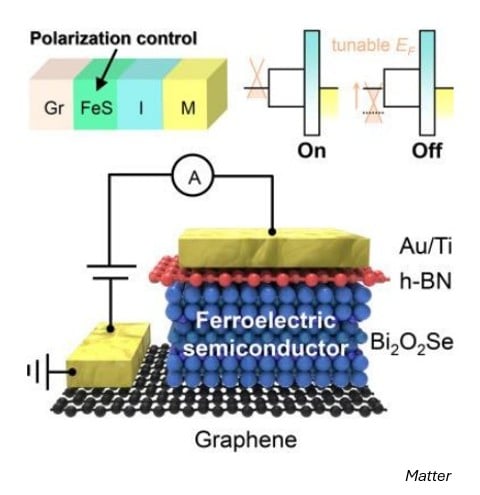

Based on the layered design to decouple polarization, tunneling, and screening for the functionality of each constituent material, it is possible to overcome the drawback of conventional ferroelectric tunneling memories and reach low-power consumption and high on/off ratio.
A van der Waals ferroelectric-semiconductor tunneling memory that separates the material roles: Bi₂O₂Se supplies switchable polarization, hexagonal boron nitride provides a low-leakage tunneling barrier, and graphene acts as a low-density-of-states electrode that preserves incomplete screening.
Matter
The rapid expansion of artificial intelligence and data-centric computing has exposed fundamental limitations of conventional von Neumann architectures, where frequent data transfer between logic and memory units leads to severe energy inefficiency and latency bottlenecks. Non-volatile memory concepts that enable direct modulation of charge transport, particularly ferroelectric tunneling junctions (FTJs), have attracted growing attention as potential building blocks for energy-efficient memory and neuromorphic hardware.
In FTJs, switchable ferroelectric polarization modulates the tunneling barrier, enabling non-destructive readout and low-power operation within a compact two-terminal geometry. Despite substantial progress, the practical scalability of FTJs remains fundamentally constrained by an intrinsic electrostatic dilemma.
Reducing the ferroelectric barrier thickness is essential to enhance tunneling electroresistance (TER) and lower the operating voltage, yet ultrathin ferroelectric insulators inevitably suffer from excessive leakage currents, defect-assisted transport, and incomplete electrostatic screening. Conversely, increasing the barrier thickness suppresses leakage but also weakens polarization-induced barrier modulation, resulting in limited TER and poor signal resolution. This trade-off has persisted across a wide range of material systems and device architectures, suggesting that the limitation is not merely material dependent but rooted in the electrostatic design principles of conventional FTJs.
In an article recently published in Matter, researchers from Department of Physics, National Taiwan University and collaborating institutions identified an electrostatic regime in a van der Waals heterostructure that is enabled by a low-density-of-states electrode and overcomes this trade-off by decoupling polarization control, tunneling modulation, and charge screening.
Using a ferroelectric-semiconductor tunneling memory based on Bi₂O₂Se, hexagonal boron nitride, and graphene, they achieve ultralow leakage and extremely high electroresistance on/off ratio. Low-bias readout is dominated by polarization-modulated tunneling, while higher bias programming may involve additional field-assisted carrier redistribution. Systematic variation of graphene thickness reveals an exponential decay of electroresistance governed by charge screening.
“These results establish a new design rule for low-power consumption memory based on van der Waals ferroelectric tunneling heterostructures,” remarks co-corresponding author Prof. Yang-Fang Chen of Department of Physics at National Taiwan University.
Additionally, the team anticipates that the implemented semiconductor ferroelectric material possesses a great potential for the development of optically/electrically encodable/readable memories, which should be very useful and timely to attract both scientific and industrial interests.
Prof. Yang-Fang Chen’s email address: [email protected]
Advertisement
Advertisement