
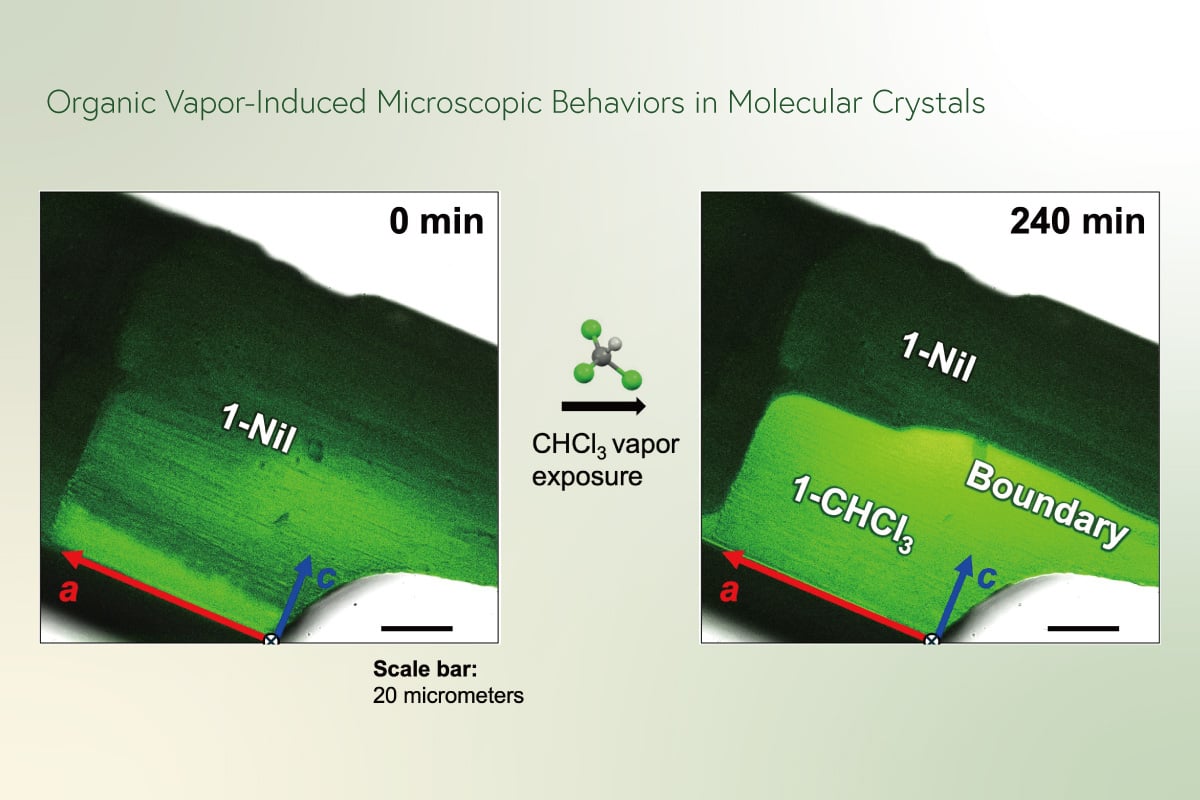

A study from the Institute of Industrial Science, The University of Tokyo used special instruments to investigate how crystals smaller than a strand of hair change and move as they draw in chloroform vapor
Tokyo, Japan – Many of the common materials we encounter in our daily lives are crystalline, including ice, salt and sugar. The crystal structures of some solids are formed from molecules in simple geometric patterns, and these patterns can be changed to provide the solids with special properties required for high-tech applications. However, changing these connections requires extreme measures, such as high heat, leaving researchers with the challenge of finding an easier transformation method.
Newer so-called “soft crystals” can be modified more easily. Now, researchers from the Institute of Industrial Science, The University of Tokyo and the Graduate School of Science, University of Hyogo have used sophisticated instruments to learn much more about these unusual materials, with some interesting results. The findings are set to be published in Small.
Modifying a solid, otherwise known as a phase transition, is complicated and difficult to observe. Despite these difficulties, researchers have continually attempted to learn more about phase transitions and improve research techniques. This is particularly relevant as certain substances have specialized and important applications in electronics and other technologies based on unique molecular connections.
In the study, the researchers studied extremely small crystals of a rhenium complex molecule. The crystals of various sizes are measured with micrometer resolution, where a micrometer is one millionth of a meter - making them thinner than the width of a single hair. These compounds were exposed to vapors of the liquid solvent chloroform and observed using an extremely powerful laser microscope and X-ray diffraction, a technique that shows molecular patterns.
“We were able to see drastic changes in these crystals as they absorbed the chloroform,” says lead author, Xiao Ma. “As chloroform migrated into the samples, areas made of more than 10,000 molecules moved cooperatively. This movement produced a phase transition changing the structure of the crystal.” (https://youtube.com/shorts/Wms2R6U9FSs)
Examination of crystals as small as one micrometer showed other interesting behaviors as the chloroform soaked into the sample.
“Some samples showed deliquescence,” explains senior author, Kazuyuki Ishii, “meaning that the crystal absorbed so much chloroform that parts of it dissolved.” (https://youtube.com/shorts/bqfFg3r4TP8)
Another novel observation highlighted that some crystals moved as they absorbed chloroform because of changes in volume and recrystallization. Other important insights into these crystal changes were also obtained and detailed theoretical evaluations were performed.
The findings can provide useful insight into the fundamental behaviors of crystals as they take in vapor. This knowledge could lead to the development of advanced devices, such as sensors for volatile organic compounds, an important class of pollutants. The research also demonstrated potential applications, with a quick and simple approach to fine-tuning the crystals that might someday power our high-tech gadgets.
##
The article, “Organic Vapor-Induced Microscopic Behaviors in Molecular Crystals,” was published in Small at DOI: 10.1002/smll.75743.
About Institute of Industrial Sciene, The University of Tokyo
The Institute of Industrial Science, The University of Tokyo (UTokyo-IIS) is one of the largest university-attached research institutes in Japan. UTokyo-IIS is comprised of over 120 research laboratories—each headed by a faculty member—and has over 1,200 members (approximately 400 staff and 800 students) actively engaged in education and research. Its activities cover almost all areas of engineering. Since its foundation in 1949, UTokyo-IIS has worked to bridge the huge gaps that exist between academic disciplines and real-world applications.
Advertisement
Advertisement