

Researchers developed a terbium-doped aluminum gallium nitride LED that produces blue, green, yellow, and red light from the same area at room temperature. The emission wavelengths remained highly stable as the current changed. Increasing the aluminum content improved energy transfer and efficiency, while using an aluminum nitride base layer enhanced crystal quality and device performance. With further improvements, this approach could simplify the production of full-color micro-LED displays and contribute to compact displays, wearable devices, and white-light sources.
Fig. 1
A schematic of a Tb-doped AlGaN light emitting diode resulting in blue/green/yellow/red luminescences. This graphic was created with the assistance of artificial intelligence. If cross-posting or sharing, please retain this disclosure tag.
Original content, Credit must be given to the creator. No derivatives or adaptations of the work are permitted., Shuhei Ichikawa
A research team in Japan developed a terbium-doped AlGaN LED that emits blue, green, yellow, and red light from the same area, with no detectable wavelength shift as the drive current changes
Osaka, Japan - Full-color displays normally require separate red, green, and blue light emitters. A team from the University of Osaka and Ritsumeikan University has demonstrated another approach, a single light-emitting layer that produces several colors when electrically powered at room temperature. The study was published in Applied Physics Letters.
Micro-LED displays promise high brightness, energy efficiency, and resolution. However, conventional green and red nitride LEDs can show changes in color as the current increases. Producing several colors also generally requires multiple light-emitting layers or separately manufactured chips, making it difficult to place many pixels into a very small area.
The team used a manufacturing method already widely employed for nitride LEDs to create aluminum gallium nitride LEDs containing terbium ions.
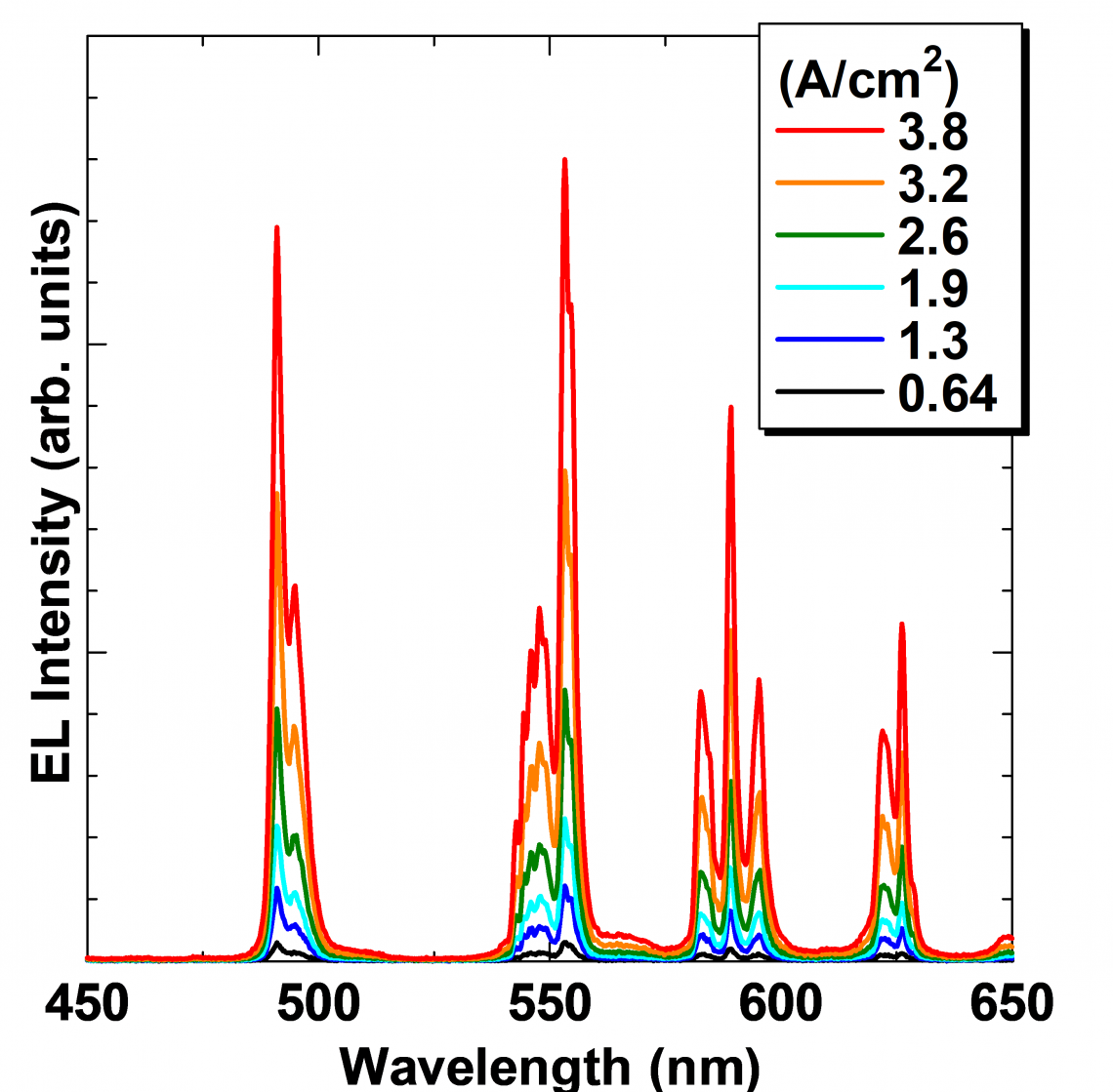
These ions produced blue, green, yellow, and red light from the same light-emitting area. When the researchers changed the current, no shift in the emission peaks could be detected within the measuring instrument’s resolution of 0.6 nanometers.
Increasing the amount of aluminum helped energy move more efficiently from the semiconductor material to the terbium ions. As a result, the external quantum efficiency increased by up to 10.3 times compared with the device containing the lowest amount of aluminum tested in the study.
The researchers also improved the crystal quality and device performance by growing the LEDs on an aluminum nitride base layer, which provided a better match with the light-emitting material and reduced defects. Using color filters, the team was able to obtain red, green, and blue light separately from the same light-emitting area.
This single-layer approach could make it easier to integrate several colors into one micro-LED device and reduce the need to assemble separately manufactured red, green, and blue chips.
The technology is still at an early stage, and further improvements in efficiency and control of the brightness of each color will be needed. In the future, it could contribute to compact, high-resolution displays for smart glasses, wearable devices, and other applications, as well as new white-light sources.
“We demonstrated multiple colors from one light-emitting layer, together with exceptional stability as the current changed,” said senior author Shuhei Ichikawa. “Our next goal is to improve the efficiency and control the intensity of each color.”
###
The article, “Ultra-stable multiple emission wavelengths produced by Tb-doped AlxGa1-xN-based light-emitting diodes,” was published in Applied Physics Letters DOI: https://doi.org/10.1063/5.0331734
About The University of Osaka
The University of Osaka was founded in 1931 as one of the seven imperial universities of Japan and is now one of Japan's leading comprehensive universities with a broad disciplinary spectrum. This strength is coupled with a singular drive for innovation that extends throughout the scientific process, from fundamental research to the creation of applied technology with positive economic impacts. Its commitment to innovation has been recognized in Japan and around the world. Now, The University of Osaka is leveraging its role as a Designated National University Corporation selected by the Ministry of Education, Culture, Sports, Science and Technology to contribute to innovation for human welfare, sustainable development of society, and social transformation.
Website: https://resou.osaka-u.ac.jp/en
Fig. 2
Electroluminescence spectra of Tb-doped AlGaN under various current injection conditions showing ultra-stable multiple emission wavelengths.
Original content, Credit must be given to the creator. No derivatives or adaptations of the work are permitted., Shuhei Ichikawa
Advertisement