
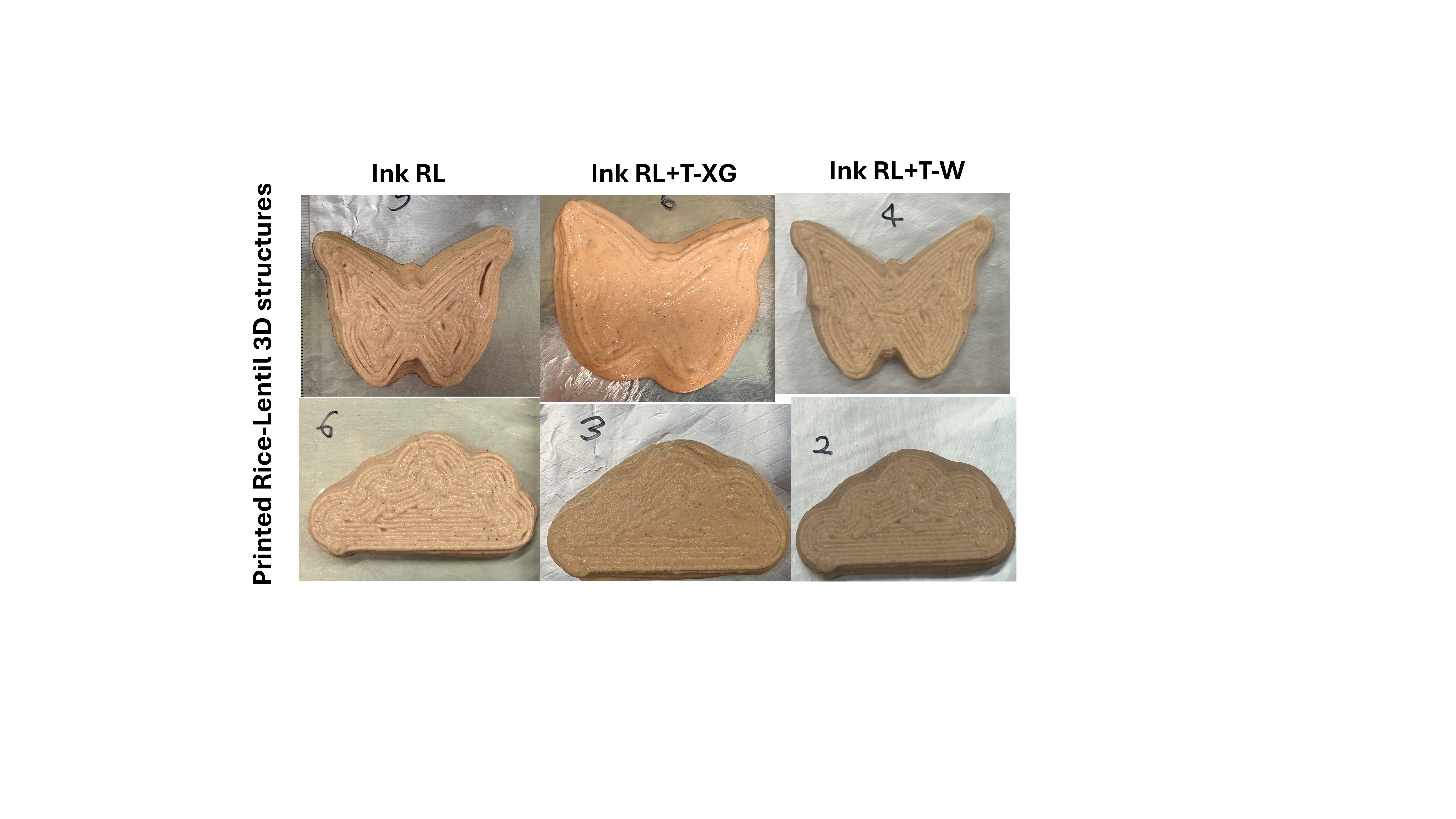
Printed Rice-Lentil 3D structures
Rice and lentils are a pairing that goes a long way back, whether as khichdi in India or mujaddara in the Middle East. On its own, each is a source of incomplete protein, short on certain essential amino acids — but paired together, they fill each other's gaps, and lentils also blunt white rice's high glycaemic index.
Extrusion-based 3D food printing, which builds edible shapes by squeezing paste through a nozzle layer by layer, has mostly used processed cereal-legume ingredients. Refined starches and protein isolates behave predictably in the nozzle, and hydrocolloids such as xanthan gum are often added generously to hold prints together. Producing these, however, costs energy and chemicals, and hydrocolloids in large doses can ruin the taste. Whole flours, by contrast, are unpredictable, as their own proteins, fats, and fibres all push and pull on how a paste flows.
In their paper “3D printing and post-processing of multicomponent rice-lentil based flour blends”, a team of researchers from Singapore University of Technology and Design (SUTD) led by Professor Chua Chee Kai and Associate Professor Tan U-Xuan wanted to know whether white rice and red lentil flours could be used to print and cook well with small additions of wheat flour, tapioca flour, and a trace of xanthan gum.
The motivation was partly personal. “I grew up in a vegetarian household where rice and lentils were staple food choices, well before the term ‘plant-based’ became commonplace,” said SUTD Research Associate Aakanksha Pant, lead author of the study. “Transforming minimally processed flours into visually appealing yet nutritionally balanced 3D shapes was exciting, as it combines food, material science, design, and additive manufacturing.”
The team ground red lentils into flour and blended it with rice flour, oil, seasonings, and water, trialling 11 formulations before retaining three. “Printability was characterised by precision and shape stability,” explained Phoebe Leam Xin Ni, a PhD student at SUTD who is also part of the research team. “Inks with a smooth extrusion profile that produced uniform, well-adhered prints and held their shape for 30 minutes after deposition were classed as successful.”
One ink used rice and lentil flours alone. A second swapped part of the rice for tapioca flour and added xanthan gum at just 0.05 percent by weight. A third combined rice, tapioca, and wheat flours. All three thinned under the shear of the nozzle and thickened again once deposited. The xanthan gum ink retained the most water and was marginally the most reluctant to flow, yet it clumped during printing. The other two inks produced neater butterfly and cloud shapes.
As the flours were raw, every print had to be cooked. The team froze each print overnight at -18 degrees Celsius, then oven-dried, air-fried, steamed, or microwaved it. Freezing turned out to matter as their dimensions barely changed, and frozen prints were easier to handle and held their shape under heat.
“Freezing helped minimise shrinking during subsequent thermal post-processing, reducing structural deformation,” Pant added.
Each method produced a recognisably different food from the same paste. Steaming gave the densest, hardest, and most cohesive prints, with no surface cracks. The dry methods, on the other hand, drove off water and left surface cracks, while the oven and air fryer also browned the prints; microwaving and air-frying puffed them slightly. The wheat-tapioca ink, with starch from three sources, came out harder and chewier than the others. The plain rice-lentil ink handled printing and cooking best.
“Air frying caused moderate puffing without shape disintegration,” Pant said. “It induced desirable surface browning through the Maillard reaction, leading to crust formation and textural enhancement.”
That range echoes traditional cooking, where the same rice-lentil batter is steamed for idli or pan-fried for dosa. Two of the three inks are also gluten-free.