
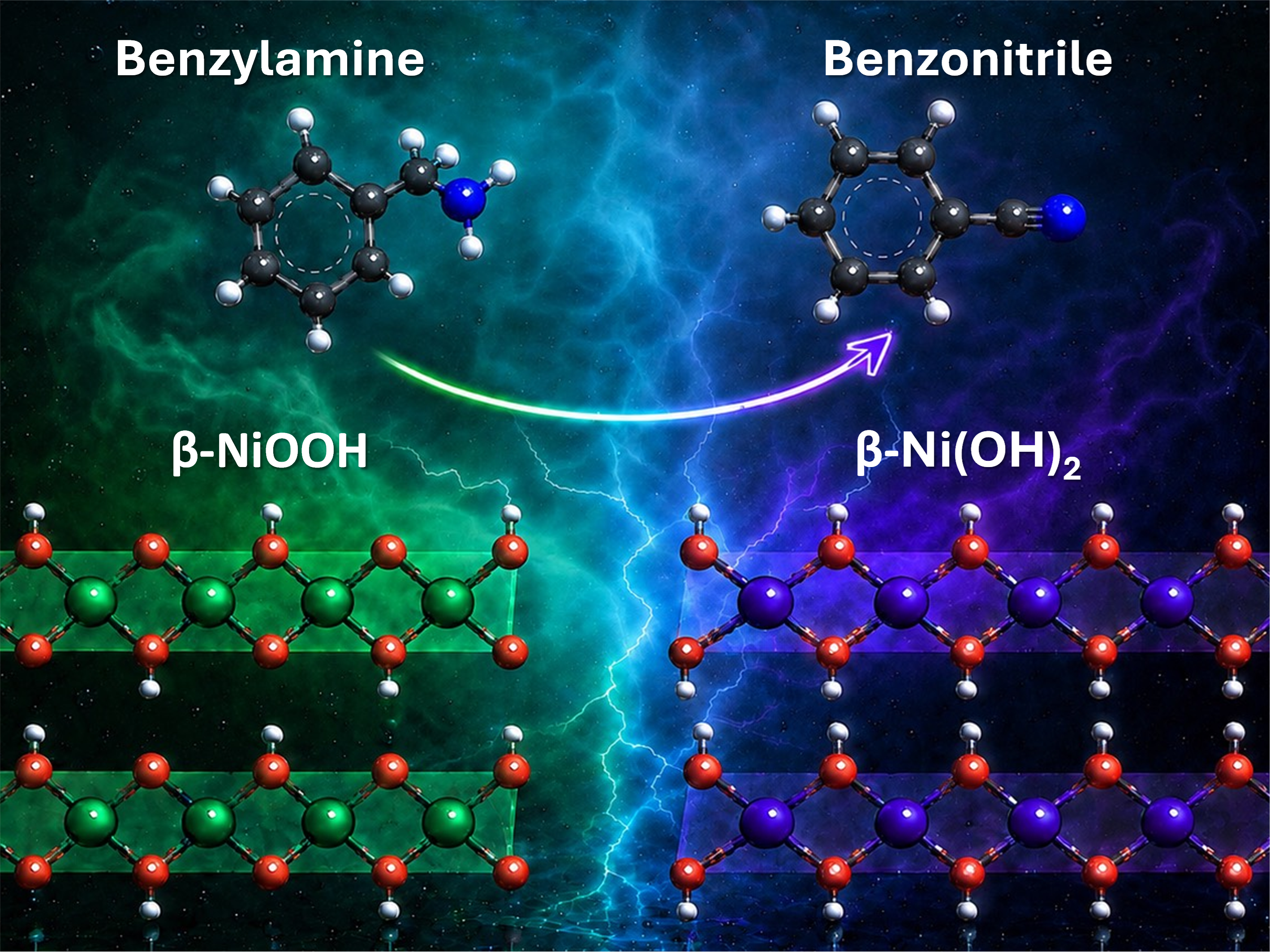

Inspired by pumped-storage hydropower, a nickel-based redox reservoir enables spontaneous nitrile synthesis in organic solvents, while hydrogen gas is produced separately.
Schematic illustration of a NiOOH/Ni(OH)₂ redox reservoir enabling spontaneous benzylamine oxidation in an organic solvent.
National Taiwan University
Nitriles are important chemical building blocks used in pharmaceuticals, agrochemicals, dyes, electronic materials and polymers. However, conventional routes for producing nitriles often require hazardous reagents or harsh reaction conditions, driving the search for cleaner and more controllable synthesis methods.
One promising alternative is an electrochemical method that converts benzylamine into benzonitrile. This reaction can be paired with hydrogen production, enabling the simultaneous generation of a value-added chemical and hydrogen fuel. When powered by renewable electricity, the approach could offer a more sustainable route to chemical manufacturing.
There is, however, a chemical challenge. The conversion of benzylamine to benzonitrile is commonly carried out in strongly alkaline aqueous electrolytes to accelerate the reaction. Under these conditions, benzylimine intermediates and the desired benzonitrile product can react with water and hydroxide ions, gradually forming unwanted products. The problem becomes increasingly serious at higher benzylamine concentrations, making it difficult to translate promising results from dilute laboratory solutions to more practical conditions.
A research team led by Prof. Chih-Jung Chen at National Taiwan University Graduate School of Advanced Technology has developed a way around this limitation by separating nitrile synthesis from hydrogen production. Their study, published in Angewandte Chemie International Edition, uses a NiOOH/Ni(OH)₂ electrode as a rechargeable redox reservoir that temporarily stores and releases oxidizing power.
The concept resembles pumped-storage hydropower. Water can be stored at a higher elevation and released later when energy is needed. In a similar way, the nickel-based reservoir stores oxidative capacity in NiOOH and releases it later to drive chemical conversion. When NiOOH is placed in a benzylamine solution, it spontaneously transforms benzylamine into benzonitrile under open-circuit conditions, without an externally applied electrical bias, while NiOOH itself is reduced to Ni(OH)₂. The reduced reservoir can then be electrochemically recharged to NiOOH, while hydrogen gas is generated at the cathode.
This separation gives the two processes something that conventional coupled electrocatalysis cannot easily provide: the freedom to operate in different environments and at different times. Nitrile synthesis no longer needs to occur in the alkaline aqueous electrolyte. Instead, it can proceed in an organic solvent, avoiding the hydrolysis reactions that degrade benzylimine and benzonitrile.
Among the solvents examined, hexane gave the best performance. The researchers attribute this result to strong interactions between benzylamine and the NiOOH surface, together with minimal self-reduction of NiOOH. High benzonitrile yield, selectivity and Faradaic efficiency were maintained even at benzylamine concentrations above 100 mM. Because the organic reaction does not require supporting electrolyte salts, subsequent product separation is also simplified.
“A redox reservoir works much like a water reservoir,” said corresponding author Prof. Chih-Jung Chen. “Rather than requiring chemical synthesis and hydrogen production to occur simultaneously, we can store oxidative capacity first and use it later. This gives us much greater latitude in choosing the most suitable environment for each process.”
The researchers further showed that the strategy is not limited to benzylamine. Several benzylamine derivatives containing different functional groups could also be converted into their corresponding nitriles, suggesting that the approach could be adapted to produce different chemicals according to demand.
More broadly, the study shows that electrochemically coupled reactions do not necessarily have to take place simultaneously or under identical conditions. By using a rechargeable material as an intermediate reservoir, nitrile synthesis and hydrogen production can be independently optimized, opening a more flexible route toward renewable-electricity-driven chemical manufacturing.
Prof. Chih-Jung Chen's email address: [email protected]
The lab of Prof. Chen linked to https://sites.google.com/view/chihjungchen
Advertisement