


Researchers at National Taiwan University (NTU), a collaboration from the College of Engineering, College of Medicine, and the National Taiwan University Hospital (NTUH), have developed a revolutionary method for producing aerogels, introducing what they describe as the world's first purely gaseous-born aerogel fabrication platform.
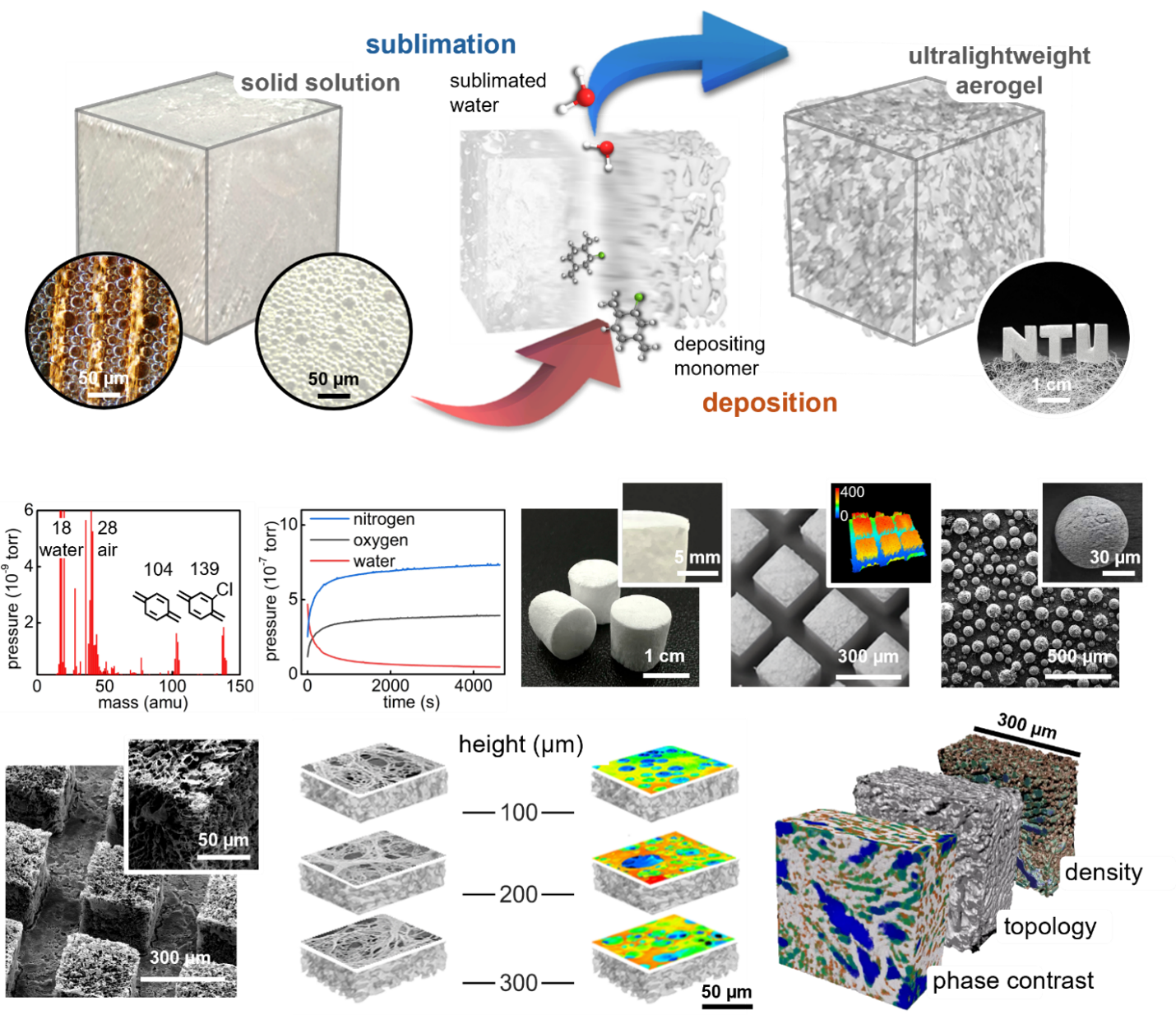
Figure: The process of vapor sublimation and deposition fabrication of the functional aerogels. A variety of geometric shapes can be produced according to the application needs.
Nature Communications
Researchers at National Taiwan University (NTU), a collaboration from the College of Engineering, College of Medicine, and the National Taiwan University Hospital (NTUH), have developed a revolutionary method for producing aerogels, introducing what they describe as the world's first purely gaseous-born aerogel fabrication platform. The study is published in Nature Communications.
Unlike conventional aerogel manufacturing, which depends on liquid-based sol-gel chemistry and complex drying processes, the new technique uses vapor sublimation and deposition polymerization to create ultralight, highly porous materials directly from solid solutions.
The new process transforms frozen solid templates containing microscopic gas bubbles into three-dimensional aerogels under low-pressure conditions. During fabrication, ice sublimates directly into vapor while polymer molecules deposit and assemble into an interconnected porous network. This solvent-free approach is environmentally friendly, generates no harmful byproducts, and enables unprecedented flexibility in material design.
The resulting aerogels exhibit exceptional performance, achieving densities as low as 0.004 g/cm³, porosities of 90–99%, and surface areas exceeding 1,300 m²/g while maintaining strong mechanical stability. These properties position the materials among the lightest and most versatile aerogels reported to date.
A major breakthrough of the platform is its ability to directly incorporate a wide range of functional components. The researchers successfully fabricated metal-organic framework (MOF) aerogels, multi-component aerogels, cell-laden aerogels, and gas-laden aerogels using the same fabrication strategy.
In biomedical studies, living stem cells and other cell types survived the fabrication process and remained biologically active within the aerogel structures. The materials supported stem cell spheroid formation, neural differentiation, angiogenesis, and osteogenesis, highlighting their potential for tissue engineering and regenerative medicine.
The team also demonstrated aerogels capable of storing and releasing gases such as argon and carbon dioxide in a controlled manner, opening opportunities for gas delivery, sensing, environmental remediation, and advanced storage applications.
Overall, the study establishes a new generation of customizable aerogels that combine ultralight weight, multifunctionality, biological compatibility, and scalable manufacturing. The technology could impact fields ranging from healthcare and biotechnology to electronics cooling, energy storage, aerospace materials, and environmental engineering.
Co-corresponding author Prof. Nai-Chen Cheng, Department of Surgery, College of Medicine, NTU and NTUH|[email protected]
Co-corresponding author Prof. Yu-Chih Chiang, Graduate Institute of Clinical Dentistry, College of Medicine, NTU and NTUH|[email protected]
Co-corresponding author Prof. Hsien-Yeh Chen, Department of Chemical Engineering, College of Engineering, NTU|[email protected]
Advertisement