


SUTD researchers have designed and 3D-printed microscopic colour routers that can capture clearer images in dim conditions without the light losses of conventional filters.
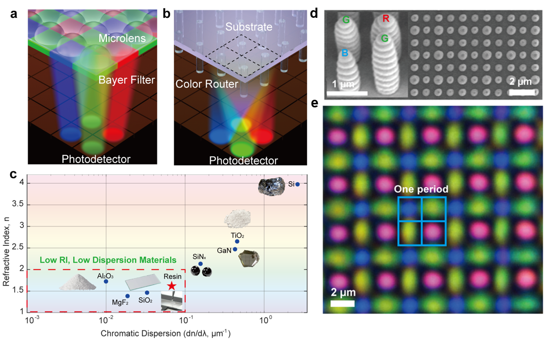
Low-refractive-index color routers for image sensors. (a,b) Schematics of a conventional Bayer-filter sensor and a color-router-based sensor. (c) Comparison of refractive index and chromatic dispersion for representative optical materials, highlighting low-index, low-dispersion materials. (d) Scanning electron micrographs of the fabricated polymer nanopillars and periodic array. (e) Optical image of the routed color pattern, with one RGGB unit cell outlined.
SUTD
Almost every sensor in a digital photography device, from a smartphone to a digital camera, relies on colour filters to separate incoming light into red, green and blue before it reaches the sensor. Substantial light is lost through the process, however, and in dim conditions, this results in images with higher noise, longer exposures and more motion blur. The most conventional configuration, a Bayer filter array, transmits only about a third of the light striking it.
A team comprising researchers from Singapore, China and Japan have built a colour router that overcomes light loss. Rather than filtering colours out and ‘discarding’ the light, the device steers the light to where it is captured.
“A Bayer filter separates colours by letting one colour through and absorbing the others,” shared Professor Joel Yang from Singapore University of Technology and Design (SUTD), who led the research. “A colour router instead steers those colours towards the corresponding sensing regions, allowing three times more of the incoming light to be used.”
The team published their findings in the paper “3D printed designer colour routers with low refractive index for low-light imaging” in Nature Communications.
Earlier versions of colour routers have relied on high-refractive-index materials such as titanium dioxide or gallium nitride, which bend light strongly but demand precise, multi-step fabrication. The team instead turned to low-refractive-index materials: ordinary polymers and glasses that are cheaper, more widely available and compatible with simpler, scalable manufacturing. The trade-off is that these materials interact with light far more weakly, which has left them largely unexplored for this purpose.
“Building on our experience with 3D-printed polymer optics, we wanted to explore whether carefully optimised geometry could overcome that limitation,” said lead author and SUTD PhD candidate, Pan Cheng-Feng.
The team’s answer was geometry rather than chemistry. Each unit cell of their colour router contains four cylindrical nanopillars, printed to precise heights and widths using two-photon polymerisation, a 3D-printing technique capable of producing features as small as 150 nanometres. The pillars do not act as individual colour filters. Instead, light scattered by all four interferes collectively, steering red, green and blue wavelengths towards their designated spots.
“The four pillars act as a coordinated optical system,” said Pan. “A pillar positioned beneath the red sensing region is not simply an independent ‘red pillar’. In our design, the desired routing emerges from the collective response of the complete arrangement.”
To find the right combination of pillar heights and radii, the team used particle swarm optimisation. This algorithm tests candidate geometries through simulation and refines them based on the weakest-performing colour channel, so that red, green and blue can route efficiently together rather than optimising for just one.
“A Bayer filter separates colours by letting one colour through and absorbing the others. A colour router instead steers those colours towards the corresponding sensing regions, allowing three times more of the incoming light to be used."
Professor Joel Yang, Singapore University of Technology and Design
The resulting design achieved a simulated routing efficiency of almost 90 percent across the visible spectrum, well above the roughly 20 to 35 percent typical of commercial Bayer filters. In physical devices, printed as arrays of 250,000 unit cells across a one-millimetre square, the routers achieved about 70 percent efficiency—a drop the team attributes to fabrication-induced deviations from the ideal design rather than any fundamental limitation.
Imaging tests using a monochrome sensor confirmed the practical benefit: images captured through the colour router showed improved colour fidelity with a third of the exposure time than those from a standard filter-based sensor.
A further advantage lies in how the devices are made. Unlike fully three-dimensional nanostructures, the pillars share a flat base and involve no overhangs or enclosed cavities, a ‘2.5D’ geometry that lends itself to mass replication.
“Nanoscale 3D printing is just the beginning as it allowed us to check that our concepts and designs work,” described Prof Yang. “The path to manufacturing will require updated designs optimised for foundry compatible materials and processes.”
Beyond consumer devices, the team sees potential in extending the approach past the standard three colours and towards compact multispectral sensors tuned to specific wavelength bands. One application could be fluorescence imaging of living cells, where signals are often faint and excessive illumination risks damaging the sample. A colour router tuned to the relevant emission bands could direct more of that limited signal to the sensor, allowing researchers to observe biological processes with less light and shorter exposures.
For the immediate next phase, the researchers want to integrate the colour router directly onto an image sensor to test how the optical gains translate into real improvements in exposure time, noise and colour accuracy in a working camera. They also want to reduce leakage between colour channels, improve performance for light arriving at different angles and demonstrate repeatable replication.
“Together, these steps would move the technology from a laboratory demonstration to a practical imaging component,” Prof Yang added.
Advertisement
Advertisement