
A field experiment with the Japan Marrow Donor Program showed that adding one factual sentence to HLA match letters—telling potential donors that compatible registered donors are limited—raised progression to confirmatory typing by 7.3%. The intervention was low-cost and simple, while combined messages weakened the effect. The result could help reduce donor dropout and improve stem cell transplant coordination.
Fig. 1
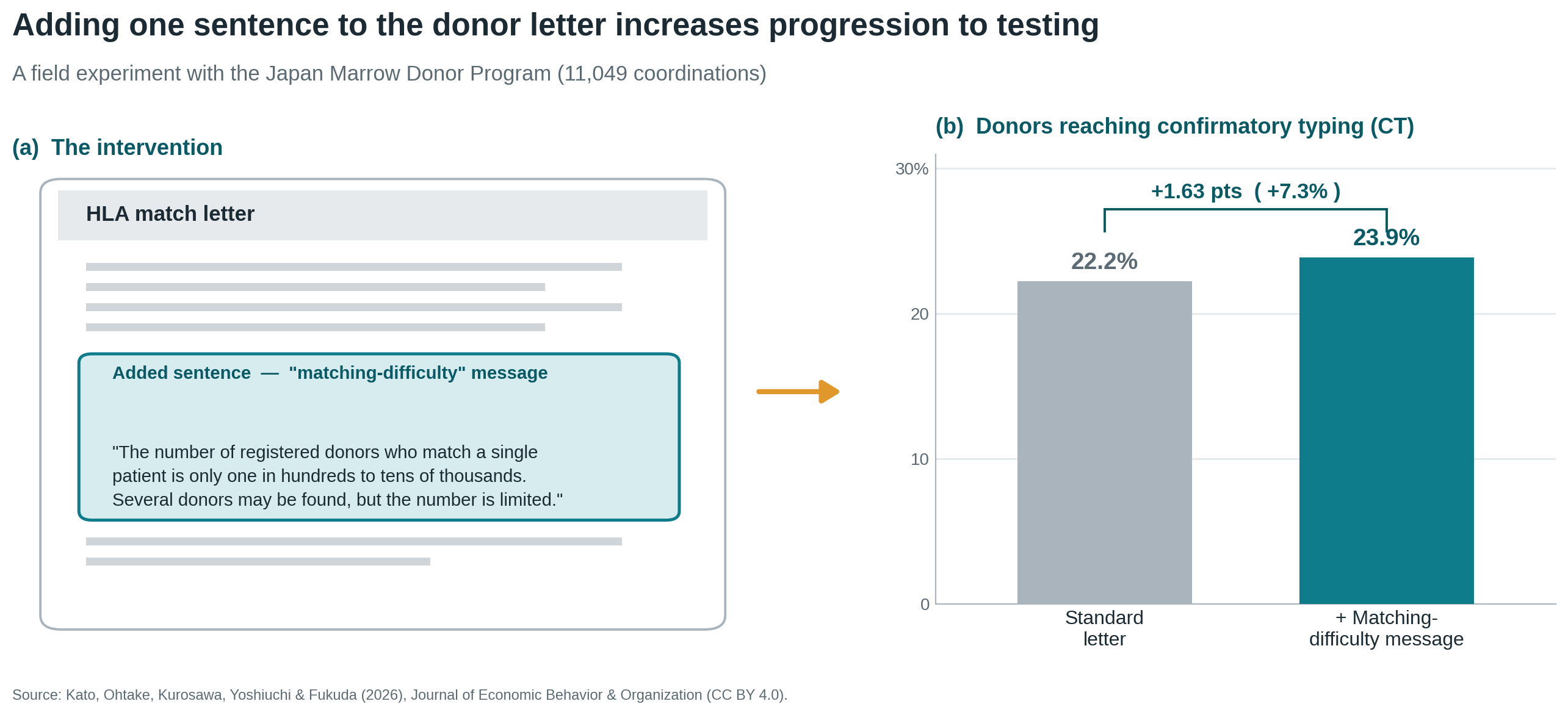
Adding a one-sentence "matching-difficulty" message to the HLA match letter raised the share of donors reaching confirmatory typing (CT) from 22.2% to 23.9% (+1.63 points; +7.3% relative).
Original content, Credit must be given to the creator., 2026 Kato H. & Ohtake F. et al., The University of Osaka (CiDER). Original graphic created for this press release; based on data from the JEBO (2026) paper (CC BY 4.0).
Researchers from the University of Osaka have revealed that adding a sentence informed by behavioral economics to donor notification letters increased progression to a key pre-donation test in a field experiment with the Japan Marrow Donor Program.
Osaka, Japan - When a patient needs a stem cell transplant, finding a registered donor is only the first step. Some potential donors drop out before confirmatory typing, reducing the pool from which doctors can choose. Researchers from the University of Osaka and collaborators tested whether a small change in wording could help more donors continue. This study was published in the Journal of Economic Behavior & Organization.
Hematopoietic stem cell transplantation is an important treatment for leukemia and other blood cancers, but donor availability remains a challenge worldwide. In Japan, many coordination processes stop before confirmatory typing (CT), the pre-donation test used to check whether a donor is suitable. Recruiting new donors is costly, so preventing dropout among people already registered is a major practical issue.
The team worked with the Japan Marrow Donor Program to conduct a randomized field experiment from September 2021 to February 2022. A total of 11,154 HLA match letters were assigned to four groups: standard letter only, a “matching difficulty” message, an “early coordination” message, or both messages. The analysis covered 11,049 coordinations involving donors living in Japan.
Fig. 2
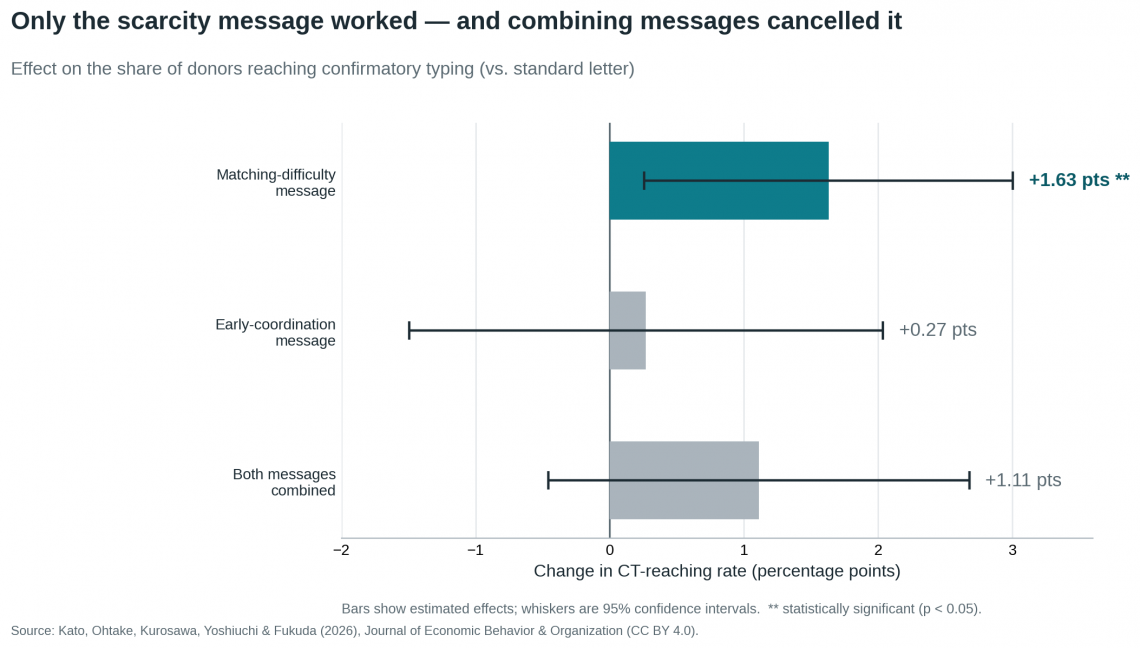
Estimated effect of each message on the CT-reaching rate. Only the matching-difficulty (scarcity) message was statistically significant; combining messages cancelled the effect (95% confidence intervals shown).
Original content, Credit must be given to the creator., 2026 Kato H. & Ohtake F. et al., The University of Osaka (CiDER). Original graphic created for this press release; based on data from the JEBO (2026) paper (CC BY 4.0).
The matching difficulty message told donors that the number of registered donors compatible with one patient is limited. This raised the CT-reaching rate from 22.25% to 23.88%, a 1.63 percentage-point increase, or 7.3% in relative terms. The early coordination message did not significantly increase CT completion, and combining both messages weakened the effect, suggesting that simple information works best.
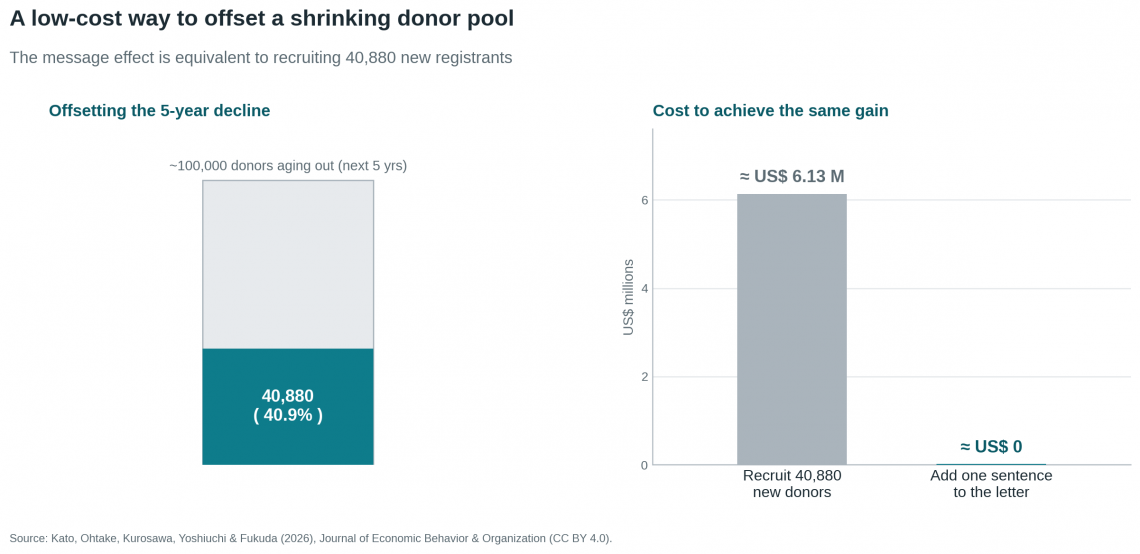
The effect is estimated to be equivalent to securing about 40,880 new donor registrations, offsetting roughly 40.9% of the projected five-year donor-pool decline of about 100,000 donors caused by the donation age limit. The finding offers a low-cost way to help doctors access a broader donor pool.
“Without using money or pressure, one factual sentence can help donors’ goodwill reach patients more reliably,” said Professor Fumio Ohtake. “We hope this evidence supports practical improvements in transplant coordination.”
###
The article, “Exploring information provision to promote stem cell donation: Evidence from a field experiment of the Japan Marrow Donor Program,” was published in Journal of Economic Behavior & Organization at DOI: https://doi.org/10.1016/j.jebo.2026.107666.
Fig. 3
Policy impact: the message effect is equivalent to recruiting about 40,880 registrants, offsetting roughly 40.9% of the projected five-year donor-pool decline at a small fraction of the recruitment cost.
Original content, Credit must be given to the creator., 2026 Kato H. & Ohtake F. et al., The University of Osaka (CiDER). Original graphic created for this press release; based on data from the JEBO (2026) paper (CC BY 4.0).
About The University of Osaka
The University of Osaka was founded in 1931 as one of the seven imperial universities of Japan and is now one of Japan's leading comprehensive universities with a broad disciplinary spectrum. This strength is coupled with a singular drive for innovation that extends throughout the scientific process, from fundamental research to the creation of applied technology with positive economic impacts. Its commitment to innovation has been recognized in Japan and around the world. Now, The University of Osaka is leveraging its role as a Designated National University Corporation selected by the Ministry of Education, Culture, Sports, Science and Technology to contribute to innovation for human welfare, sustainable development of society, and social transformation.
Website: https://resou.osaka-u.ac.jp/en
Advertisement