
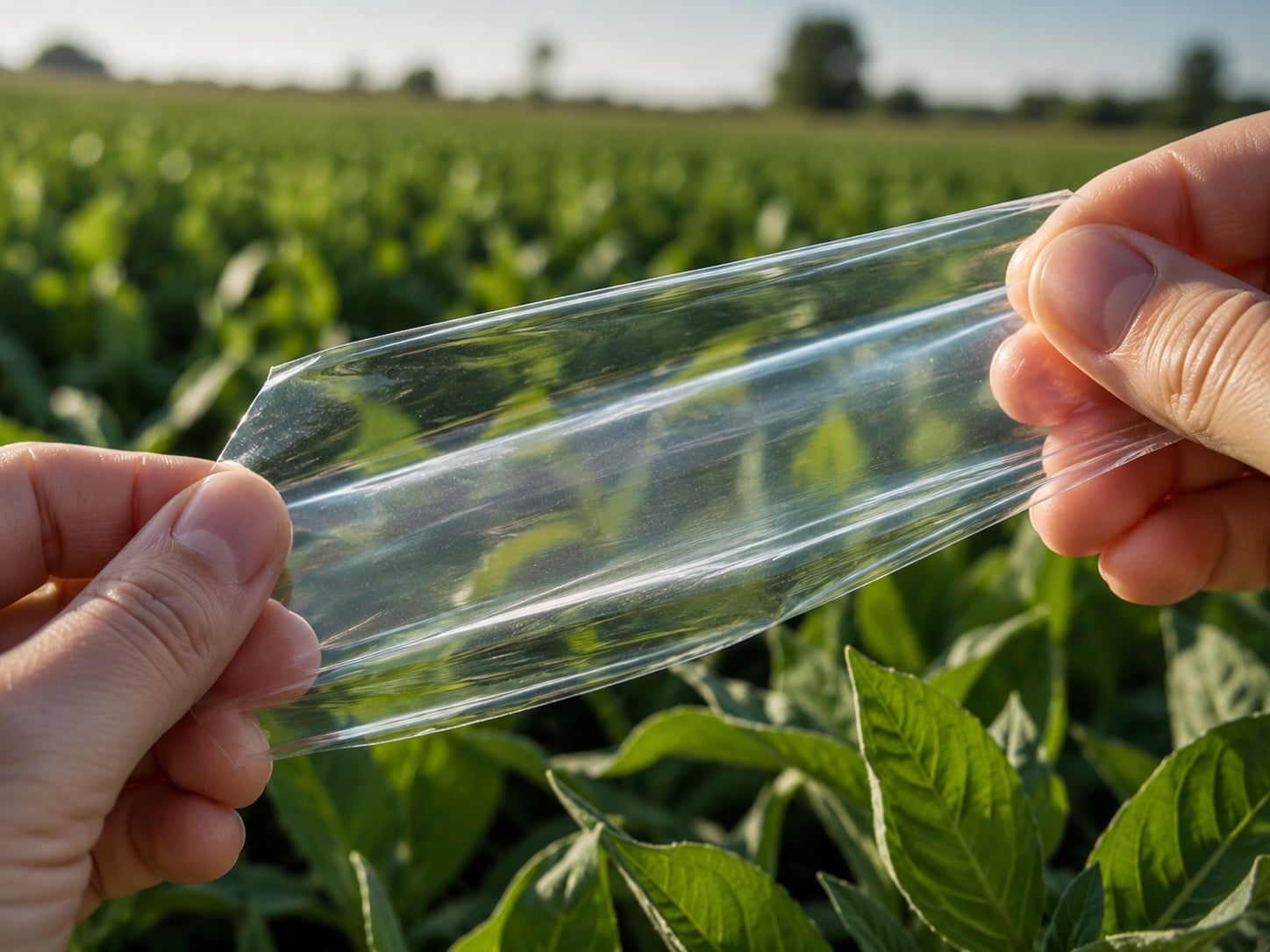
A flexible transparent polymer film is demonstrated outdoors, reflecting growing interest in sustainable materials designed for performance, repairability and lifecycle value.
A France–Thailand symposium highlighted how advances in polymer science, natural rubber, bio-based coatings and degradable plastics are opening new routes towards more sustainable materials.
The UHA–KU Bilateral Symposium 2026, held online across May, brought together researchers from the University of Haute-Alsace in France and Kasetsart University in Thailand. The programme covered a broad range of materials research, including energy materials, surface science, biotechnology, nanomaterials, natural rubber and polymer engineering. Within this wider programme, one clear theme stood out: polymer materials are increasingly being designed not only for performance, but also for durability, repairability, lower environmental burden and better end-of-life outcomes.
A central contribution came from Dr Wirasak Smitthipong of Kasetsart University, who presented recent developments in photostimulus-responsive and smart functional polymers. His slides highlighted self-healing polymer systems, including rubber and hydrogel materials, where molecular interactions such as hydrogen bonding, metal-ligand coordination and π–π interactions can help damaged material regions recover function.
The sustainability potential of such materials lies not only in their chemistry, but in how they behave during service. If smart polymers can indicate damage, recover function, or extend useful life, they may reduce the need for premature replacement. This is especially relevant for applications involving rubber, coatings, adhesives, films and composite materials, where damage may begin locally but eventually lead to the replacement of a much larger product.
Light-driven polymer processing was another important theme. Dr Jacques Lalevée from the Institut de Science des Matériaux de Mulhouse, University of Haute-Alsace, discussed new photoinitiating systems for high-performance materials. His presentation showed how photopolymerisation can be used in coatings, inks, adhesives, 3D printing and composites, with advantages including spatial and time control, low or no volatile organic compound release, and rapid reactions.
The same presentation also pointed towards bio-based photoinitiating systems and biosourced resins, including the photopolymerisation of unsaturated oils through thiol-ene processes. This suggests a possible route towards lower-energy production, localised repair, and more sustainable polymer processing.
Other presentations focused on end-of-life control. Dr Amornrat Lertworasirikul of Kasetsart University presented work on bio-based additives for accelerated degradation of polylactic acid, or PLA. The slides showed PLA as a bio-based and biodegradable polymer used in packaging, automotive, agriculture, drug delivery and tissue engineering applications, while also noting challenges such as brittleness and environment-dependent degradation. The research explored oligoricinoleic acid as a degradation-enhancing additive, with results indicating that a 3 wt% addition improved ductility and promoted molecular weight reduction during hydrolysis.
This raises a wider question for sustainable polymer design: should a material be made to last longer, degrade faster, or be easier to repair and reuse? The answer depends on the application. Short-life packaging may benefit from controlled degradation. Engineering materials, protective films and composite components may benefit more from durability, inspection, repair and longer service life. Sustainability therefore depends on the full lifecycle, not only on whether a material is bio-based or biodegradable.
Natural rubber also emerged as a strong platform for functional materials. Dr Sutee Boonchui presented transparent flexible fluorescent films based on natural rubber composited with quantum dots for traffic equipment. The slides described the blending of quantum dots with natural rubber to create flexible fluorescent devices, with possible application in traffic equipment and road safety.
Another natural rubber application was presented by Dr Kiadtisak Saenboonruang, who discussed multilayer natural rubber latex gloves with enhanced mechanical and X-ray shielding properties. His slides showed that multilayer structures using nano-bismuth oxide could provide better X-ray attenuation than single-layer gloves at the same equivalent filler content, while retaining better mechanical properties through pristine natural rubber outer layers.
Circularity in rubber processing was addressed by Dr Hassarutai Yangthong, whose presentation examined fly ash as a sustainable activator for reducing zinc oxide use in tire tread rubber. The slides framed zinc oxide as an environmental concern and showed how fly ash could partly replace commercial activators in rubber vulcanisation. The conclusion noted that lifecycle assessment indicated reductions in freshwater aquatic ecotoxicity, marine aquatic ecotoxicity and global warming potential when zinc oxide was replaced by fly ash in vulcanised rubber formulations.
Taken together, the presentations showed how sustainable polymer research increasingly depends on connecting materials design, surface functionalisation, application testing and lifecycle thinking. The symposium highlighted complementary strengths in natural rubber, bio-based polymers, photochemistry, coatings, surface engineering and advanced characterisation, while also opening space for further discussion on durability, repairability and circular materials design.
This broader perspective is important because sustainable materials cannot be judged by origin alone. A bio-based polymer may still require high processing energy. A degradable material may not be suitable for long-life applications. A functional additive may improve performance but complicate recycling. Conversely, a coating, repair system or multilayer design may reduce environmental impact if it extends service life or reduces material use.
The symposium therefore pointed towards a more integrated view of polymer sustainability. Future research in this area is likely to focus not only on making greener materials, but on designing polymer systems whose performance, repairability, lifetime and environmental impacts are understood together.
Contacts
Dr Wirasak Smitthipong
Department of Materials Science, Faculty of Science
Kasetsart University, Thailand
Hub of Talents in Natural Rubber, National Research Council of Thailand
Dr Karine Mougin
Institut de Science des Matériaux de Mulhouse
University of Haute-Alsace, France
Dr Kheng-Lim Goh
Newcastle University in Singapore
Email: [email protected]
Advertisement