
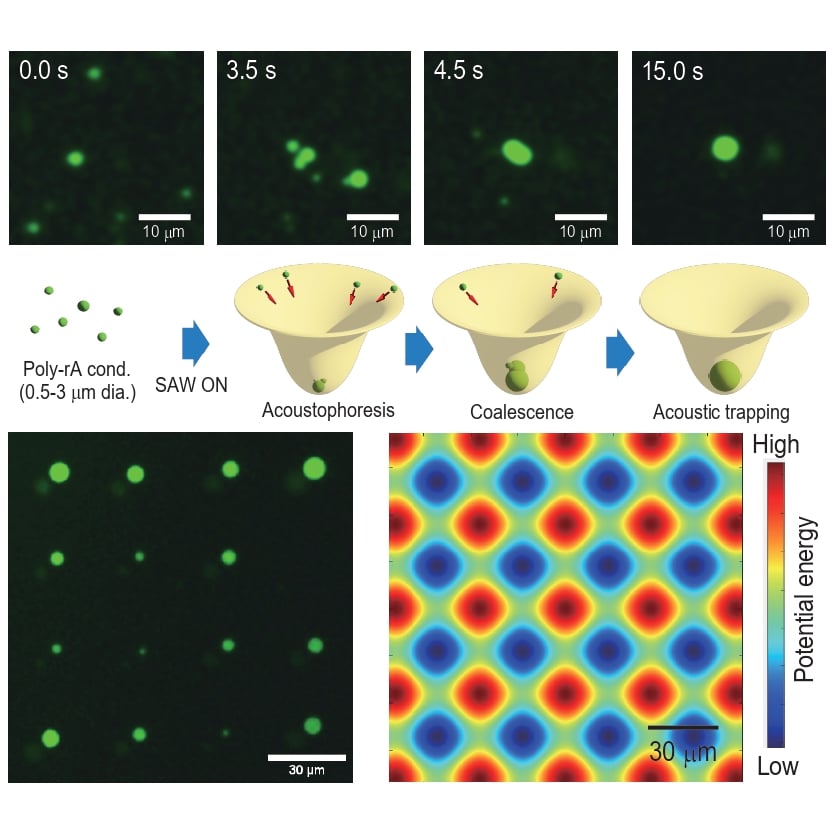

A team led by researchers from the University of Osaka has used acoustic tweezers to analyze the mechanical properties of biopolymer droplets without needing to physically touch the material. Using this method, the team investigated the stiffness of condensates of a model biopolymer. This technique will further the knowledge of biopolymer droplets and their roles in cellular biology, and may lead to the discovery of novel methods of treating diseases caused by the dysfunction of these droplets.
Fig. 1
Acoustic trapping of biomolecular droplets
CC BY, K. Nakajima et al, PRX Life(American Physical Society)
Researchers from the University of Osaka have used an acoustic trapping method to gain insights into the mechanical properties of biopolymer condensates
Osaka, Japan — Being able to measure something plays a vital role in our ability to understand many phenomena. But the action of measuring can often affect what we are trying to measure; this is particularly the case when trying to measure substances that are very small, soft, or fragile.
In a recent study published in PRX Life, a research team led by the University of Osaka successfully used acoustic tweezers as a contactless method to investigate an important type of fragile material called biopolymer condensates.
Biopolymer condensates are liquid-like droplets composed of proteins and/or nucleic acids, and are involved in regulating a variety of physiological functions within cells to keep them healthy. However, problems with these droplet systems can result in a variety of diseases, including neurodegenerative diseases. The mechanical properties of biopolymer droplets, such as fluidity and stiffness, are important for biological activity. Hence, better knowledge of the mechanical properties of these droplets will help us to understand their roles in healthy cells and disease states. However, these droplets are very small and fragile and are difficult to investigate using conventional techniques.
A multi-institutional team led by researchers from the University of Osaka has developed an analytical tool called acoustic tweezers that uses ultrasound to enable the mechanical properties of condensates to be investigated without needing to physically touch the material. “We fabricated a device that creates an acoustic force that can trap condensates at a specific point,” explains lead author Kichitaro Nakajima.
As a proof of concept, the group investigated biopolymer condensates made of polyadenylic acid. These condensates are sensitive to salt concentration, so the research team expected that changing the salt concentration would cause changes in the mechanical properties of the droplets, which could then be measured using the acoustic trapping method.
“We found that these condensates could be efficiently trapped and aligned based on the acoustic force in a contactless manner” says Nakajima. “In addition, two condensates could be trapped to analyze what occurs when droplets merge.”
The team found that when acoustic trapping was applied, the changes in the natural movement of a droplet in solution could be used to provide information on the stiffness of the droplet and the state of the molecules inside the droplet. They then developed a framework to essentially estimate the stiffness of a droplet from its behavior in their sound-based trapping system. “This information is useful for understanding the mechanical properties of these droplets and hence their biological activity” explains Nakajima.
These acoustic tweezers are useful tools for investigating soft materials, such as biomolecular droplets, and allow better understanding of their role in living cells and disease states. This knowledge may lead to the discovery of new methods for treating diseases associated with the dysfunction of biomolecular droplets.
The article, “Mechanical profiling of biopolymer condensates through acoustic trapping,” was published in PRX Life at DOI: https://doi.org/10.1103/kl9v-5ywv
Movie 1
RNA droplets trapped by acoustic tweezer
©CCBY, K. Nakajima et al, PRX Life(American Physical Society)
Movie 2
Microparticles aligned by acoustic tweezer
©CCBY, K. Nakajima et al, PRX Life(American Physical Society)
About The University of Osaka
The University of Osaka was founded in 1931 as one of the seven imperial universities of Japan and is now one of Japan's leading comprehensive universities with a broad disciplinary spectrum. This strength is coupled with a singular drive for innovation that extends throughout the scientific process, from fundamental research to the creation of applied technology with positive economic impacts. Its commitment to innovation has been recognized in Japan and around the world. Now, The University of Osaka is leveraging its role as a Designated National University Corporation selected by the Ministry of Education, Culture, Sports, Science and Technology to contribute to innovation for human welfare, sustainable development of society, and social transformation.
Website: https://resou.osaka-u.ac.jp/en
Advertisement