
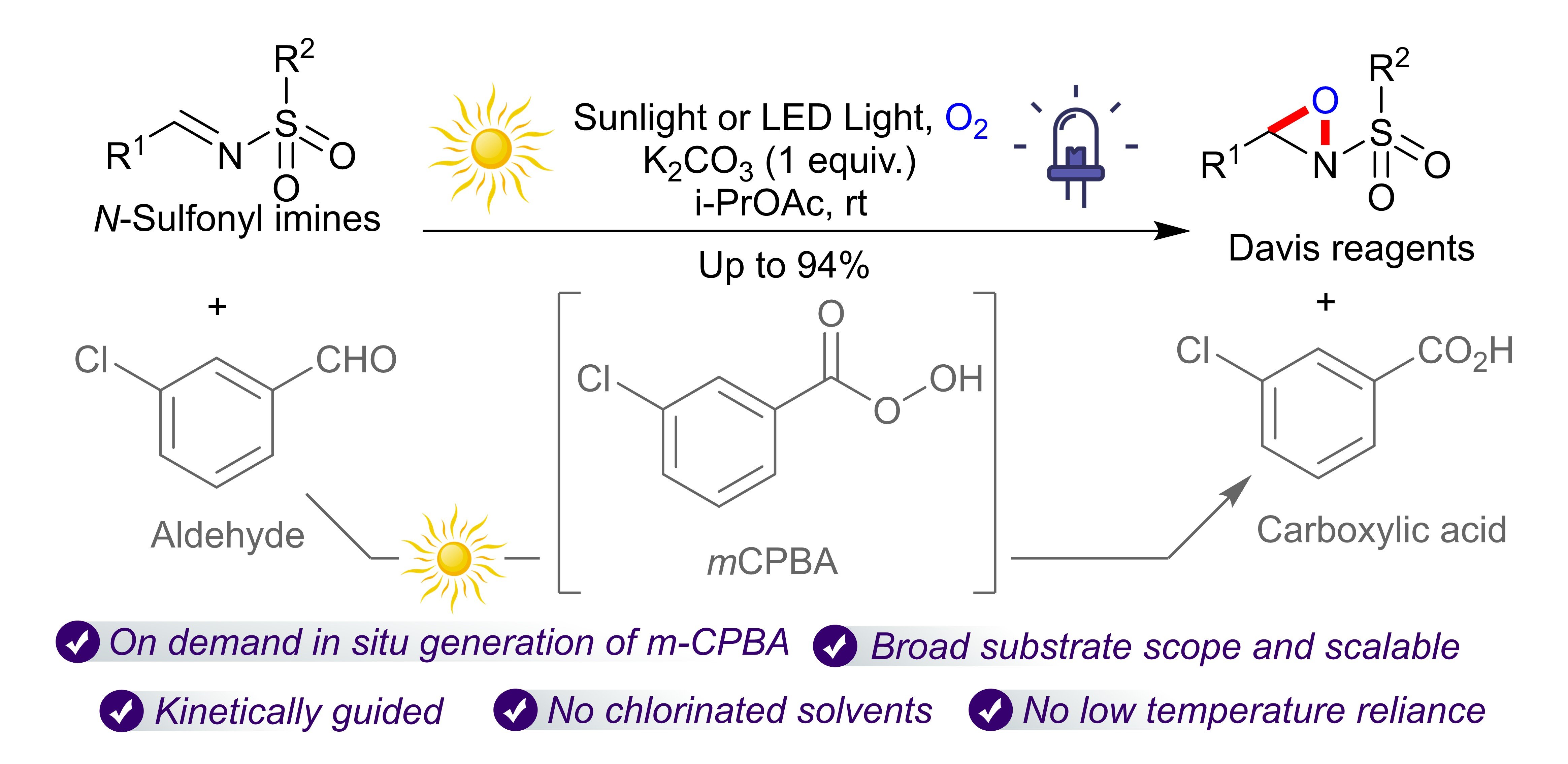

Researchers at the University of Osaka developed a light-driven method for synthesizing Davis reagents that generates the hazardous oxidant mCPBA only on demand and consumes it immediately. Kinetic analysis showed no detectable accumulation of the oxidant, improving process safety. The reaction proceeds at room temperature in non-halogenated solvents and can use sunlight or LEDs, offering a safer, greener, and scalable alternative for pharmaceutical-related synthesis.
Fig. 1
Light-driven, green and safe access to Davis reagents
Original content, No restrictions, The University of Osaka
Green process generates a reactive oxidant only as needed, reducing hazardous inventory while producing precision reagents for pharmaceutical synthesis
Osaka, Japan — In chemical manufacturing, one of the most difficult safety challenges is not just making useful molecules, but managing dangerous reagents on the way. This is especially true for the synthesis of Davis reagents, important tools for building pharmaceutical molecules, which has traditionally relied on bulk amounts of meta-chloroperbenzoic acid (mCPBA), a powerful oxidant that can pose serious explosion risks during transport, storage, and scale-up. Researchers at the University of Osaka have now found a way around that problem, instead of storing the oxidant, they make it only when needed, using light and oxygen.
A research team led by Professor Shinobu Takizawa at SANKEN developed a safe and sustainable sequential process for preparing Davis reagents. Instead of handling bulk meta-chloroperbenzoic acid (mCPBA), a powerful but potentially explosive oxidant, the method produces mCPBA in situ from meta-chlorobenzaldehyde and molecular oxygen under sunlight or LED irradiation, and immediately uses it to oxidize N-sulfonyl imines.
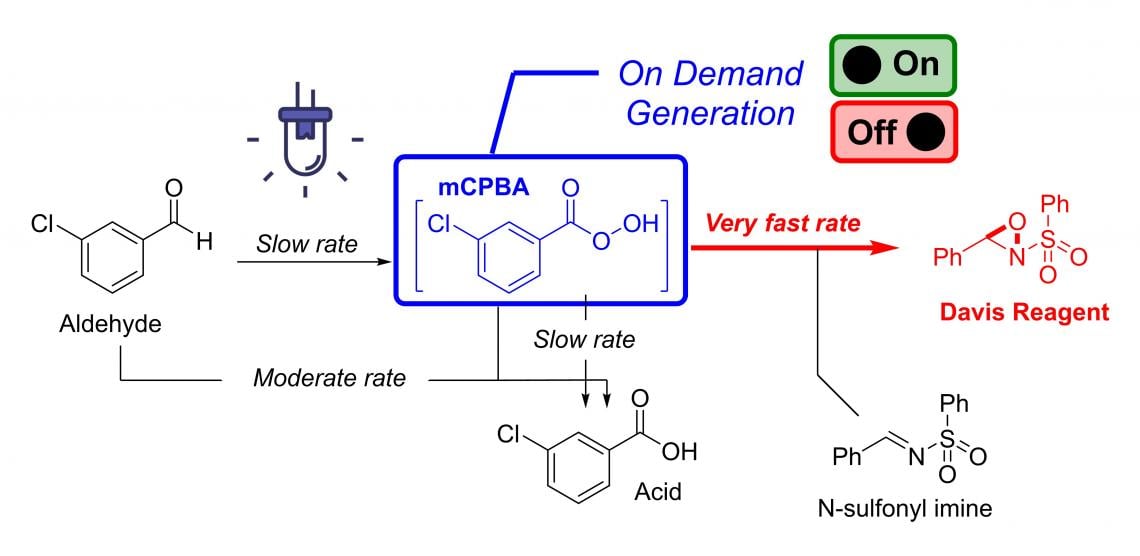
The key advance is that the oxidant is generated only as needed. Kinetic analysis showed that mCPBA forms in the reaction mixture but does not accumulate to detectable levels, because it is consumed essentially as soon as it is produced. This greatly reduces the risks associated with storing or handling bulk peracids.
The method also aligns with green chemistry principles. The reaction proceeds at ambient temperature, avoids halogenated solvents, and can be driven by natural sunlight or low-energy LEDs. The researchers also demonstrated broad substrate scope and gram-scale synthesis, obtaining the target product in 76% isolated yield under sunlight.
Professor Takizawa commented, “Developing technologies that manufacture essential compounds for fine organic synthesis in safer and more environmentally friendly ways is an important challenge for realizing a sustainable society. This work proposes a new organic synthesis process that combines safety with environmental compatibility.”
###
The article, “Kinetically guided on-demand mCPBA generation enables safe and sustainable light-driven synthesis of Davis reagents,” was published in Green Chemistry at DOI: https://doi.org/10.1039/d6gc02210c
Fig. 2
On-demand generation of mCPBA from an aldehyde under light irradiation and its immediate use in imine oxidation to produce the Davis reagent, avoiding the accumulation of hazardous peroxide.
Original content, No restrictions, The University of Osaka
About The University of Osaka
The University of Osaka was founded in 1931 as one of the seven imperial universities of Japan and is now one of Japan's leading comprehensive universities with a broad disciplinary spectrum. This strength is coupled with a singular drive for innovation that extends throughout the scientific process, from fundamental research to the creation of applied technology with positive economic impacts. Its commitment to innovation has been recognized in Japan and around the world. Now, The University of Osaka is leveraging its role as a Designated National University Corporation selected by the Ministry of Education, Culture, Sports, Science and Technology to contribute to innovation for human welfare, sustainable development of society, and social transformation.
Website: https://resou.osaka-u.ac.jp/en
Advertisement