

A new three-drug “RAD” regimen produced encouraging responses in patients with relapsed or refractory primary central nervous system lymphoma (PCNSL). The early-stage clinical results support further evaluation of this targeted therapy and immunotherapy combination.
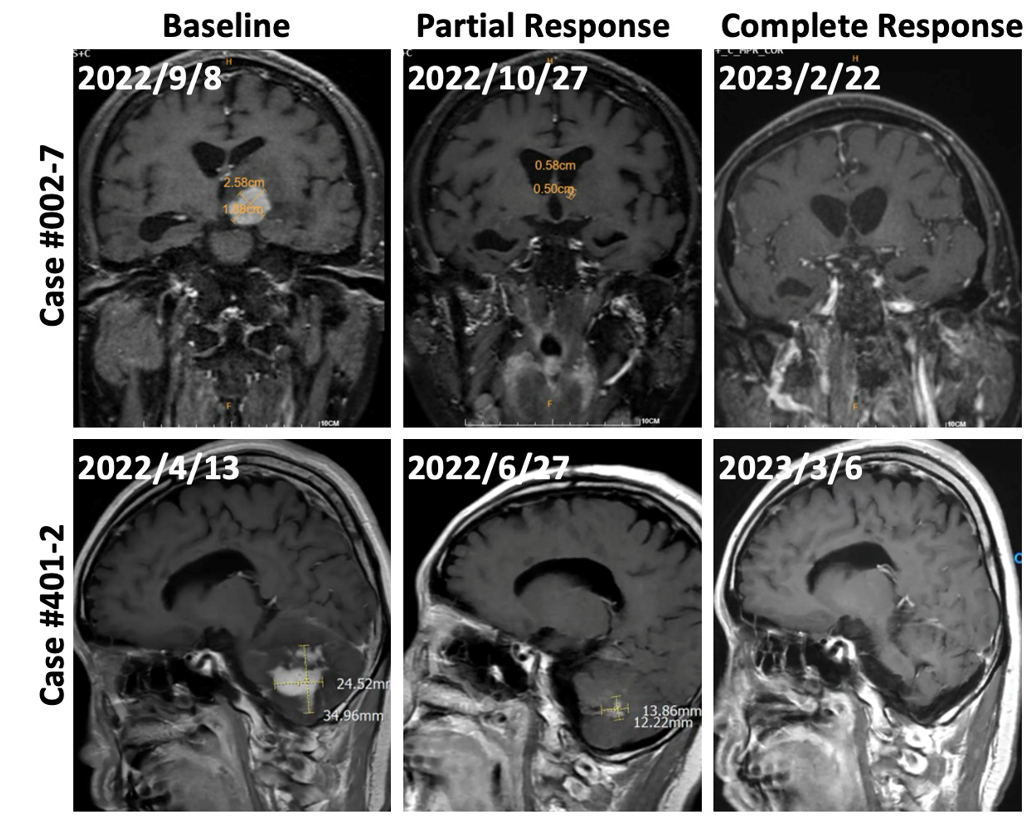
MRI images of two subjects with complete response after receiving the RAD regimen. Subjects #002-7 and #401-2 each showed progressive improvement over several months.
National Taiwan University
A collaborative clinical study led by National Taiwan University Hospital (NTUH) and Taiwan Clinical Oncology Group, National Health Research Institutes (TCOG, NHRI) has yielded promising results for a new therapeutic regimen to treat primary central nervous system lymphoma (PCNSL), a rare and aggressive cancer that develops in the brain or other parts of the central nervous system.
PCNSL is extremely difficult to treat, and patients with poor response to standard therapy or with relapsed disease have limited therapeutic options. For these patients, previous studies have reported a median overall survival of only 4.8 months following salvage chemotherapy.
The new study, conducted at four medical centers in Taiwan, evaluated a novel treatment called the “RAD” regimen. This regimen is a combination of three approved cancer therapies (rituximab, acalabrutinib, and durvalumab) with complementary mechanisms of action. The study published in Clinical Cancer Research, is the first reported clinical evaluation of this type of three-drug combination in relapsed or refractory PCNSL.
The investigators considered the toxicity manageable; no new unexpected adverse events were observed. Among 16 evaluable patients in the phase 1b study, 62.5% responded to treatment and 12.5% achieved a complete response. At the recommended dose, 10 of 13 patients showed objective response. The responders had a median overall survival of 20.6 months, compared with only 10.2 months for patients who did not respond.
The team conceived the RAD regimen based on the different mechanisms of action for each component. Acalabrutinib is a BTK inhibitor that suppresses survival and proliferation signaling of malignant B cells. Rituximab targets malignant B cells for destruction through immune mechanisms, and durvalumab blocks PD-1/PD-L1-mediated suppression of anti-tumor immunity. Thus, the drugs are expected to act on both the tumor cells and the immune environment to induce tumor cell death.
“This research represents an important first step in the clinical evaluation of a new treatment for PCNSL,” said first author Dr. Kwang-Yu Chang of NHRI and National Cheng Kung University Hospital, and senior author Prof. Shang-Ju Wu of NTUH. “We are highly encouraged by the early findings and cautiously optimistic that we are on the right track to find a more effective treatment option for patients with this devastating disease.”
Prof. Shang-Ju Wu's email address: [email protected]
Prof. Kwang-Yu Chang’s email address: [email protected]
Advertisement