
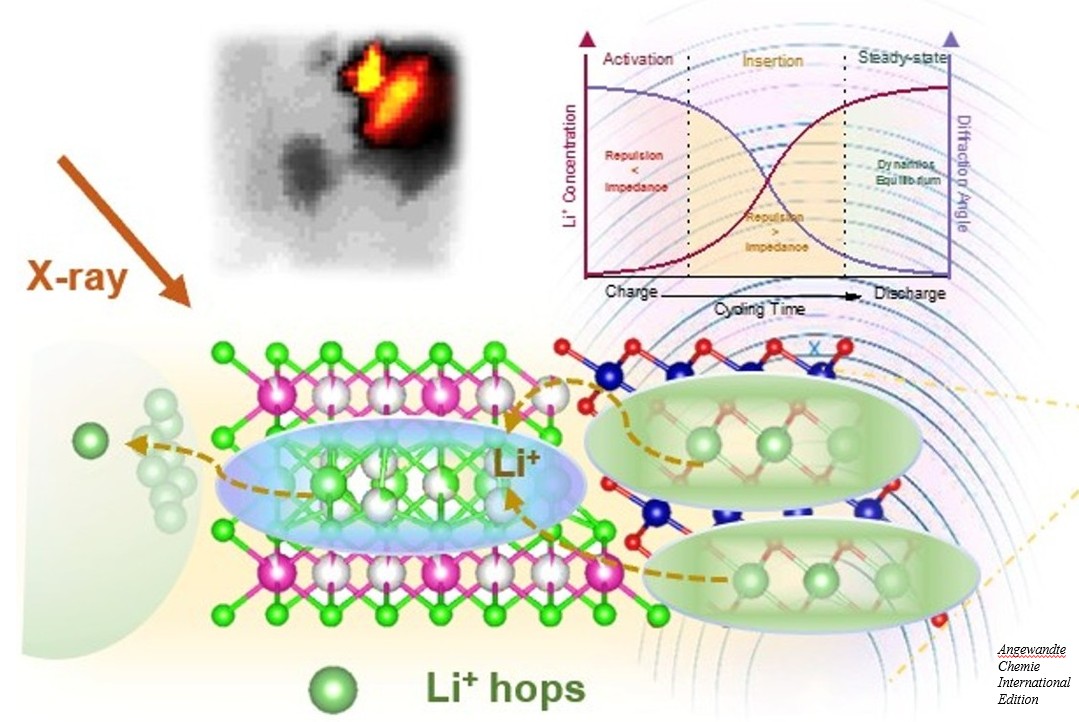

This work reveals how lithium migrates in solid-state batteries and shows that fast charging can cause irreversible lithium migration.
A new view inside solid-state batteries reveals how lithium moves through hidden pathways in the solid electrolyte, offering key guidance for safer, faster-charging, and longer-lasting next-generation batteries.
Angewandte Chemie International Edition
Seeing lithium move inside solid-state batteries
Solid-state batteries are often viewed as a promising path toward safer and more powerful energy storage. However, one key question has remained difficult to answer: how does lithium actually move inside the solid materials during charging and discharging? Unlike liquid batteries, where ions can move more freely, solid-state batteries depend on lithium passing through dense solid particles and across complex interfaces. This makes their internal behavior hard to observe and even harder to control.
In this work, researchers developed a practical way to “see” lithium motion inside a working solid-state battery. Instead of only measuring the overall battery performance, they looked deep inside the battery materials and followed how lithium changed the structure of the solid electrolyte during operation. This allowed them to understand not only whether lithium could move, but also where it preferred to move.
A key finding is that lithium does not move evenly through the whole solid electrolyte. It tends to pass through more ordered regions, which act like preferred pathways for ion transport. These pathways help lithium move across the boundary between the electrode and the solid electrolyte.
The study published in Angewandte Chemie International Edition also found that some strained regions are less likely to accept lithium, leading to uneven lithium distribution inside individual particles.
Another important result is related to fast charging. The study suggests that rapid charging, rather than simply charging the battery deeply, is more likely to cause irreversible lithium motion. This means that controlling the charging rate and improving the internal interfaces may be crucial for making solid-state batteries more stable and longer-lasting.
“This study provides a clearer picture of how lithium moves inside solid-state batteries and shows that understanding these hidden pathways is essential for designing safer, faster-charging, and more durable next-generation batteries,” says corresponding author Dr. Ru-Shi Liu, distinguished professor of chemistry at National Taiwan University.
Prof. Ru-Shi Liu's email address: [email protected]
Advertisement