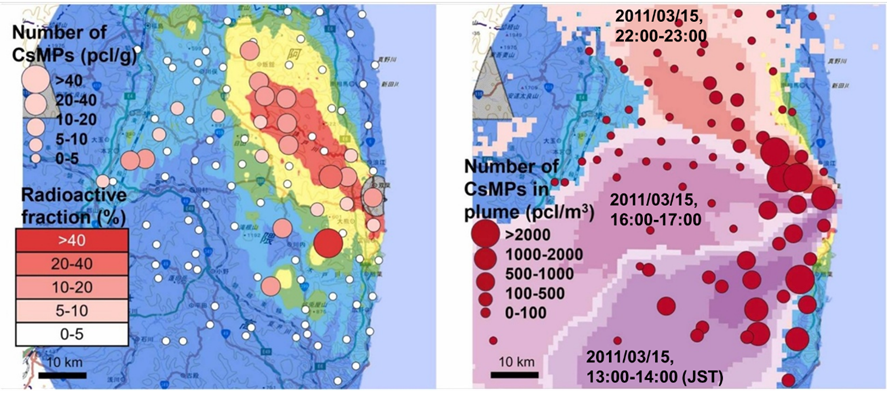

By quantitatively analyzing 100 soil samples collected across Fukushima Prefecture in 2011, researchers found that cesium-rich microparticles (CsMPs) were distributed over a wide area, with abundances ranging from 0 to 52.3 particles g⁻¹ and accounting for up to 61.9% of the total radioactivity in some samples. Their results further revealed that most CsMPs originated from a single radioactive plume released on 15 March 2011, whereas later emissions contained mainly water-soluble cesium rather than particulate CsMPs.
(Left) The size of each circle represents the number of CsMPs contained in 1 g of surface soil. The color within each circle indicates the fraction of total radioactive cesium attributable to CsMP-derived radioactivity.
(Right) Distribution of the number of CsMPs per 1 m³ of radioactive plume air. The size of the red circles represents the number of CsMPs and is overlaid on a representative plume distribution map for 15 March 2011.
Journal of Hazardous Materials
During the Fukushima Daiichi Nuclear Power Plant accident, tiny particles a few micrometers in diameter, known as highly radioactive cesium-rich microparticles (CsMPs), were released into the environment. Because these particles contain highly concentrated radioactive cesium, understanding their health impacts when inhaled and how they dispersed through the environment has been an important issue.
In this study, published in Journal of Hazardous Materials, researchers analyzed soil samples collected from 100 locations across Fukushima Prefecture to investigate the abundance and distribution of CsMPs. The results showed that CsMP abundance varied greatly by region, and in some locations more than 60% of the total radioactivity in the soil was attributable to CsMPs.
By combining the measurements with atmospheric dispersion simulations, researchers further revealed that a large number of CsMPs were generated and released around 3:00 a.m. on 15 March 2011. A radioactive plume containing up to 4,700 CsMPs per cubic meter of air was transported over a wide area of Fukushima Prefecture by the clockwise movement of the plume from south to northwest on 15 March.
In contrast, radioactive cesium released after midnight on 16 March contained no CsMPs and instead existed mainly in water-soluble forms. The study also demonstrated that the deposition of CsMPs onto soil strongly depended on rainfall patterns and the number of airborne particles.
“These findings provide important insights into how radioactive microparticles released during nuclear accidents disperse in the environment and are expected to contribute to future environmental risk assessments for nuclear disasters. Furthermore, the knowledge and research approach established in this study represent an important step toward the creation of a new research field, Advanced Radioactive Particle Science,” says corresponding author Prof. Satoshi Utsunomiya in the Department of Geosciences at National Taiwan University.
Prof. Satoshi Utsunomiya's email address: [email protected]
The lab of Prof. Utsunomiya linked to https://www.satoshiutsunomiya.com/
Advertisement