
Researchers at the University of Osaka, Shimane University, and Kyoto Sangyo University have now theoretically identified an unusual pattern of vibrations that emerges just before a crystal made of regularly arranged grains yields. Many vibrational modes soften simultaneously along particular directions, while long-wavelength waves travel more slowly than shorter ones. The findings reveal a possible physical precursor to failure in highly ordered particulate materials.
Fig. 1
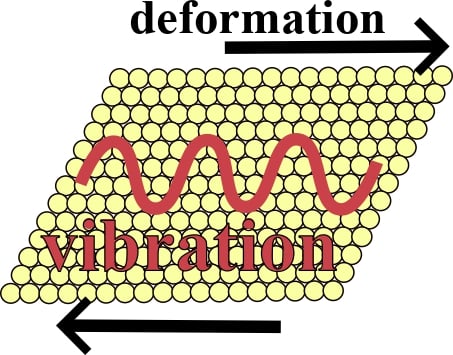
Grains are arranged in a regular pattern, and a shear deformation—like sliding a deck of cards sideways—is applied. The system is then slightly perturbed, and the frequencies at which it vibrates are analyzed theoretically. This revealed that, just before the crystal begins to break, unusual vibrational properties emerge that differ from those of ordinary solids.
Original content, Credit must be given to the creator., Fumiaki Nakai
Theory reveals that vibrations soften and long waves slow down just before an ordered structure begins to yield
Osaka, Japan — Sand, powders, and other collections of visible-sized grains are found throughout daily life, from food and pharmaceuticals to soils and industrial materials. When grains of similar size are arranged regularly, they can form a strong crystal-like solid. Yet what happens inside such an ordered structure immediately before it begins to break has remained unclear.
Researchers at the University of Osaka, Shimane University, and Kyoto Sangyo University have now theoretically identified an unusual pattern of vibrations that emerges just before a crystal made of regularly arranged grains yields. Many vibrational modes soften simultaneously along particular directions, while long-wavelength waves travel more slowly than shorter ones. The findings reveal a possible physical precursor to failure in highly ordered particulate materials.
The team studied a two-dimensional model in which particles were arranged in a triangular crystal and slowly sheared, similar to sliding the top of a deck of cards sideways. By taking advantage of the crystal’s regular structure, the researchers analyzed its vibrational modes mathematically as it approached yielding—the point at which deformation becomes irreversible.
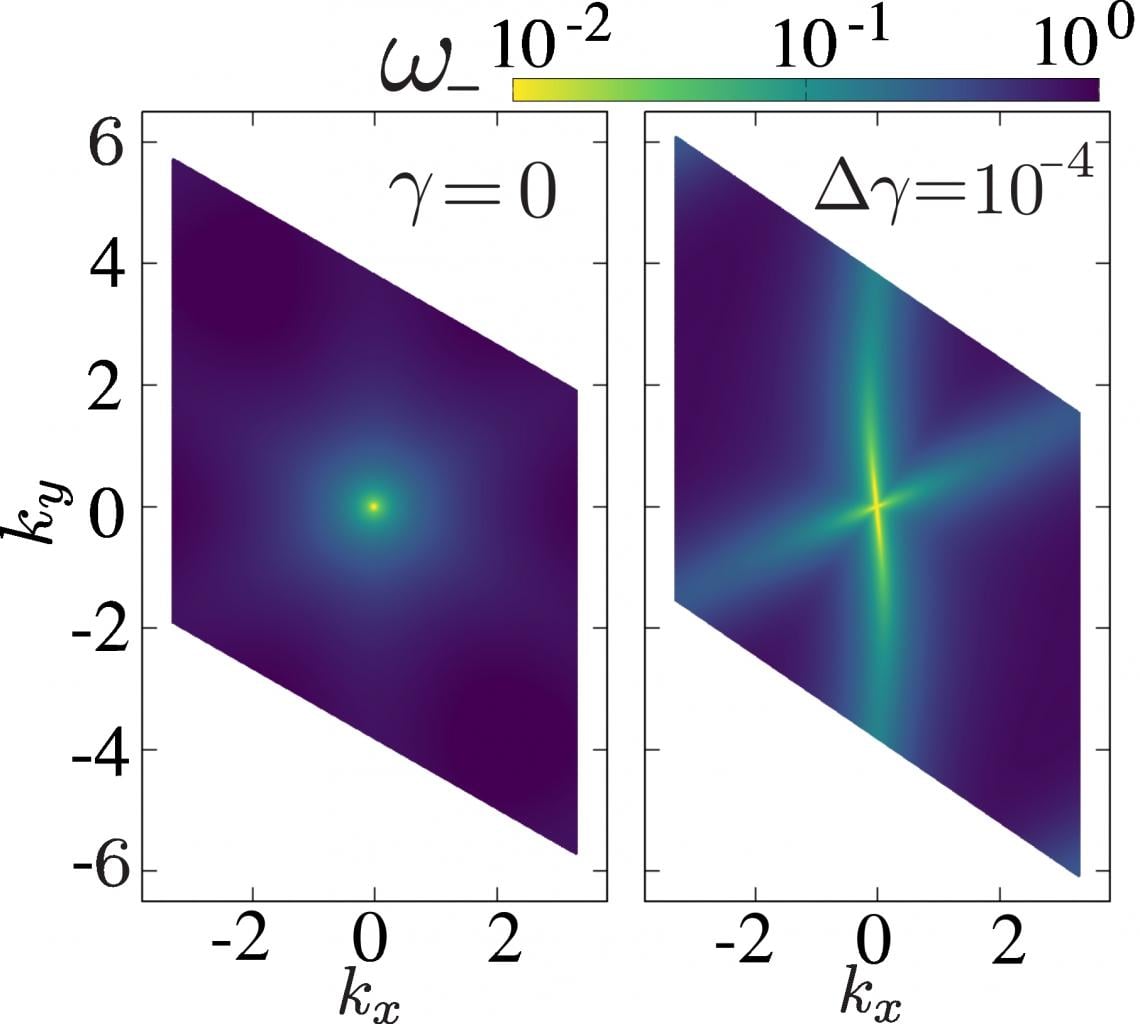
Before shear, low-frequency vibrations were concentrated near the center of wave-number space, corresponding to long wavelengths, as expected for an ordinary solid. Close to yielding, however, soft vibrations extended along two specific directions, forming a cross-shaped pattern in wave-number space. “Soft” means that even a small force can cause a large vibrational response.
Fig. 2
Maps of the vibration frequency across wavenumber space. Before shear (γ = 0, left), low-frequency vibrations gather near the center. Just before the crystal breaks (Δγ = 10⁻⁴, right), a cross-shaped low-frequency region appears, showing that the crystal becomes soft along particular directions.
CC BY, Adapted from: F. Nakai, M. Otsuki, K. Saitoh, and H. Katsuragi, "Anomalous phonon dispersion near yielding in athermal crystals," Phys. Rev. E (2026). DOI: 10.1103/3lnj-1ml1.Licensed under CC BY 4.0.
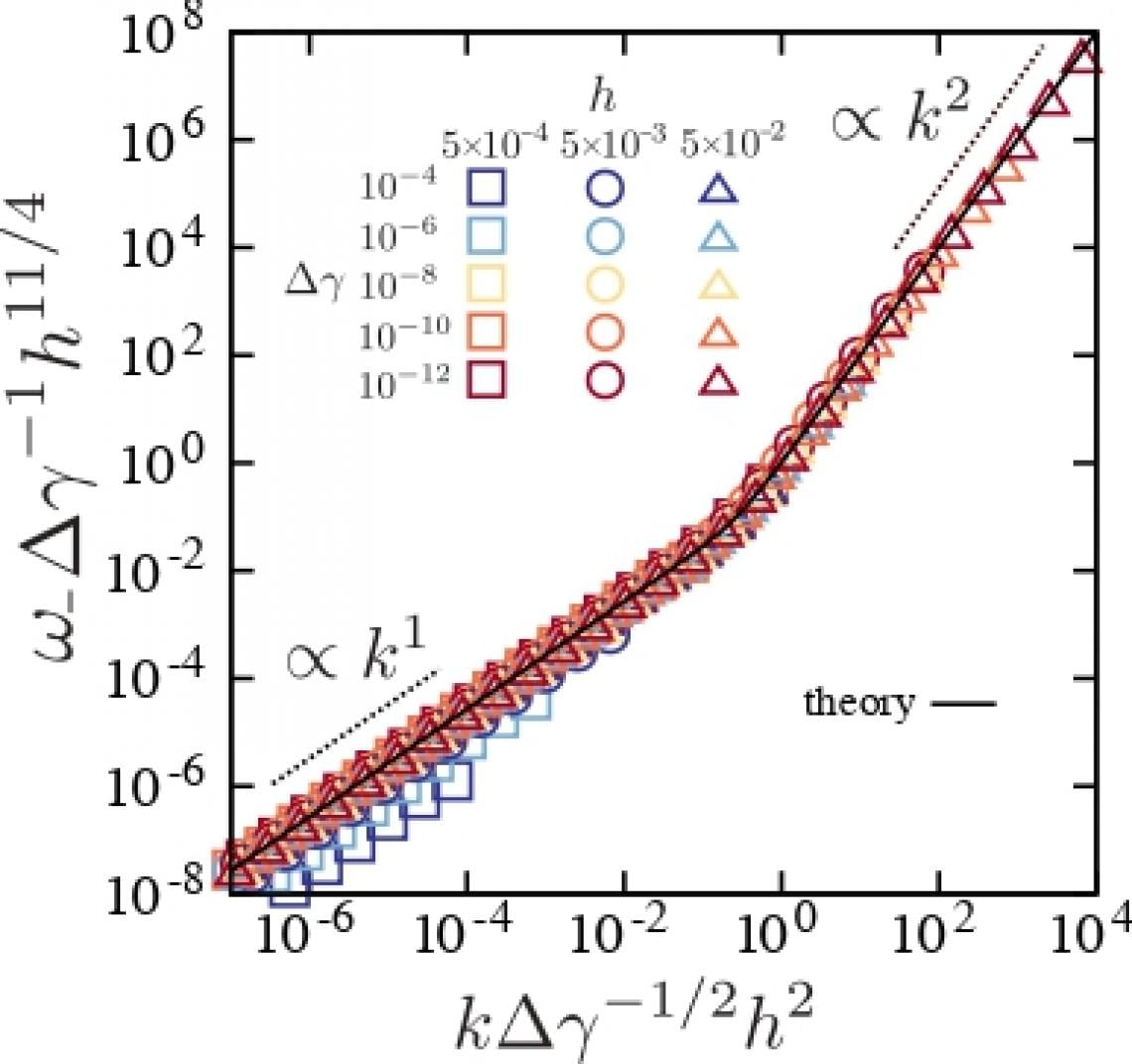
The researchers also found a striking change in how waves travel through the crystal. In ordinary solids, sufficiently long acoustic waves travel at nearly the same speed regardless of wavelength. Immediately before yielding, waves traveling along the soft direction instead followed a quadratic frequency-wavenumber relationship; longer, gentler waves propagated more slowly than shorter ones. The number of low-frequency vibrations also increased beyond the level predicted by the conventional Debye law.
The team derived these relationships analytically, including their numerical prefactors, and confirmed similar behavior using another type of interaction between particles. This suggests that the behavior may occur broadly in defect-free, ordered particulate systems.
“Granular materials are familiar, but many aspects of their physical behavior remain poorly understood,” says lead author Fumiaki Nakai. “By studying a simple, regularly ordered system, we were able to describe in detail how it approaches yielding. We hope this work will provide a foundation for exploring more complex effects such as disorder, friction, and energy dissipation.”
The findings provide a foundation for understanding and eventually predicting when and how ordered granular materials and colloidal crystals begin to fail. Such knowledge could ultimately contribute to safer and more reliable handling and design of materials made from regularly arranged particles. Because the study considered an ideal crystal without defects, further work will be needed to determine whether similar warning signs appear in real materials.
###
The article, “Anomalous phonon dispersion near yielding in athermal crystals,” will be published in Physical Review E at DOI: https://doi.org/10.1103/3lnj-1ml1
Fig. 3
The relationship between vibration frequency and wavelength just before breaking. Long-wavelength (gentle, slow) vibrations follow ω ∼ k² instead of the usual ω ∼ k, so their frequency drops far lower than normal. Results obtained under different conditions all fall onto a single curve, in agreement with the theory (solid line).
CC BY, Adapted from: F. Nakai, M. Otsuki, K. Saitoh, and H. Katsuragi, "Anomalous phonon dispersion near yielding in athermal crystals," Phys. Rev. E (2026). DOI: 10.1103/3lnj-1ml1.Licensed under CC BY 4.0.
About The University of Osaka
The University of Osaka was founded in 1931 as one of the seven imperial universities of Japan and is now one of Japan's leading comprehensive universities with a broad disciplinary spectrum. This strength is coupled with a singular drive for innovation that extends throughout the scientific process, from fundamental research to the creation of applied technology with positive economic impacts. Its commitment to innovation has been recognized in Japan and around the world. Now, The University of Osaka is leveraging its role as a Designated National University Corporation selected by the Ministry of Education, Culture, Sports, Science and Technology to contribute to innovation for human welfare, sustainable development of society, and social transformation.
Website: https://resou.osaka-u.ac.jp/en
Advertisement