
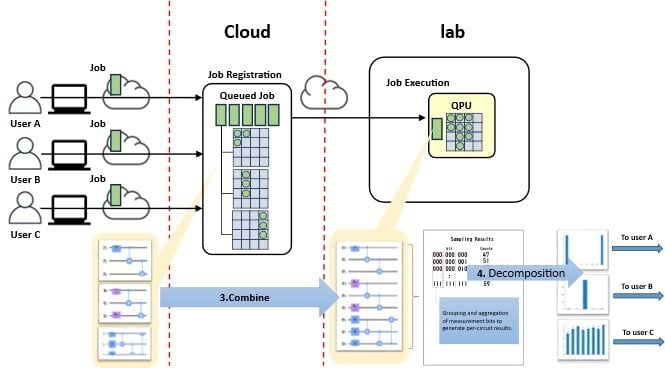
Fig. 1
Mechanism of quantum multi-programming (auto mode)
Quantum multi-programming reduces wait times by running multiple users’ programs in parallel
Osaka, Japan – Researchers from Japan have developed quantum multi-programming auto mode, a function that automatically runs quantum programs from different users in parallel. Launched on Japan’s leading research institute, the Center for Quantum Information and Quantum Biology (QIQB)’s quantum computer cloud service, the system reduces idle qubit resources, improves throughput, and may help ease congestion in quantum cloud computing.
Quantum computers are expected to become powerful next-generation computing platforms, but access to real quantum hardware remains limited. Because quantum chips require specialized facilities and careful control to operate stably, many universities, research institutes, and companies now provide access to them through cloud services.
However, cloud access creates a new challenge: waiting. Current noisy intermediate-scale quantum computers have a limited number of qubits, and conventional cloud operation often allows one job to occupy an entire quantum chip. This means that many qubits can remain unused, even while other users are waiting for their programs to run.
A research group led by QIQB at The University of Osaka in collaboration with Systems Engineering Consultants Co.,LTD. (SEC) and Juntendo University, has now developed and launched quantum multi-programming (auto mode), a function that automatically executes quantum programs from different users in parallel on QIQB’s quantum computer cloud service.
The University of Osaka’s quantum computer cloud service operates a 64-qubit quantum chip. However, many research programs use only around 10 qubits. Under the conventional “one job occupies the whole chip” approach, this leaves much of the chip idle.
The new auto mode helps solve this problem by selecting suitable jobs from the cloud queue, assigning them to available qubits, and executing them together. It improves on the previously released quantum multi-programming (manual mode), which allowed parallel execution only for multiple programs manually specified by the same user.
“Reducing computation wait times is one of the key challenges toward practical quantum computing,” says MORI Toshio, Specially Appointed Researcher (full-time) at The University of Osaka. “As the number of qubits in quantum computers continues to grow, we expect demand for quantum multi-programming auto mode to increase. This function can also be used on systems that have not yet adopted OQTOPUS by introducing OQTOPUS as middleware, and we hope to accelerate its deployment to other systems going forward.”
The new function does more than simply fill empty space on a chip. It uses mathematical optimization to determine how multiple quantum circuits can be placed efficiently.
First, the system represents both quantum circuits and the quantum chip as graphs made up of vertices and edges. It then solves a subgraph isomorphism problem, fitting multiple circuit graphs into the chip graph like pieces of a puzzle. By using an integer programming solver, the system can determine placements quickly and accurately, even for complex quantum circuits.
Second, the system automatically accounts for hardware-specific constraints, such as the direction of qubit connections and limited connectivity between distant qubits. The circuits are transformed, or transpiled, before being combined, allowing users to run their programs without needing to manage these physical constraints themselves.
Third, the system is designed with fairness in mind. It checks a fixed number of jobs at the front of the queue and searches for combinations that can be executed in parallel. This allows jobs that have waited longer to be prioritized while still improving overall efficiency.
To test the system, the team used a dataset reflecting real-world user behavior. In one evaluation, five users submitted 110 jobs for two-qubit circuits on an 11-qubit chip, assuming a situation in which small-scale quantum circuits are frequently used for research. The system improved throughput, or the amount of computation processed per unit time, by approximately 3.76 times.
“Maximizing the utilization of qubit resources is a key challenge for the future use of quantum computers,” says UCHIDA Ryo, Technical Manager at SEC. “Quantum multi-programming auto mode reduces wait times and improves resource efficiency through parallel execution of quantum programs and their optimized qubit allocation. We will continue our R&D efforts to advance quantum computing.”
The results suggest that automatic quantum multi-programming can help ease congestion in quantum computer cloud services. By running more quantum circuits at the same time, the system reduces idle qubit resources and improves the operating efficiency of valuable quantum computing infrastructure.
“This work shows that classical optimization methods can contribute to the operation of quantum computers,” says NAKADA Hidemoto, Professor at Juntendo University. “We will continue to explore similar contributions.”
The function has been implemented in OQTOPUS, an open-source basic software stack for quantum computers, and will be provided sequentially to organizations participating in the Quantum Software Consortium that use The University of Osaka’s quantum computer cloud service.
QIQB, SEC, and Juntendo University will continue to advance system software research and development to improve the usability and performance of quantum computers and contribute to the practical application of quantum technologies.
###
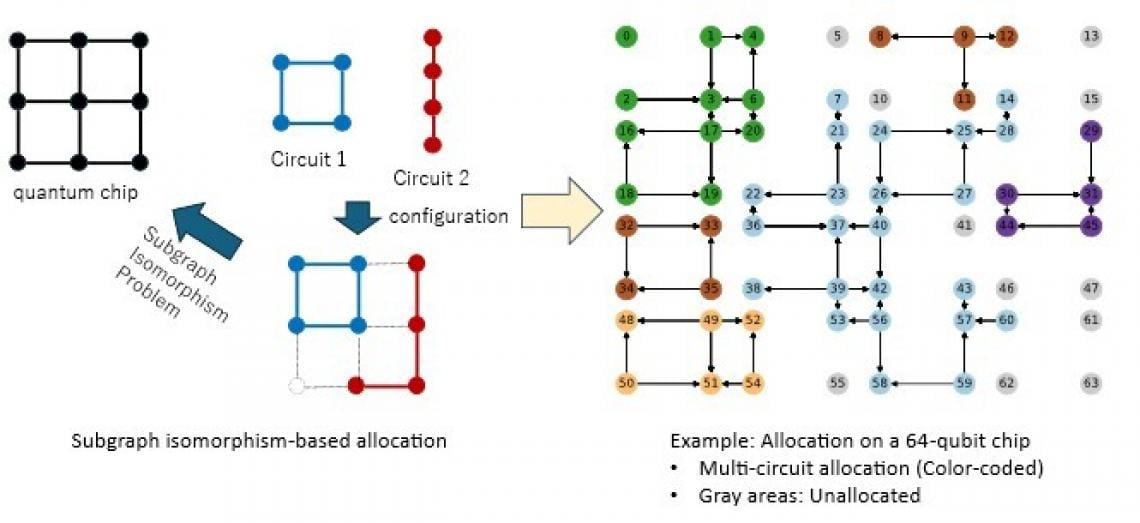
Fig. 2
Example of a quantum chip allocation result
About The University of Osaka
The University of Osaka was founded in 1931 as one of the seven imperial universities of Japan and is now one of Japan's leading comprehensive universities with a broad disciplinary spectrum. This strength is coupled with a singular drive for innovation that extends throughout the scientific process, from fundamental research to the creation of applied technology with positive economic impacts. Its commitment to innovation has been recognized in Japan and around the world. Now, The University of Osaka is leveraging its role as a Designated National University Corporation selected by the Ministry of Education, Culture, Sports, Science and Technology to contribute to innovation for human welfare, sustainable development of society, and social transformation.
Website: https://resou.osaka-u.ac.jp/en
About Systems Engineering Consultants Co.,LTD.
Systems Engineering Consultants (SEC) is a software development company specializing in real-time technology, contributing to the safety and development of society. Real-time technology is a universal form of technology used for developing advanced computer systems. We offer real-time software in four different business fields: mobile networking, internet technology, public infrastructure, and space, robotics and advanced technologies.
Website: https://www.sec.co.jp/en/index.html
About Juntendo University
Juntendo is the oldest school of Western medical education in Japan, originating from the Dutch medical school ‘Wada-juku’ established in Yagenbori, Edo (present-day Higashi-Nihonbashi, Chuo-ku, Tokyo) in 1838, during the late Edo period. Today, Juntendo University is a comprehensive health integrated university and hospital network consisting of nine faculties (Faculty of Medicine, Faculty of Health and Sports Science, Faculty of Health Care and Nursing, Faculty of Health Science and Nursing, Faculty of International Liberal Arts, Faculty of Health Science, Faculty of Medical Science, Faculty of Health Data Science, and Faculty of Pharmacy), eight graduate schools, and six affiliated hospitals. Through its commitment to education, research, medical care, and liberal arts, Juntendo University aims to contribute to society and develop human resources on an international level.
Website: https://en.juntendo.ac.jp/