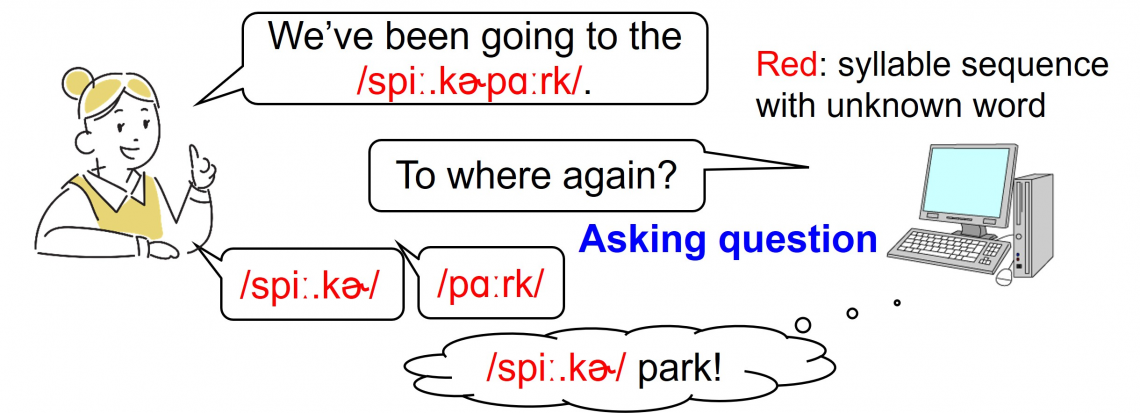

The University of Osaka researchers developed a reinforcement learning framework that lets dialogue systems efficiently learn new words while asking fewer questions. This approach enhances user experience and enables future systems to naturally acquire family-specific nicknames and expressions, becoming more familiar companions in everyday life.
Fig. 1
Decision on whether to ask about an unknown word
Licensed content, Credit must be given to the creator., Kazunori Komatani (created with the images provided by Loose Drawing)
Researchers in Japan develop a reinforcement learning framework that enables spoken dialogue systems to acquire new vocabulary efficiently while minimizing user burden.
Osaka, Japan – Researchers at The University of Osaka have developed a mechanism that allows spoken dialogue systems to learn new words through conversation without overwhelming users with repetitive questions. By optimizing when to ask a question using reinforcement learning, the system can achieve efficient knowledge acquisition with minimal interruptions.
Current dialogue systems often fail to understand words not included in their training data, such as nicknames, local slang, or newly coined terms. While large language models can handle common vocabulary from the Web, they still struggle with group-specific expressions used in everyday conversation. Conventional approaches rely on repeatedly asking users for clarification, which risks frustrating them and disrupting the dialogue flow.
To address this challenge, the SANKEN team at The University of Osaka formulated the learning process as a stream-based active learning problem. Their method enables the system to decide dynamically whether to ask the user for confirmation. By introducing reinforcement learning extensions—including pseudo-labeling (self-learning) and budget-aware decision-making—the system can efficiently update its vocabulary with far fewer user queries. Simulation experiments confirmed that this approach improves word segmentation performance while reducing the number of questions asked.
This breakthrough paves the way for more natural, user-friendly dialogue systems. In the future, when such systems are part of our homes, they will be able to learn family-specific nicknames and unique expressions, becoming more familiar and trusted companions rather than intrusive tools.
“Large language models are trained on massive text data, but they cannot adapt to the unique words and expressions of each household through interaction,” explains Professor Kazunori Komatani. “Our work takes a step toward dialogue systems that learn personally, making them closer companions in daily life.”
###
The article, “Learning to Ask Efficiently in Dialogue: Reinforcement Learning Extensions for Stream-based Active Learning,” was published at an article available: https://aclanthology.org/2025.sigdial-1.34.pdf
Fig. 2
Asking about the input syllable sequence for correct word segmentation
Licensed content, Credit must be given to the creator., Kazunori Komatani (created with the images provided by Loose Drawing)
About The University of Osaka
The University of Osaka was founded in 1931 as one of the seven imperial universities of Japan and is now one of Japan's leading comprehensive universities with a broad disciplinary spectrum. This strength is coupled with a singular drive for innovation that extends throughout the scientific process, from fundamental research to the creation of applied technology with positive economic impacts. Its commitment to innovation has been recognized in Japan and around the world. Now, The University of Osaka is leveraging its role as a Designated National University Corporation selected by the Ministry of Education, Culture, Sports, Science and Technology to contribute to innovation for human welfare, sustainable development of society, and social transformation.
Website: https://resou.osaka-u.ac.jp/en
Advertisement