【Horizontal distributions of surface dissolved PCBs concentrations.】
Horizontal distributions of surface dissolved (a1–d1) CB28, (a2–d2) CB101, (a3–d3) CB153, and (a4–d4) CB180 concentrations.
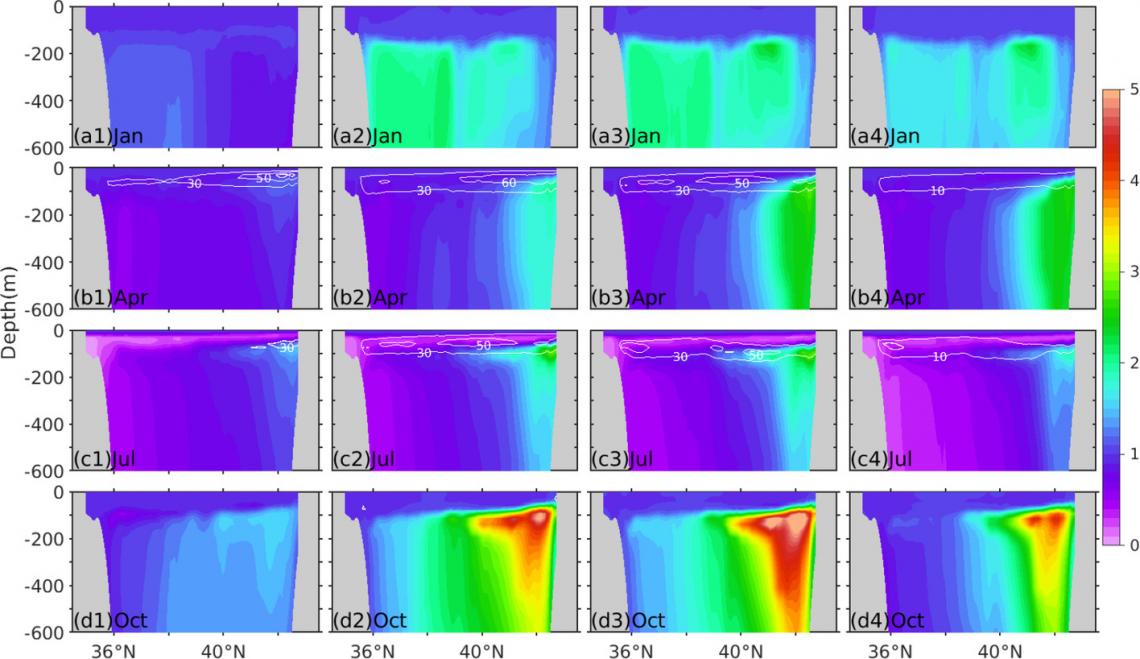
【Vertical distributions of the accumulation factors for PCBs along section 131°E.】
Vertical distributions of the accumulation factors for (a1–d1) CB28, (a2–d2) CB101, (a3–d3) CB153, and (a4–d4) CB180 along section 131°E (unitless). White solid lines represent the remineralization flux of the dissolved PCBs (ug d-1) for each grid point.
Persistent organic pollutants (POPs), particularly polychlorinated biphenyls (PCBs), are synthetic chemicals known for their extreme stability, toxicity, and potential for long-range transport. Although their production was banned in the late 1970s, PCBs remain widespread in the global ocean due to their hydrophobic nature and strong affinity for organic matter, which enables them to accumulate and biomagnify within food webs. Even trace levels of dissolved PCBs in seawater correspond to significant burdens in plankton, particulate matter, and higher trophic levels, thereby sustaining ecological and human health risks long after emissions have ceased.
This study demonstrates that the differential accumulation potential of PCB congeners in the intermediate waters of the Sea of Japan arises from the interplay of congener-specific air–sea exchange, bio-particle sorption, and remineralization fluxes within a strongly stratified, semi-enclosed basin. During spring, scavenging by phytoplankton and detritus loads particles with PCBs near the surface. The continuous sinking of these particles through the thermocline and their subsequent remineralization below the shallow mixed layer in summer contribute to the accumulation of PCBs in the intermediate waters. This remineralization flux injects PCBs into the subsurface dissolved pool, creating an intermediate layer concentration maximum that exceeds what winter mixing alone would produce. By depicting the seasonal and spatial patterns for CB28, CB101, CB153, and CB180, and quantifying their accumulation factors and biogeochemical flux budgets, we demonstrate that CB153 is the most prone to intermediate layer enrichment, whereas CB28 is the least, despite its large atmospheric input.
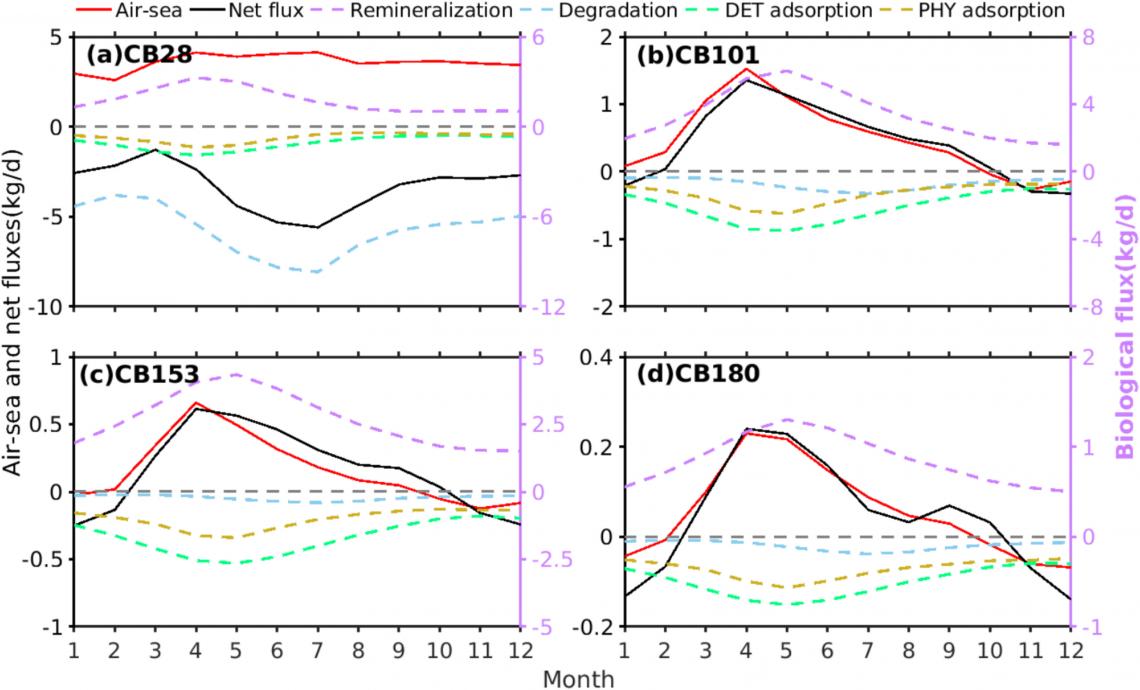
【Time series of source and fate fluxes of dissolved PCBs in the seawater.】
Time series of source and fate fluxes of dissolved (a) CB28, (b) CB101, (c) CB153, and (d) CB180 in the seawater. Fluxes are calculated by integrating the whole space of the Sea of Japan. The air–sea exchange flux is represented by the red solid line, with a scale shown on left axis. The biological fluxes are represented by the dashed lines including phytoplankton adsorption (brown), detritus adsorption (green), and detritus remineralization (purple), with a scale shown on the right axis. The net flux of dissolved PCBs is represented by the solid black line, with a scale shown on the left axis. The self-degradation flux of dissolved PCBs is represented by the dashed cyan line, with a scale shown on the right axis. Positive fluxes are defined to increase the dissolved PCBs concentration in the seawater. “PHY” denotes phytoplankton; “DET” denotes detritus.
Our findings have three broad implications. First, the pronounced subsurface maxima of dissolved PCBs indicate an elevated exposure potential for mid-water and benthopelagic biota. Because our model does not simulate bioaccumulation or trophic transfer, we recommend targeted subsurface monitoring and future integration with bioaccumulation models to quantify species-level risk. Second, as climate warming intensifies summer stratification, two opposing effects on PCB accumulation can be anticipated. On one hand, a shallower mixed layer will weaken winter mixing, leaving more PCBs trapped below the thermocline and thereby enhancing intermediate-water enrichment over successive years. On the other hand, reduced nutrient upwelling under stronger stratification may suppress phytoplankton growth and particle export, weakening the biological pump and consequently reducing the subsurface delivery of PCBs. Finally, by distilling these processes into a semi-enclosed basin paradigm—characterized by restricted water exchange with the outside, seasonal bloom-driven particle export, and congener-specific remineralization—this work offers a transferable model for understanding pollutant cycling in other enclosed seas and fjords.