
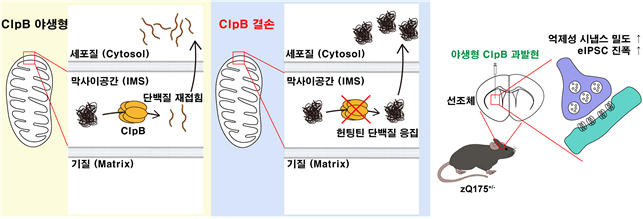
□ DGIST (President Kunwoo Lee) announced that a research team led by professors Jiwon Um and Jaewon Ko has revealed for the first time worldwide the function of ‘ClpB,’ the mitochondrial protein that directly dissolves and eliminates toxic protein aggregates, which are the leading cause of Huntington’s disease. This discovery suggests a new direction in treating degenerative brain diseases by demonstrating that it is possible to remove protein aggregates that have already accumulated in the brain and even restore damaged nerve cell functions.
□ Huntington’s disease is a common degenerative brain disorder inherited with a 50% chance from parents. Memory loss or motor issues gradually interfere with daily life. While many patients and their families live with the fear, “Would my child also develop this disease?”, there are currently no treatments to stop the progression or reverse existing issues. Most research so far has focused on ‘preventing’ protein aggregation. In other words, some treatments have been effective in slowing or stopping protein aggregation but have limitations in ‘directly dissolving’ large aggregates that have already formed.
□ To address these limitations, the research team focused on the ‘ClpB’ protein, which operates within mitochondria, which is equivalent to the ‘energy factory’ inside cells. Although ClpB has been shown to unravel protein clumps under dangerous conditions like heat stress, whether it actively breaks down toxic proteins and restores neurological function in the pathological environment of brain disease was unknown. Using a Huntington's disease cell model and mouse model, the team carefully controlled ClpB expression and studied its role. As a result, when ClpB was absent, even normal Huntington protein easily aggregated, increasing cell damage. However, when ClpB levels were increased, the toxic clumps of mutant Huntington protein were directly broken apart and reduced.
□ This achievement is very important for Huntington's disease and the treatment of various neurodegenerative disorders where protein aggregation is a primary cause, such as Alzheimer's, Parkinson's, and amyotrophic lateral sclerosis (ALS). Notably, the fact that it ‘directly takes apart existing protein aggregates’ is likely to become a key discovery that opens a new therapeutic pathway for actually restoring damaged neuronal functions, going far beyond existing prevention-focused strategies.
□ Professor Jiwon Um stated, "This study is very significant because it confirms the existence of a mechanism that can directly disaggregate toxic protein aggregates already accumulated in the brain. It suggests a new therapeutic approach that prevents protein aggregation and also restores already damaged neuronal function."
□ Hyunho Kim, a postdoctoral researcher at the Center for Synapse Diversity and Specificity, Department of Brain Sciences, DGIST, participated as the lead author, and the results were published in the renowned international journal in the field of integrated medicine, ‘Theranostics.’ This research was funded by the Ministry of Science and ICT and the National Research Foundation of Korea through the Global Leader Research Project, Basic Research Laboratory Support Project, Mid-career Researcher Support Project, and Sejong Science Fellowship.