
The opening reception of Fleeting, Fleeting Light—Imagery of Time in Chinese Art at the Chamber of Young Snow Art Exhibition Hall, Lingnan University.
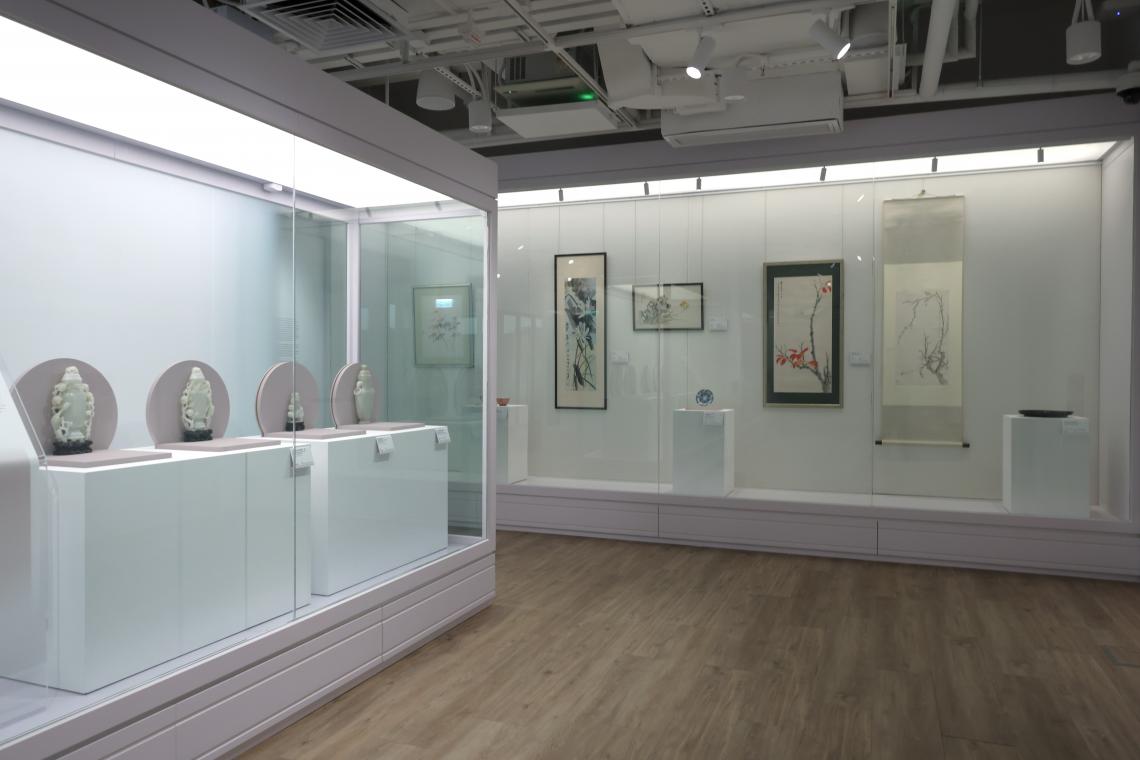
Lingnan University’s Chamber of Young Snow Art Exhibition Hall presents a new exhibition featuring rare ink paintings, porcelain, lacquerware, and jade, spanning from the late Yuan dynasty to the modern era.
Curated by the Department of Digital Arts and Creative Industries at Lingnan University, and generously supported by loans of precious antiques and contemporary works from the Chamber of Young Snow, the exhibition explores how Chinese art transforms the abstract notion of time into a perceptible visual language.
At the opening reception, Prof S. Joe Qin, President and Wai Kee Kau Chair Professor of Data Science at Lingnan University, thanked the Chamber of Young Snow for its longstanding support and said, “In an age shaped by the rapid development of artificial intelligence and digital technology, art offers us a space to pause and reflect on the passage of time. As a research-oriented liberal arts university comprehensive in arts and sciences, Lingnan hopes that this exhibition will help people discover the deeper meanings embedded in Chinese art and serve as an important platform for cultural inheritance and preservation.”
Dr Stephen Suen, Representative of Chamber of Young Snow, said “As a connector between the Chinese Mainland and the world, Hong Kong SAR uses art and culture as effective tools for foreigners to understand our profound civilisation and philosophy, which has a history of 5,000 years. For example, this exhibition successfully applies common visual imagery to understand the profound Chinese philosophy of time and space (宇宙), originating around 400 BC (Warring States period, 戰國時期). It even aims to touch on some concepts beyond time and space, the phenomenon Xu Guo (虛霩) originated from Daoism (道家). This sophisticated philosophical. This sophisticated philosophical phenomenon (虛) has a corresponding saying in Buddhism from a similar period in another oriental country, India, called Akasa (虛空). These profound Eastern philosophical concepts can be learnt through direct experience ⸻ what is known in Chinese culture as spiritual practice (修行) ⸻ through the exquisite exhibits presented in this exhibition.”
The exhibition is organised into three sections, presenting different dimensions of time in Chinese art.
‘A Year in View’
These flower and bird and landscape paintings, and the seasonal motifs on porcelain and lacquerware, look at the Chinese understanding of time as both cyclical and linear. Flowers and natural landscapes with distinctive characteristics throughout the year have long been used for emotional expression.
‘Unending’
Focusing on porcelain and jade, these images of eternity depict mythical beasts, their spatial arrangement on objects, and the material qualities of jade. In the decorative arts, eternity signifies the unbroken continuation of an ideal state.
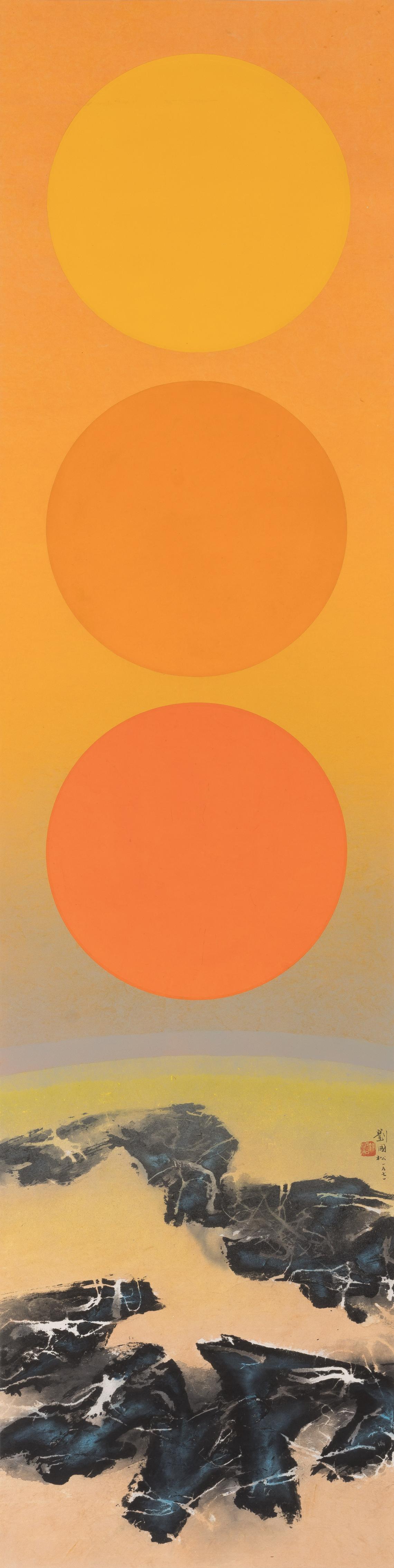
‘The Course of the Sun’
In Liu Kuo-sung’s Space Series, the relationship between the sun and the earth is reinterpreted, expanding the conceptual boundaries of time.