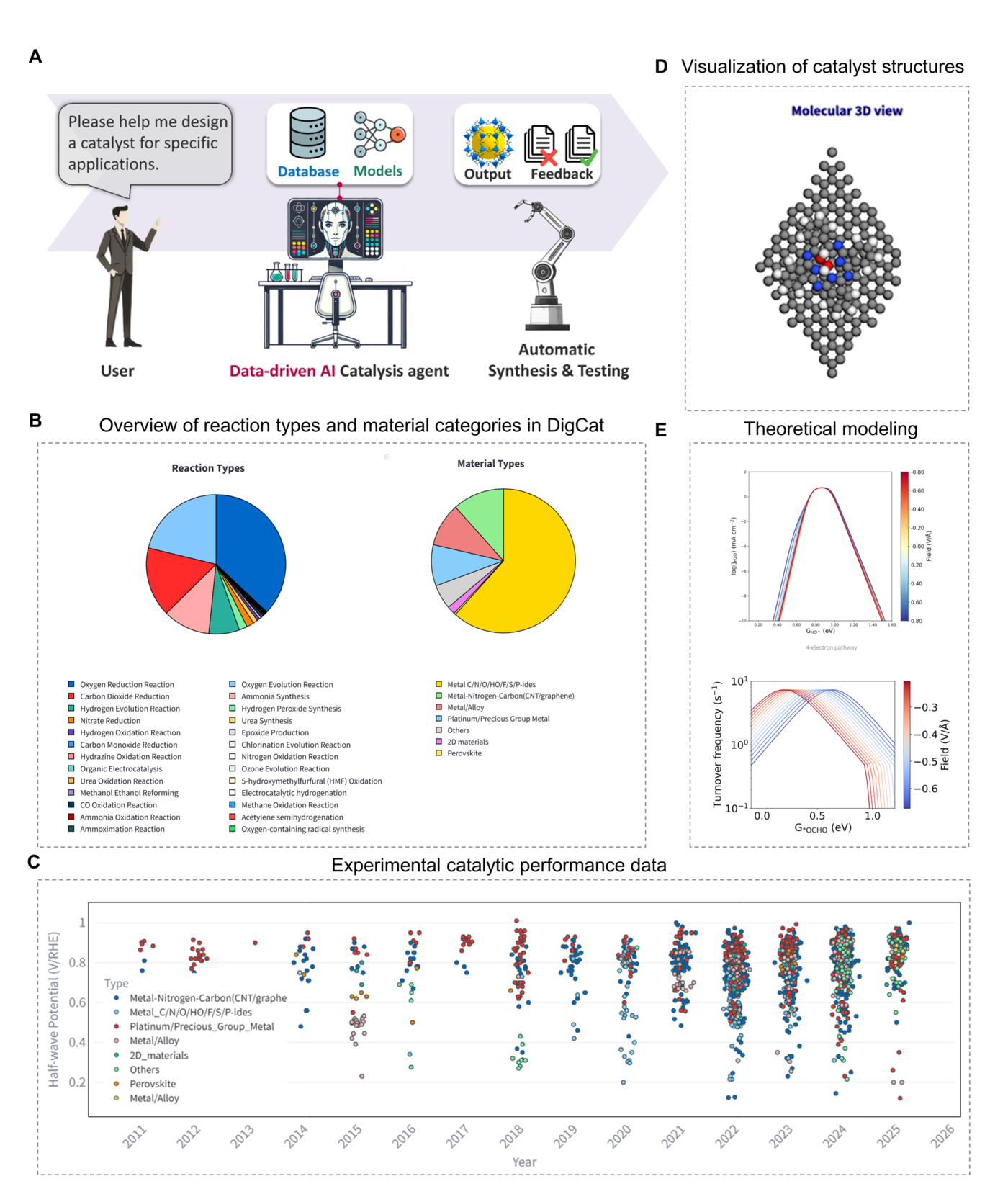
Overview of the DigCat platform integrating big data, data analytics, and AI-driven catalysis workflows.
Artificial intelligence is rapidly changing how scientists search for new catalysts - the materials that speed up chemical reactions essential for producing fuels, chemicals, and clean energy technologies. However, despite remarkable advances in AI, a major obstacle remains: a lack of comprehensive, standardized data that AI systems can effectively learn from. Solving this data challenge is key to unlocking the next generation of AI-driven catalyst discovery.
To alleviate this issue, researchers from Tohoku University have introduced DigCat 4.0, a digital catalysis platform designed to bring together AI, experimental data, theoretical calculations, and scientific literature into a single, integrated environment. Rather than relying on fragmented datasets scattered across different sources, the platform provides researchers with curated, interoperable data alongside visualization, modeling, and machine-learning tools that can accelerate catalyst research.
The platform was highlighted in a recently published paper in Chem Catalysis on June 16, 2026.
Catalysts play a vital role in modern society, enabling the production of fertilizers, fuels, pharmaceuticals, and countless industrial chemicals. They are also central to emerging technologies such as hydrogen production, carbon dioxide conversion, and environmentally friendly manufacturing. Identifying improved catalyst materials has traditionally required years of trial and error, but AI has the potential to dramatically shorten this process - provided it has access to reliable, high-quality data.
The researchers argue that future advances in catalysis will depend less on developing increasingly powerful AI models alone and more on building robust digital infrastructures capable of organizing and connecting scientific knowledge. DigCat 4.0 addresses this need by integrating large-scale datasets with AI-ready tools that allow scientists to analyze data, uncover hidden relationships, and identify promising catalyst candidates more efficiently.
Beyond functioning as a data repository, the platform also incorporates domain-specific AI agents capable of assisting researchers with data analysis, knowledge extraction, and catalyst design. These AI assistants help scientists navigate the rapidly growing volume of catalysis research while reducing the time required to transform published findings into actionable insights.
"Artificial intelligence is only as powerful as the data that supports it," said Hao Li, Distinguished Professor at Tohoku University's Advanced Institute for Materials Research (WPI-AIMR). "By integrating high-quality experimental results, theoretical calculations, and scientific knowledge into a unified platform, DigCat 4.0 provides the foundation needed for AI to become a practical partner in catalyst discovery. Our long-term vision is to enable autonomous, data-driven workflows that accelerate scientific innovation while keeping researchers at the center of the discovery process."
Future versions of the platform are likely to employ closed-loop discovery systems that combine AI with automated experimentation and robotic laboratories. In these systems, AI could propose new catalyst candidates, evaluate their predicted performance, recommend experiments, analyze the resulting data, and continuously refine future predictions with minimal manual intervention.
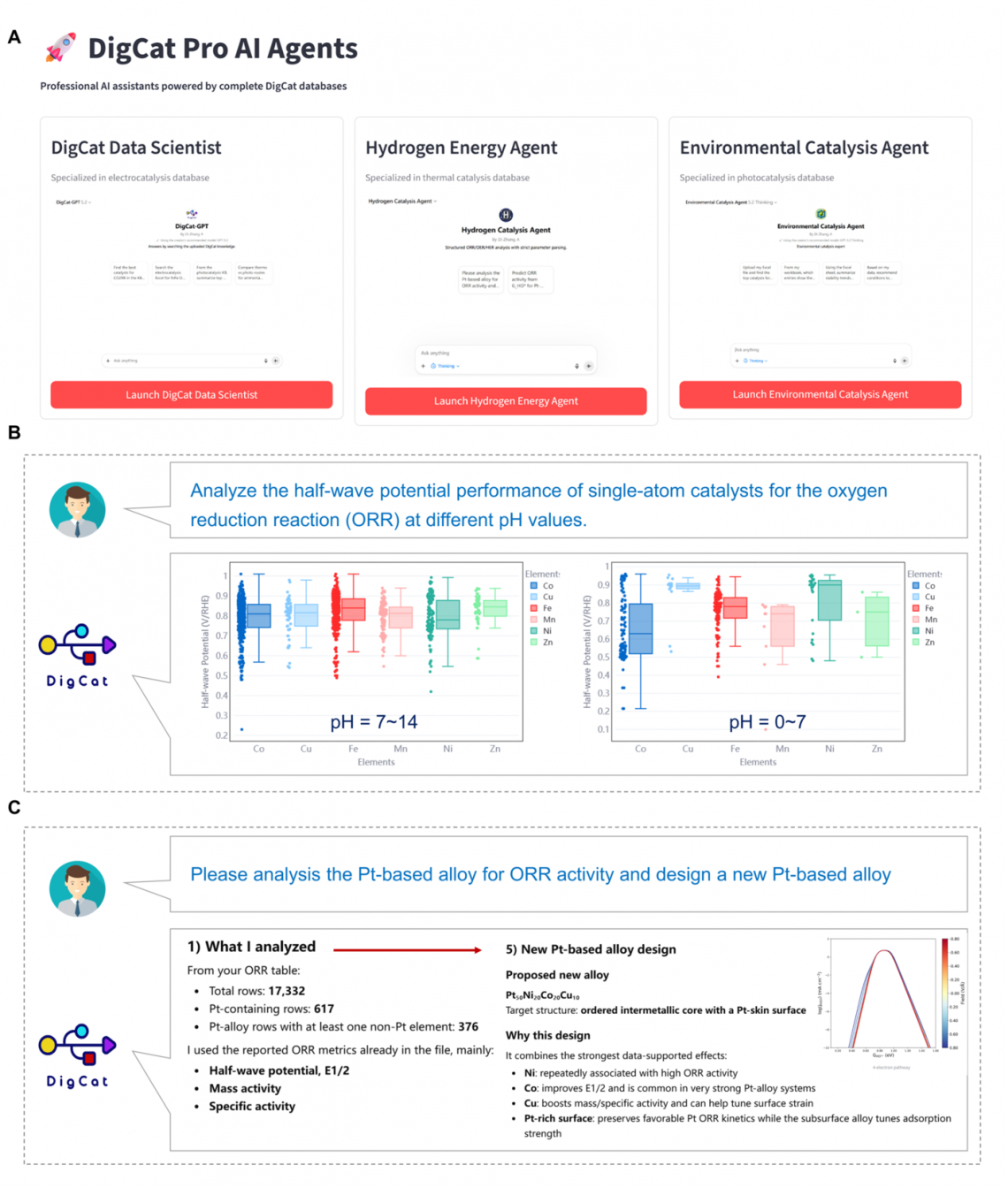
AI agents in DigCat for data analysis, knowledge extraction, and catalyst design.
To achieve this vision, significant challenges remain. The team highlights the need for improved metadata standards, more consistent benchmarking, greater sharing of negative experimental results, and broader community participation in data collection and curation. Future development of DigCat will also expand its coverage across additional catalysis fields while incorporating operando data and stronger AI-assisted data verification.
Even at the preprint stage, the work has attracted considerable attention within the catalysis community, receiving approximately 50 citations within a year. During the same period, DigCat 4.0 has also grown to several thousand registered users, reflecting increasing interest in data-centric approaches to catalyst research. By providing a common digital foundation for researchers worldwide, the platform aims to accelerate discoveries that could contribute to cleaner energy, greener chemical production, and a more sustainable future.
Advertisement