
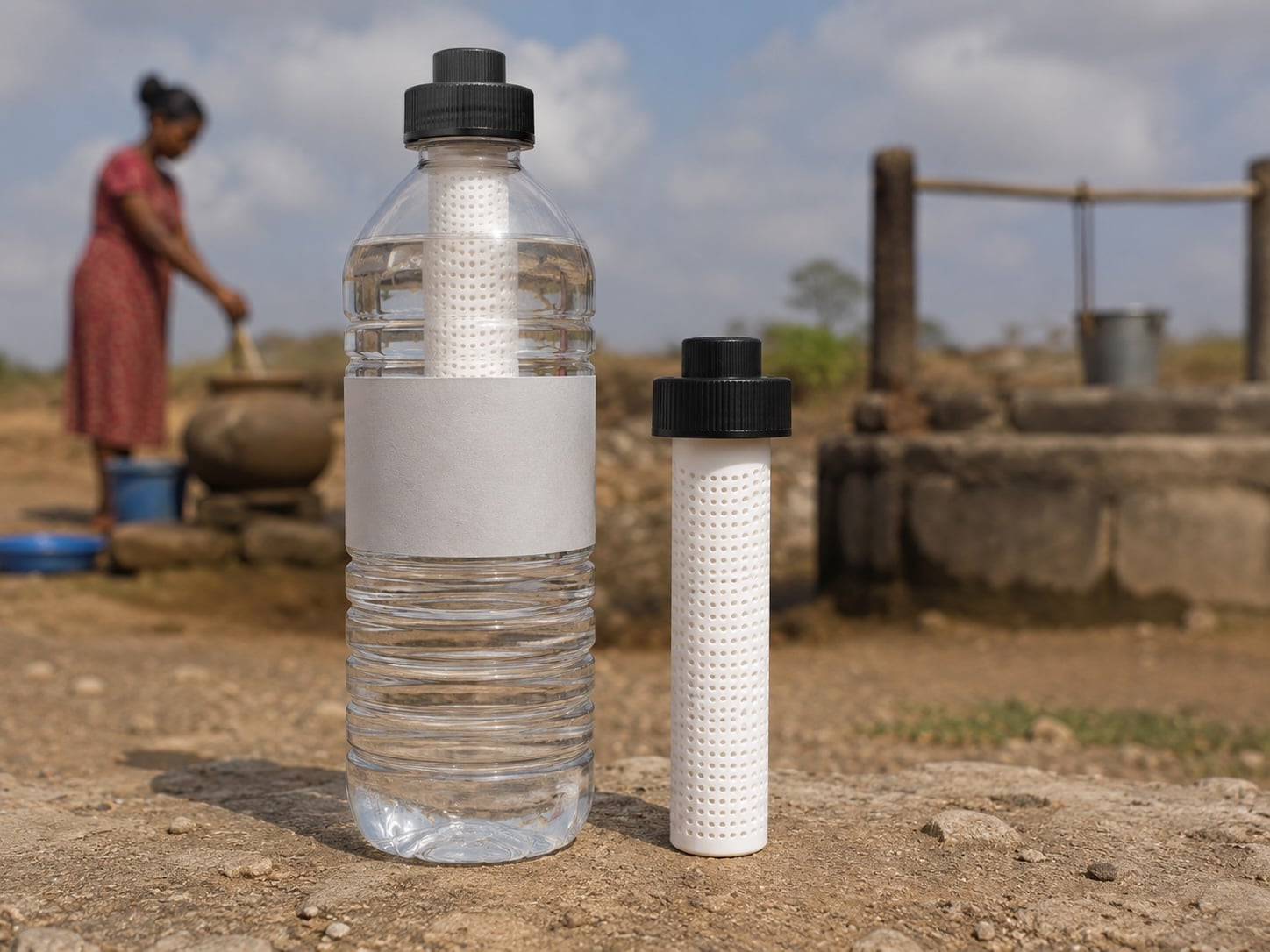
A portable water filtration device fitted to an everyday bottle could help provide cleaner drinking water in rural and climate-stressed regions.
An international team has patented a portable water filtration device designed to help communities access safer drinking water during droughts, floods and water contamination events.
Climate change is making water security harder to manage. Around the world, communities face a growing mix of drought, floods, polluted groundwater and damaged water infrastructure. The United Nations notes that climate change is intensifying both water scarcity and water-related hazards such as floods and droughts. The UN Office for Disaster Risk Reduction also reports that nine out of ten disasters triggered by natural hazards in the last decade were water-related.
This makes portable, affordable and easy-to-use water treatment technologies increasingly important. They are not only relevant to long-term rural water access, but also to disaster response, emergency preparedness, climate adaptation and humanitarian relief. According to UNICEF and WHO, 2.1 billion people still lacked safely managed drinking water in 2024, despite global progress in expanding access.
An international team involving the Sri Lanka Institute of Nanotechnology (SLINTEC), Newcastle University and Monash University Malaysia has developed and patented a portable water filtration device designed to fit everyday plastic drinking bottles. The patent was granted by the National Intellectual Property Office of Sri Lanka on 31 December 2025 under Patent No. 21609.
The device was originally motivated by the need to address water contamination challenges in Sri Lanka, including heavy metal contamination in groundwater in the North Central region. Chronic kidney disease of unknown aetiology, or CKDu, has been a major public health concern in affected rural communities. The patent document also notes wider drinking water challenges linked to bacteria, viruses, heavy metals, chemical pollutants, dirt and other contaminants, including in regions affected by floods and limited safe water access.
Although the problem was first approached through Sri Lanka’s local water challenges, the need is much broader. Climate change is increasing pressure on water systems in many countries. Floods can contaminate wells and surface water, while drought can concentrate pollutants in limited water sources. In emergency settings, safe drinking water may need to be delivered quickly, without relying on fixed infrastructure. A compact point-of-use filter that can be attached to a commonly available bottle could therefore support both everyday household use and disaster-management response.
The patented device works as a portable adaptor that can be screwed onto commonly used PET water or fizzy-drink bottles. Water passes through a primary nanofibrous filter medium and a secondary carbonaceous filter medium before reaching the outlet. The bottle can be squeezed to drive water through the filter, making the device simple to use without electricity or a fixed water supply.
The primary filter medium consists of multiple layers of electrospun nanofibrous mats. These layers are designed for different functions, including bacteria removal, virus removal and heavy metal removal. The patent describes the use of polyacrylonitrile-based composite nanofibres, blended with co-polymers and functional nanomaterials, to control porosity, surface charge, mechanical stability and contaminant capture.
The secondary filter medium uses modified carbonaceous material, such as activated carbon impregnated with metal or metal-oxide nanoparticles. This provides an additional line of defence for removing organic compounds and improving antimicrobial performance.
Test data reported in the patent draft and supporting documents indicate that the system can remove a range of contaminants. The filter system is described as removing up to 99.999% of bacteria such as Escherichia coli and Staphylococcus aureus under dynamic conditions. It also showed heavy metal removal for iron, cadmium, lead, chromium, arsenic and other metals under specified test conditions. In one test using groundwater containing arsenic and cadmium, the filter removed nearly 99% of cadmium and 69% of arsenic.
The supporting project document describes the device as a low-cost compact water filter unit that fits a standard PET bottle cap. It reports a unit weight below 10 g, an effective filter rate of 100 ml/min, and capacity up to about 1300 L in the prototype performance summary.
The technology is especially relevant because it combines portability with multi-contaminant filtration. Many point-of-use filters focus mainly on microbial removal. This patented device was designed to address a broader set of risks, including heavy metals, microorganisms, volatile organic compounds and other macro-pollutants.
The team now seeks partners to support translation from patent protection and prototype development towards commercialisation. Potential partners may include impact investors, water technology companies, humanitarian organisations, disaster-management agencies, corporate social responsibility programmes and manufacturers with experience in filtration, polymer processing, nanofibres or consumer water products.
The opportunity is not limited to Sri Lanka. The same type of portable filtration approach could be relevant to rural communities, schools, disaster-relief packs, field workers, military and civil-defence units, refugee support, flood response and drought-affected regions where drinking water sources may be intermittently unsafe.
A key attraction of the technology is its familiar form factor. By fitting onto everyday bottles, the device could reduce barriers to adoption. It can potentially be distributed as a compact filter unit rather than as a complete bottle system, lowering material use and making it easier to transport in emergencies.
Further development will be needed to optimise manufacturing, validate performance across different water sources, meet regulatory requirements and establish cost-effective production. However, the granting of the Sri Lankan patent provides a stronger intellectual property foundation for discussions with investors, development partners and industrial collaborators.
The inventors hope that the technology can move beyond the laboratory and patent stage towards real-world deployment. In the present climate context, access to safe drinking water is not only a public health issue. It is also part of climate adaptation, disaster preparedness and community resilience.
Patent details
The patent, “A Portable Water Filtration Device”, was granted by the National Intellectual Property Office of Sri Lanka under Patent No. 21609. The patent was granted on 31 December 2025.
Inventors and institutions
The inventors listed include Rangika De Silva, Pooria Pasbakhsh, Kheng-Lim Goh, Vladimir Zivkovic, Induni W. Siriwardane, Pamoda Perera, Vyshnavi Kumaraswamy, Prasanga Mantilaka, Ananda Hettiarachchi, Gayal Rangajeewa, Buddhika Sampath Kumara, Lakshitha Pahalagedara and Dilhara Chandrakumara. The collaboration involved SLINTEC, Monash University Malaysia and Newcastle University.
Update: growing international interest
The patented portable water filtration technology has received further international attention through a new Climate Fact Checks feature examining its potential for climate adaptation, emergency response and safe water access in vulnerable communities.
The article also discusses practical steps towards wider deployment, including manufacturing, certification, field validation and partnerships.
Read the Climate Fact Checks feature: Climate-Resilient Grid: Why This Portable Purification Breakthrough Matters for the Global South
Seeking partners
The team welcomes interest from manufacturers, investors, water-technology companies, development organisations and humanitarian partners interested in supporting field validation, certification, scale-up and wider deployment.
For further details, contact Dr Kheng Lim Goh at [email protected], or Shanika Galappaththi at SLINTEC at [email protected].
Advertisement