
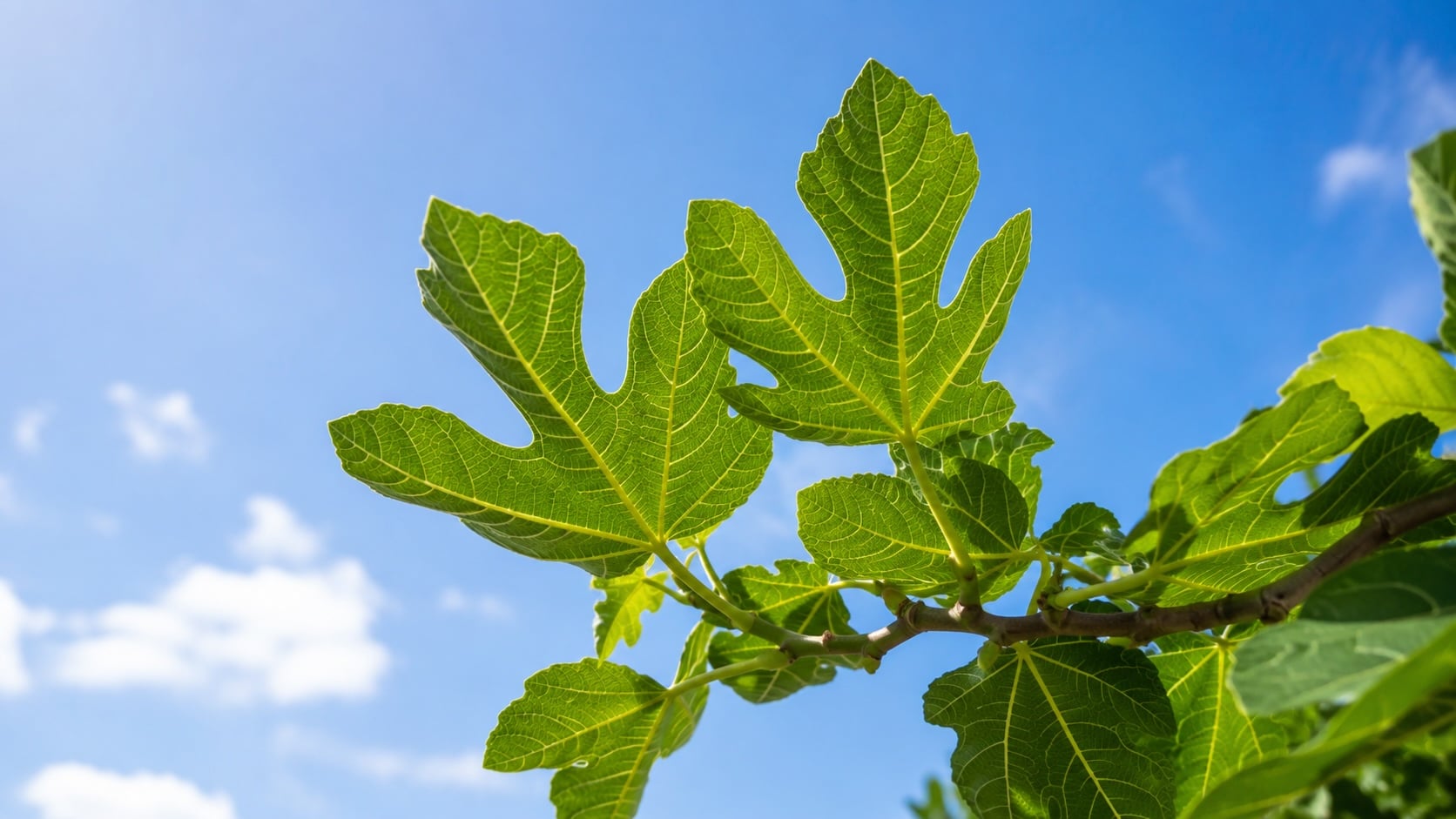
Fresh fig leaves are a natural source of ficin, a plant enzyme used in this study to extract collagen from tannery trimming waste.
Tanneries generate large quantities of skin trimmings before hides are tanned. These trimmings contain collagen but are commonly treated as low-value waste.
An international research team has developed a method that uses ficin, a protein-digesting enzyme obtained from fig leaves, to recover type I collagen from lambskin trimming waste.
The approach offers manufacturers a potential route to convert two underused biological resources—tannery trimmings and fig leaves—into collagen for higher-value applications.
The study was led by researchers at Zhengzhou University in China, working with the Leather and Footwear Research Institute in Romania and Newcastle University in Singapore.
Higher extraction yield
The researchers compared three extraction routes:
- acetic acid;
- pepsin, an animal-derived enzyme; and
- ficin extracted from fig leaves.
Using response surface methodology, they optimised the hydrolysis time, enzyme dose and liquid-to-solid mixing ratio.
Under the modelled optimum conditions, ficin-soluble collagen reached a yield of 15.28%. This was higher than the reported yields for acetic acid-soluble collagen at 9.52% and pepsin-soluble collagen at 14.56%.
The ficin process therefore matched or exceeded the performance of established extraction methods while replacing an animal-derived enzyme with a plant-derived alternative.
Preserving the collagen structure
Recovering collagen at high yield is not sufficient if the extraction process damages its molecular structure.
The team used electrophoresis, infrared spectroscopy, X-ray diffraction, ultraviolet spectroscopy and circular dichroism to characterise the recovered material.
The results identified the product as type I collagen. Ficin-extracted collagen retained the characteristic triple-helical structure and contained fewer non-collagenous protein impurities than the other extracted samples.
The ficin-derived collagen showed slightly lower thermal stability than collagen extracted using acetic acid, but its main molecular structure remained intact.
The team also tested ultrasound treatment at 800 W for 30 minutes. This treatment did not significantly disrupt the collagen triple helix, although it changed aspects of the material’s microstructure and did not improve the yield of the ficin process.
An opportunity for tannery by-products
The leather industry produces substantial quantities of untanned skin trimmings. Because these trimmings have not yet been exposed to tanning chemicals such as chromium salts, they may offer a cleaner collagen source than waste generated later in leather processing.
For industry, the proposed route could support:
- recovery of collagen from untanned trimming waste;
- reduced dependence on animal-derived extraction enzymes;
- production of value-added biomaterials from existing by-products; and
- closer integration between leather manufacturing, agriculture and bioprocessing.
Potential applications include collagen-based materials for cosmetics, biomedical products, coatings, films and other biobased products. Further application-specific testing would still be required before commercial use.
What remains before scale-up
The work was conducted at laboratory scale. Industrial adoption would require further assessment of enzyme stability, process water, chemical pretreatment, energy use, purification, product consistency and regulatory requirements.
Ficin also loses activity during storage, particularly after freeze-drying. The researchers found that storing the enzyme in solution was preferable to storing it as a powder, and they identified enzyme stabilisation and immobilisation as priorities for future work.
The study included a preliminary process-cost estimate suggesting that ficin extraction could be economically attractive. However, a full industrial techno-economic analysis and life-cycle assessment would still be needed to determine commercial viability at scale.
The findings nevertheless show that fig-leaf ficin can recover structurally intact collagen from tannery trimming waste at a competitive yield. This creates a promising starting point for leather manufacturers and biomaterials companies seeking practical routes to turn protein-rich waste into higher-value products.
Paper details
The paper, “A novel strategy for using ficin enzyme from fig leaves to extract collagen from tannery-trimming wastes”, was published in the International Journal of Biological Macromolecules in 2025.
DOI: 10.1016/j.ijbiomac.2025.141183.
International collaboration
The research involved:
- School of Materials Science and Engineering, Zhengzhou University, China;
- Collagen Department, INCDTP–Leather and Footwear Research Institute, Romania;
- Newcastle University in Singapore
For further details, contact Professor Keyong Tang, Zhengzhou University, at [email protected], or Dr Kheng-Lim Goh, Newcastle University in Singapore, at [email protected].
Advertisement