

Researchers developed a scalable method for preparing high-purity chiral mechanically interlocked molecules using a removable chiral auxiliary that can be recovered and reused. The strategy makes difficult interlocked molecular architectures more accessible and provides a practical platform for future applications in catalysis, molecular recognition, and chiroptical materials.
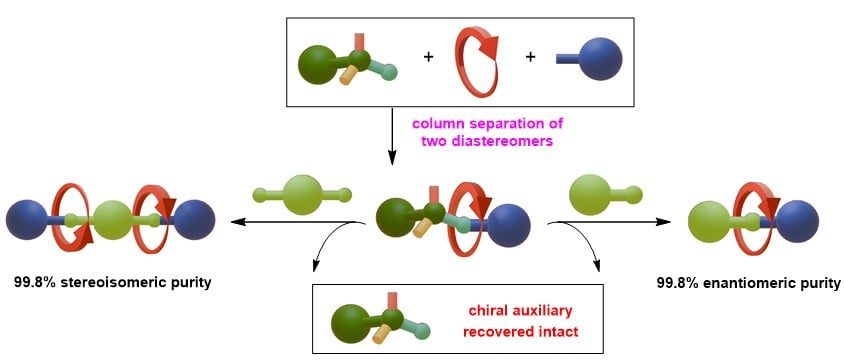
Using a recoverable chiral auxiliary, the researchers separate diastereomeric intermediates by column chromatography and convert them into highly pure mechanically planar chiral rotaxanes. The auxiliary is recovered intact, making the approach more practical for preparing complex interlocked structures.
National Taiwan University
Chiral molecules can exist in left- and right-handed forms. Although these mirror-image forms may look almost identical, they can behave very differently in chemical reactions, biological systems, and advanced materials. Preparing one mirror-image form in high purity is therefore an important goal in chemistry.
A research team at National Taiwan University has developed a practical method for preparing a challenging class of chiral mechanically interlocked molecules. These molecules, known as rotaxanes, contain ring-shaped components threaded onto dumbbell-shaped molecular axles. Because the rings can move along or rotate around the axle, rotaxanes are promising building blocks for molecular switches, catalysts, sensors, and stimuli-responsive materials.
In this study, published in Angewandte Chemie International Edition, the team focused on rotaxanes whose chirality does not come from a conventional stereogenic center. Instead, their chirality arises from the fixed relative orientation of achiral but directional molecular components within the mechanically interlocked architecture. Such mechanically planar chiral structures are attractive, but they are difficult to prepare in highly pure single-enantiomer forms and in useful quantities.
The new strategy uses a removable chiral auxiliary, a molecular helper that guides the formation of the desired interlocked structure. The resulting diastereomeric intermediates can be separated by column chromatography and then converted into the target rotaxanes, while the auxiliary is recovered intact for reuse. This makes the method more practical and economical, especially for preparing larger amounts of highly pure chiral interlocked molecules.
Using this approach, the researchers prepared a range of mechanically planar chiral rotaxanes with very high enantiomeric purity of up to ca. 99.6% ee. The method also enabled access to all three stereoisomers of a more complex rotaxane containing two rings on one axle, each obtained with 99.8% stereoisomeric purity. These results provide a more reliable platform for exploring mechanically chiral molecules in catalysis, molecular recognition, sensing, and chiroptical materials.
“The applications of chiral interlocked molecules have long been hampered by the difficulty of preparing them in pure forms. By overcoming this synthetic challenge, we hope to open the door to a new generation of chiral materials based on mechanically interlocked structures,” says corresponding author Sheng-Hsien Chiu, chair professor of chemistry at National Taiwan University.
Prof. Sheng-Hsien Chiu's email address: [email protected]
Advertisement