
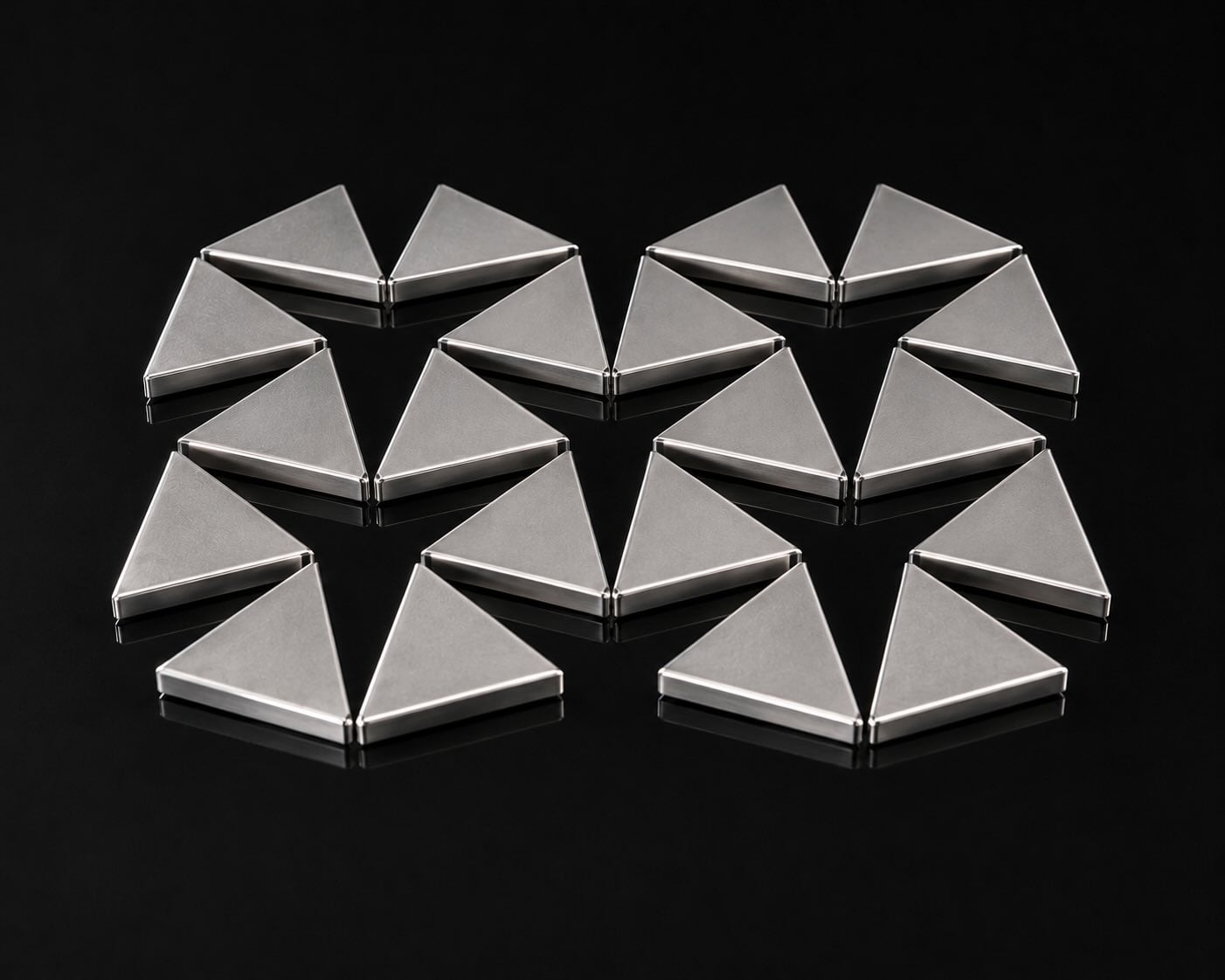
Three-dimensional rendering of a rotating-triangle auxetic structure, illustrating the geometric pattern used in the vibration-damping composite sandwich.
Vibration can undermine the accuracy, stability and lifetime of precision equipment, from semiconductor manufacturing systems and optical instruments to aerospace and advanced automation platforms.
Active vibration-control systems can offer high performance, but they require sensors, actuators and controllers, adding cost, weight and complexity. Passive systems are simpler, but improving their damping performance often means adding more layers, increasing thickness or introducing external mechanical limiters.
Researchers in Singapore have developed a different approach: an auxetic composite sandwich designed to improve passive vibration damping while remaining thin and structurally simple.
Turning deformation into damping
The new structure combines three functional layers: a constraining layer that carries load, an auxetic interlayer that deforms in a distinctive way, and a viscoelastic layer that dissipates energy.
Auxetic structures behave differently from conventional materials. When stretched in one direction, they can expand rather than contract in the perpendicular direction.
In the new sandwich, this behaviour causes the auxetic layer to deform axisymmetrically. Its facets rotate and move relative to the outer constraining layers, generating additional shear strain in the viscoelastic material.
That additional shear helps dissipate vibration energy without requiring a thicker stack of damping layers.
Up to eightfold increase in damping ratio
The researchers compared three prototypes: a conventional plain sandwich, a non-auxetic design and the new auxetic sandwich.
Experimental results showed that as input acceleration increased from 0.5 g to 4 g, the damping ratio of the auxetic prototype rose from about 0.04 to 0.29 — an eightfold increase.
At 4 g, the auxetic design outperformed the plain model substantially, while its settling time was also shorter.
The auxetic design was especially effective when vibration amplitudes were higher, because larger deformations produced greater movement of the auxetic facets and stronger shear within the viscoelastic layer.
Faster settling after vibration
For precision equipment, how quickly vibration dies away can be as important as the peak vibration itself.
The study found that the auxetic sandwich reduced settling time compared with the conventional design as acceleration increased.
In one set of tests, settling time to 0.25 g fell from about 70.7 milliseconds to 60.9 milliseconds as acceleration increased from 0.5 g to 4 g.
Numerical simulations also showed that the auxetic configuration generated much higher strains within the viscoelastic layer, helping explain its improved energy dissipation.
Better vibration attenuation across a broad frequency range
A second experiment examined how the prototypes attenuated vibration transmitted through a granite platform.
The auxetic sandwich showed effective vibration attenuation across roughly 750 to 1777 Hz.
Within this range, its attenuation performance was around three to four times better than the plain model and around 1.5 to two times better than the non-auxetic configuration.
A compact alternative for vibration-sensitive systems
The concept could be relevant to industries that need vibration control but cannot easily accommodate bulky isolation systems.
Potential applications include:
- precision manufacturing and motion-control systems;
- semiconductor and electronics equipment;
- optical and imaging systems;
- aerospace and satellite components;
- robotics and automation;
- laboratory instrumentation; and
- other vibration-sensitive machinery.
Unlike conventional constrained-layer damping approaches that often improve performance by adding thickness, the auxetic design seeks to increase damping through geometry and deformation.
The researchers also designed the outer constraining layers to carry load, potentially reducing the need for separate external displacement limiters.
Ready for further development
The current study demonstrates the concept using small-scale prototypes made from ABS, high-density polyethylene and viscoelastic tape.
Further work will focus on optimising the auxetic geometry, materials, number of facets and viscoelastic layers, and on testing the concept under application-specific loads and frequencies.
The researchers are interested in discussions with companies working in precision engineering, motion systems, vibration isolation, aerospace, automation and advanced equipment design to explore where the concept could provide the greatest value.
The work was carried out by researchers from Nanyang Technological University, Akribis Systems and Newcastle University in Singapore. It was supported through Singapore’s Economic Development Board Industrial Postgraduate Programme.
The paper, “Auxetic Composite Sandwich for Vibration Damping Through Axisymmetric Deformation,” was published in the Journal of Composites Science in 2025.
DOI: 10.3390/jcs9040162
For further discussion, contact Mr Chun Seng Yong at [email protected], Dr Sridhar Idapalapati, Nanyang Technological University, at [email protected], or Dr Kheng-Lim Goh, Newcastle University in Singapore, at [email protected]
Advertisement