

Researchers from the University of Osaka and Diponegoro University developed an AI-powered navigation system for cyborg cockroaches. Using onboard sensors and a multilayer perceptron, the system recognizes flat ground, climbs, descents, and holes in real time, then adapts electrical stimulation accordingly. By supporting natural climbing while reducing unnecessary steering, the approach shortened obstacle-crossing and total navigation times, reduced travel distance and stimulation, and significantly improved efficient movement across complex terrain.
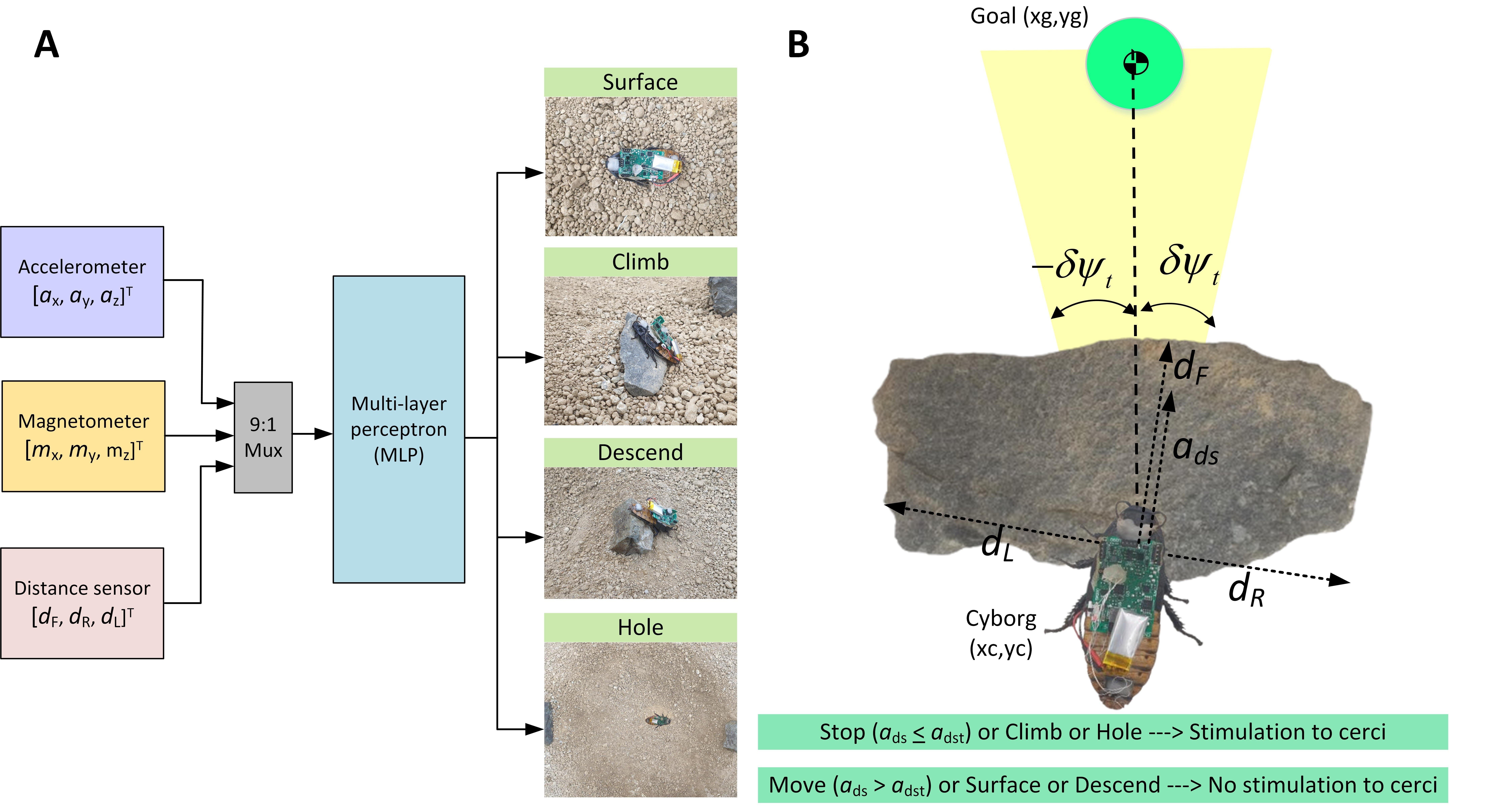
Fig. 1
Advanced locomotion control strategy based on terrain recognition. (A) MLP-based terrain classifier for identifying flat ground, uphill, downhill, and holes. (B) Adaptive stimulation strategy that adjusts locomotion control based on the recognized terrain to enhance locomotion and climbing efficiency.
©Original content, Credit must be given to the creator. Only noncommercial uses of the work are permitted. No derivatives or adaptations of the work are permitted., Mochammad Ariyanto et al., 2026, Biohybrid Navigation through Real-Time Terrain Recognition and Natural Climbing in Cyborg Insect, Device
Real-time terrain classification allows biohybrid insects to climb obstacles and cross holes with fewer detours and less steering stimulation
Osaka, Japan - Cyborg insects combine the mobility of living organisms with miniature electronic devices, offering potential applications in search-and-rescue operations, infrastructure inspection, and exploration of environments that are difficult for conventional robots. However, most autonomous navigation systems are designed to avoid obstacles, even when an insect could naturally climb over them. This can result in longer routes and reduced exploration efficiency.
An international research team from the University of Osaka and Universitas Diponegoro has developed a new navigation system for cyborg insects that combines the cockroach’s natural climbing ability with AI-based real-time terrain recognition, enabling the insects to traverse obstacles faster and more efficiently than with conventional navigation methods.
Conventional systems direct cyborg insects around obstacles, even when the insects can climb over them. The team therefore developed a reactive-climbing strategy combining goal-seeking, obstacle avoidance, wall-following, and innate climbing behavior. However, because the controller could not identify terrain, it issued steering commands during climbing, causing hesitation and inefficient movement.
To address this problem, the researchers incorporated a multilayer-perceptron-based AI module that used onboard sensor data to recognize flat surfaces, ascents, descents, and holes in real time. The classifier achieved 92% accuracy in offline evaluation, enabling the controller to adjust stimulation according to the terrain, reduced unnecessary steering, and support sustained forward movement across challenging surfaces.
“The main challenge was to develop a system capable of recognizing terrain in real time without compromising the insect’s natural locomotor abilities,” explains Professor Keisuke Morishima of the University of Osaka. “In this study, we propose ‘biohybrid physical AI’ to enable efficient autonomous navigation. We hope these findings will inspire the development of robotic systems capable of operating in complex environments, including search-and-rescue sites.”
###
The article, “Biohybrid Navigation through Real-Time Terrain Recognition and Natural Climbing in Cyborg Insect,” will be published in Device at DOI: https://doi.org/10.1016/j.device.2026.101277
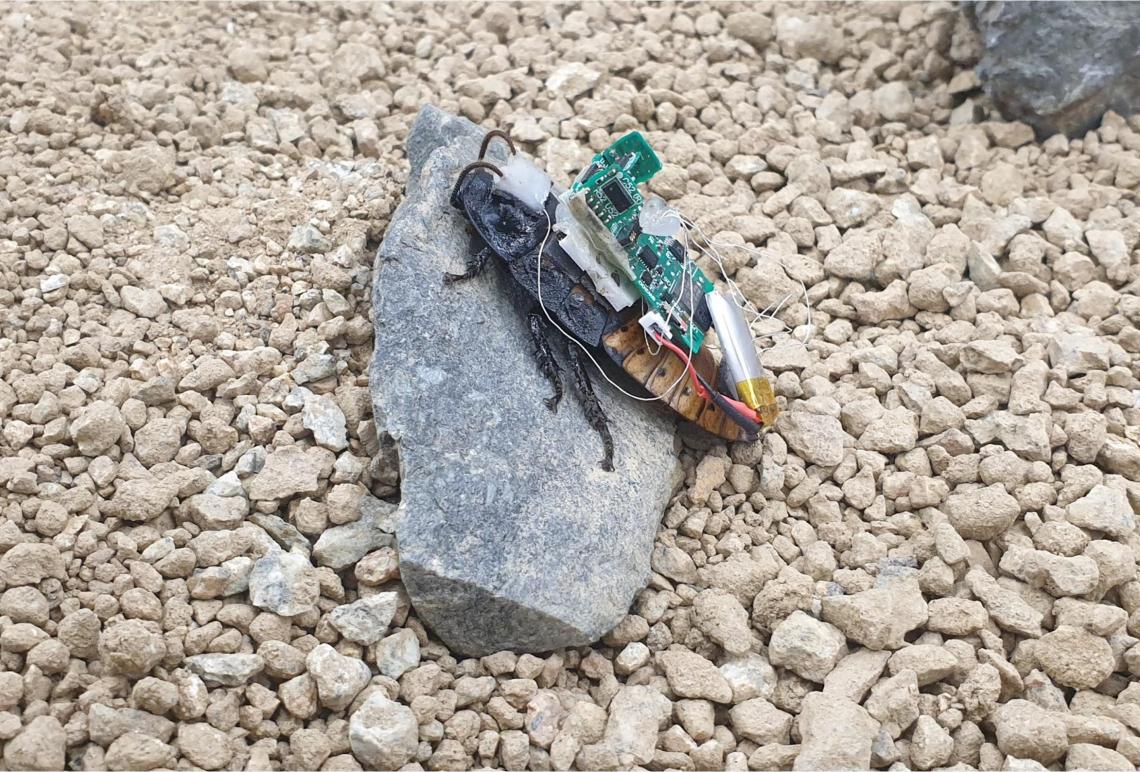
Fig. 2
Climbing cyborg insect
©Original content, Credit must be given to the creator. Only noncommercial uses of the work are permitted. No derivatives or adaptations of the work are permitted., Mochammad Ariyanto et al., 2026, Biohybrid Navigation through Real-Time Terrain Recognition and Natural Climbing in Cyborg Insect, Device
Movie 1
Movement of the cyborg insect using the proposed navigation system.
©Original content, Credit must be given to the creator. Only noncommercial uses of the work are permitted. No derivatives or adaptations of the work are permitted., Mochammad Ariyanto et al., 2026, Biohybrid Navigation through Real-Time Terrain Recognition and Natural Climbing in Cyborg Insect, Device
About The University of Osaka
The University of Osaka was founded in 1931 as one of the seven imperial universities of Japan and is now one of Japan's leading comprehensive universities with a broad disciplinary spectrum. This strength is coupled with a singular drive for innovation that extends throughout the scientific process, from fundamental research to the creation of applied technology with positive economic impacts. Its commitment to innovation has been recognized in Japan and around the world. Now, The University of Osaka is leveraging its role as a Designated National University Corporation selected by the Ministry of Education, Culture, Sports, Science and Technology to contribute to innovation for human welfare, sustainable development of society, and social transformation.
Website: https://resou.osaka-u.ac.jp/en
Advertisement